
Key Stats for AMGN Stock
- Past week performance: -9.6%
- 52-week range: $270 to $447
- Valuation model target price: $427
- Implied upside: (2.4%) over 2.3 years
Test your own Repatha growth assumptions with TIKR’s free Valuation Model (It’s free) >>>
Three Headlines, One Rough Week
Amgen (AMGN) shares fell roughly 9.6% this week as three separate negative catalysts converged in a short span. The UK’s medicines regulator suspended new-patient use of Amgen’s rare-disease drug Tavneos on September 1, citing unreliable data from the trial that originally supported approval, and the agency plans to formally revoke UK marketing authorization by March 2027. That decision followed the European Commission’s move in August to revoke Tavneos’s EU approval on similar grounds, and the FDA has separately proposed withdrawing U.S. approval.
Then came a second, unrelated blow. Novartis and Ionis Pharmaceuticals reported that an experimental heart drug missed its key goal in a closely watched late-stage trial, and because Amgen competes in similar cardiovascular disease territory with its cholesterol drug Repatha, the market read through negatively across the sector. BMO Capital Markets downgraded Amgen shares on the same day, compounding the selloff even though the Novartis setback did not directly involve any Amgen product.
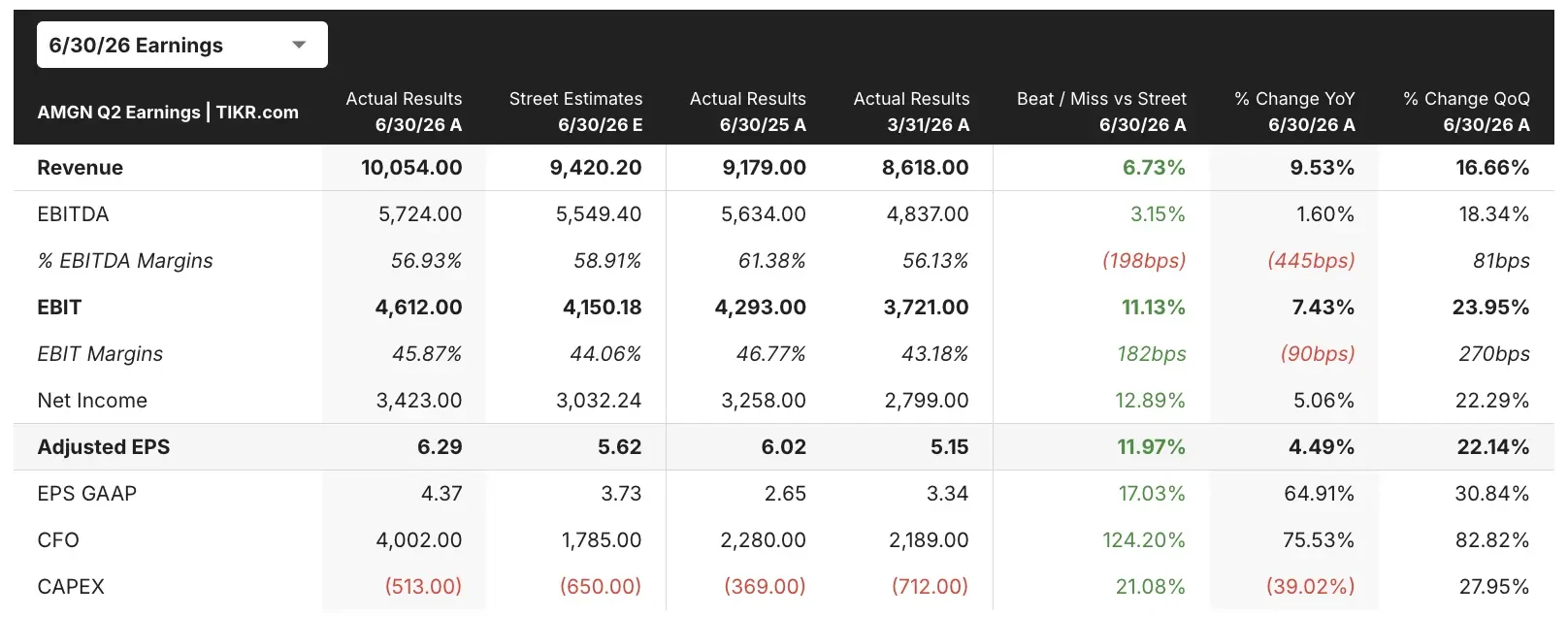
None of this changes the fundamentals from Amgen’s actual Q2 results, which were strong. Revenue rose 9.5% to $10.05 billion, beating consensus by roughly 7%, and adjusted earnings per share of $6.29 topped estimates by about 12%. CEO Bob Bradway told investors the company’s strong results were driven by the breadth and depth of its portfolio, a message that still holds even amid this week’s regulatory and competitive noise.
If Amgen can successfully appeal the Tavneos decisions using its real-world evidence, the stock’s sharp pullback this week may prove overdone relative to the underlying business.
See how Amgen’s Repatha growth compares to its full pipeline (It’s free) >>>
Does Amgen Stock Still Look Attractive After This Selloff?

Under valuation model assumptions realized through 12/31/28, the stock is modeled using:
- Revenue Growth (CAGR): 4.2%
- Operating Margins: 44.2%
- Exit P/E Multiple: 14.9x
Based on these inputs, the model estimates a target price of $427, implying a 2.4% total decline from the current share price and a negative 1.0% annualized return over the next 2.3 years.
That negative annualized return signals the model currently views Amgen as fully valued or slightly overvalued rather than a bargain, even after this week’s sharp drop. Revenue growth assumptions of just 4.2% reflect Amgen’s mature product portfolio, where older biosimilar-exposed drugs like Prolia and Enbrel continue to face pricing and competitive pressure even as newer products grow quickly. Operating margins near 44% remain strong by industry standards, but a 14.9x exit multiple suggests limited room for multiple expansion given the regulatory uncertainty now surrounding Tavneos.

Because Amgen’s growth increasingly depends on a smaller set of newer drugs, including Repatha and Tezspire, offsetting declines elsewhere, the model’s cautious stance makes sense until those products demonstrate they can carry the portfolio on their own. Investors should watch whether Repatha’s growth rate, which ran at 23% last quarter, can sustain itself as the primary offset to legacy product erosion.
Compare Amgen’s growth drivers against its full pipeline (Free with TIKR) >>>
Amgen Versus Its Biotech Peers
Regeneron Pharmaceuticals (REGN) offers the sharpest contrast this week. Regeneron posted Q2 revenue growth of 17% to $4.3 billion, nearly double Amgen’s 9.5% growth rate, driven by Dupixent global sales climbing 38% to $6.0 billion. Regeneron’s immunology franchise is growing faster than Amgen’s comparable cardiovascular and inflammation businesses, even though both companies operate in overlapping therapeutic areas and face similar biosimilar competition risks elsewhere in their portfolios.
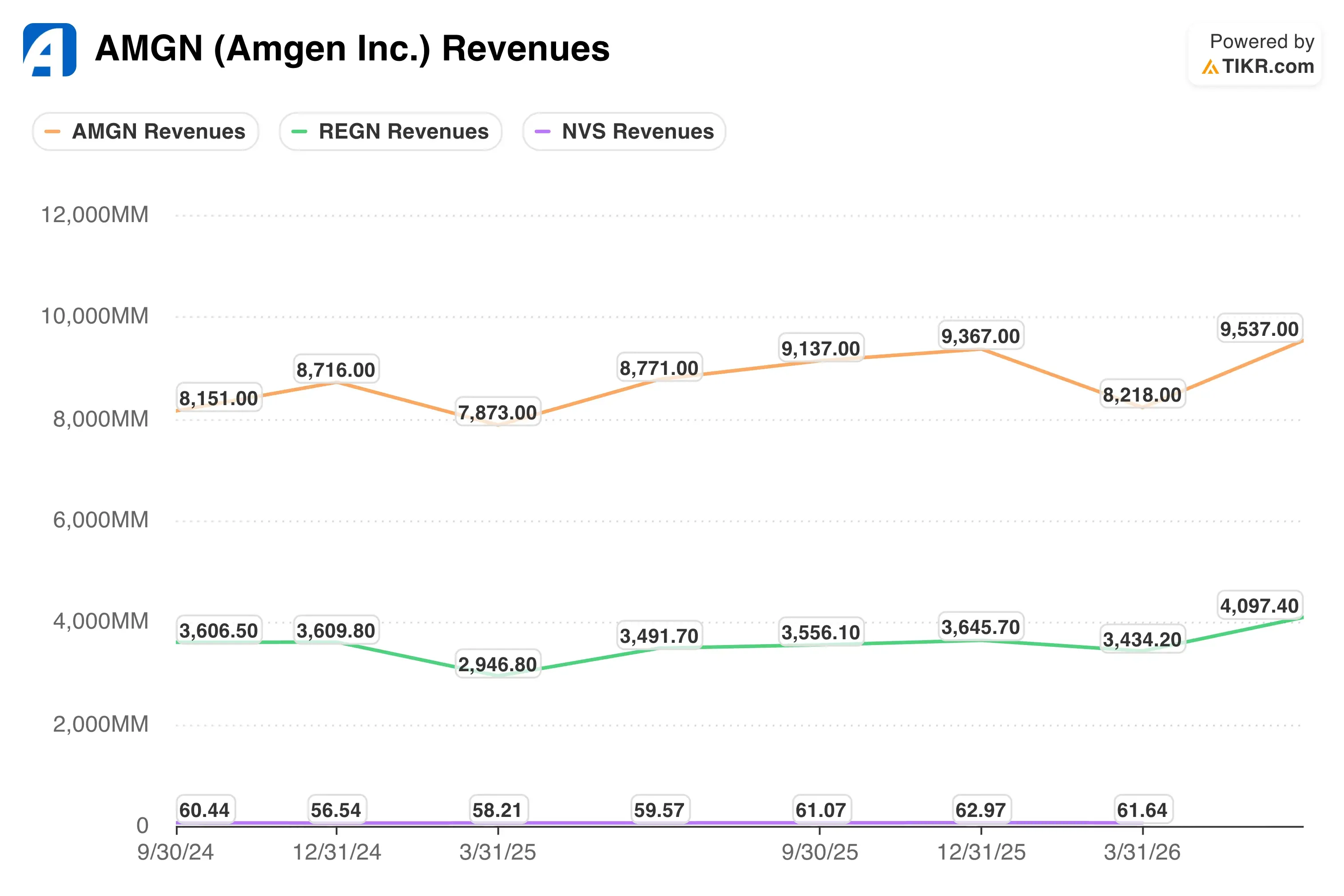
Novartis (NVS), the company at the center of this week’s selloff, provides a different kind of comparison. While Novartis and Ionis’s heart drug failure pressured the entire cardiovascular disease space, Amgen’s own Repatha franchise has continued to grow steadily even as newer oral PCSK9 competitors from Merck have entered the market. That resilience suggests Amgen’s cardiovascular business may be more insulated from single-trial shocks than this week’s stock reaction implied.
Taken together, Amgen trails Regeneron on pure growth but has shown more stability than the broader cardiovascular disease space suggested this week, a distinction that matters for investors trying to separate company-specific risk from sector-wide sentiment.
What’s Driving AMGN Stock Going Forward?
The Tavneos regulatory situation is the single biggest near-term catalyst to watch. Amgen has disputed both the UK and EU decisions, pointing to real-world evidence and additional clinical data it believes support the drug’s original approval. Existing patients can continue treatment for up to six months under the UK suspension while doctors consider alternatives, but any further regulatory action in other markets would compound the pressure on this smaller but symbolically important product line.
On the positive side, Amgen and AstraZeneca announced positive Phase 3 results for Tezspire in eosinophilic esophagitis in late August, meeting both co-primary endpoints with benefits sustained through 52 weeks. Because Tezspire is already approved for severe asthma, this new data expands its potential label into a second major indication, giving Amgen another avenue to offset legacy product declines.
Management’s raised full-year guidance, now calling for revenue between $38.2 billion and $39.4 billion and non-GAAP EPS of $22.30 to $23.50, still stands despite this week’s headlines. As long as Repatha and Amgen’s other five key growth drivers, which together made up about 70% of product sales last quarter, continue expanding at double-digit rates, the company has a credible path to hitting that guidance even with the Tavneos overhang unresolved.
Estimate a company’s fair value instantly (Free with TIKR) >>>
Should You Invest in Amgen?
The only way to really know is to look at the numbers yourself. TIKR gives you free access to the same institutional-quality financial data that professional analysts use to answer exactly that question.
Pull up AMGN, and you’ll see years of historical financials, what Wall Street analysts expect for revenue and earnings in the quarters ahead, how valuation multiples have moved over time, and whether price targets are trending up or down.
You can build a free watchlist to track AMGN alongside every other stock on your radar. No credit card required. Just the data you need to decide for yourself.
Analyze AMGN stock on TIKR Free→
Disclaimer:
Please note that the articles on TIKR are not intended to serve as investment or financial advice from TIKR or our content team, nor are they recommendations to buy or sell any stocks. We create our content based on TIKR Terminal’s investment data and analysts’ estimates. Our analysis might not include recent company news or important updates. TIKR has no position in any stocks mentioned. Thank you for reading, and happy investing!