Key Takeaways
- On the Prof G Markets podcast, AI critic Ed Zitron said at least $200 billion worth of Nvidia chips are sitting in warehouses and accused Nvidia of channel stuffing.
- Zitron didn’t say on the show where the figure comes from, and Alphabet CEO Sundar Pichai says Google is short of computing capacity every day.
- Nvidia’s receivables grew at the same pace as its sales through the year ended January 2026. Then they jumped to $63.1 billion in the quarter ended July because of longer payment terms for big customers.
- Analysts expect Nvidia’s revenue to nearly double to $412 billion this fiscal year, so how quickly it collects cash over the next few quarters is the thing to watch.
Nvidia (NVDA) is accused of stuffing its customers’ warehouses.
On Wednesday’s episode of the Prof G Markets podcast, Ed Zitron, author of the Where’s Your Ed At? newsletter, said “at least 200 billion dollars worth” of Nvidia’s chips “are sitting in warehouses.”
He also said why he thinks it’s happening. In Zitron’s telling, CEO Jensen Huang “is channel stuffing, where he’s saying to his partners, no, you will take delivery or you won’t get Vera Rubin,” Nvidia’s next generation of systems.
That’s a serious charge. Zitron didn’t say on the show where the $200 billion figure comes from. But a charge like this would leave tracks in Nvidia’s numbers, so we can check.
TIKR tracks 62 analysts on Nvidia. How many say “Buy”?
See the full breakdown of Buy, Hold, and Sell ratings on Nvidia, along with Wall Street’s revenue and earnings estimates, all in one place. More than 500,000 investors use TIKR to research stocks like this one. See Nvidia’s Analyst Ratings
Follow the receivables
A company that pushes product onto customers who can’t use it usually has a harder time getting paid. Zitron brought up Nvidia’s “ballooning accounts receivable” himself.
Through last fiscal year, receivables grew right alongside sales.
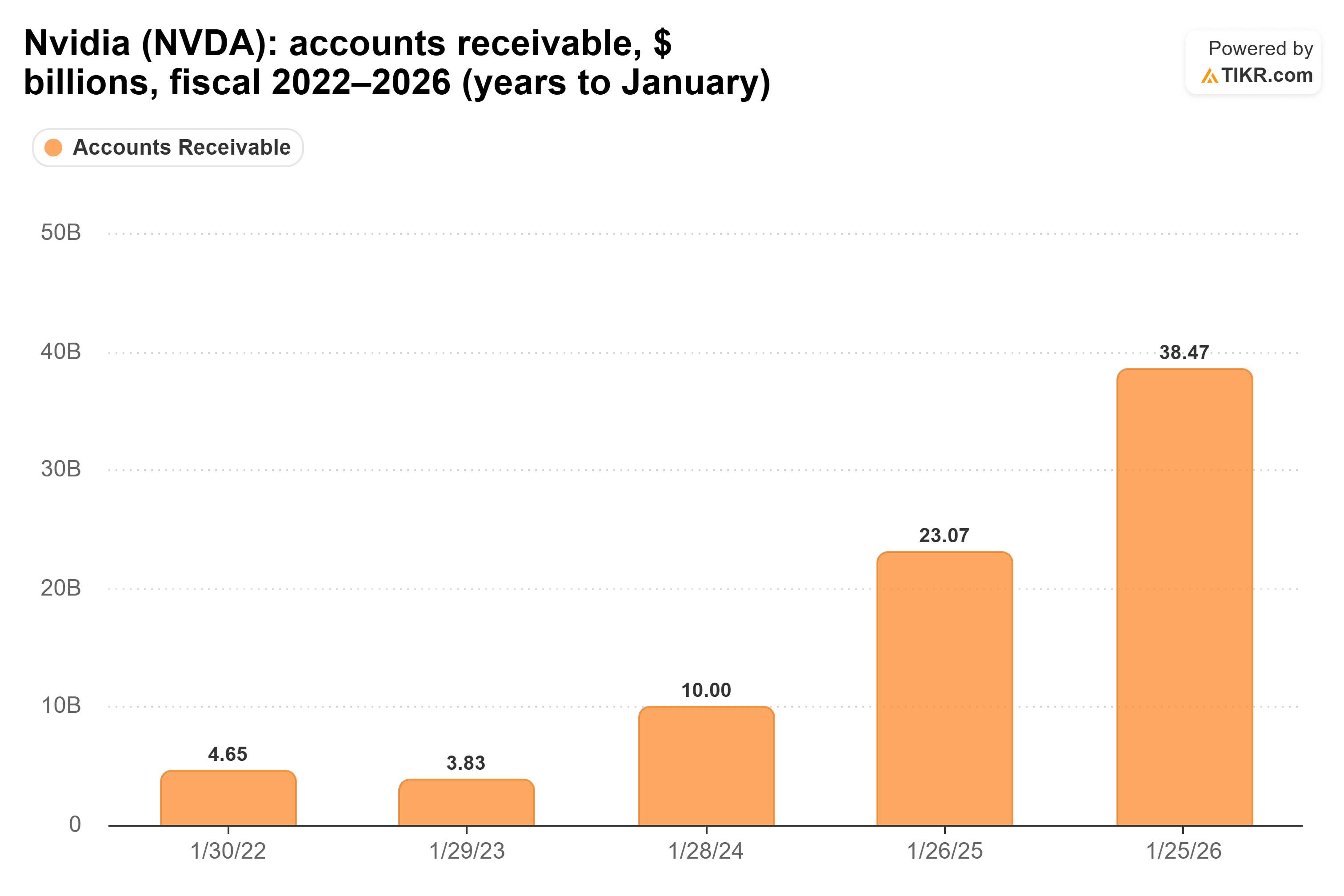
In the year ended January 2026, receivables rose 67% to $38.5 billion, and revenue rose 65% to $215.9 billion. Customers were paying about as fast as Nvidia was selling.
The latest quarter looks different. As of July 26, receivables had climbed to $63.1 billion, and days sales outstanding stretched to 60 from 45 the quarter before. Free cash flow fell to $21.3 billion from $48.6 billion, while net income was $59.7 billion.
Nvidia’s CFO commentary blames longer payment terms on large deals that run for several quarters with certain investment-grade customers.
So Zitron has a point about the receivables. When Nvidia gives its biggest buyers more time to pay, that’s worth watching. Still, investment-grade buyers pay their bills, and these are deals they signed for several quarters at a time.
Nvidia’s buyers say they’re short
The companies paying those bills describe something very different from a glut.
On Tuesday’s episode of the Big Technology Podcast, Alphabet (GOOG) CEO Sundar Pichai was asked whether AI is being overbuilt, the way railroads and fiber were. He said “this is not like fiber,” then added: “It’s not dark. We are using it. We are capacity constrained on a daily basis.”
Renters say the same. On Oct. 18, Elon Musk posted on X that a post about “What it’s like trying to rent AI/SI compute” matched what happened when SpaceX “tried to rent inference compute from AWS, GCP or anyone.” GCP is Google’s own cloud.
If $200 billion of chips were gathering dust, you’d think someone would rent a few out to SpaceX.
Analysts are betting on that demand lasting. Consensus has Nvidia’s revenue rising from $216 billion in the year ended January 2026 to $412 billion in the year ending January 2027, then $903 billion two years after that.
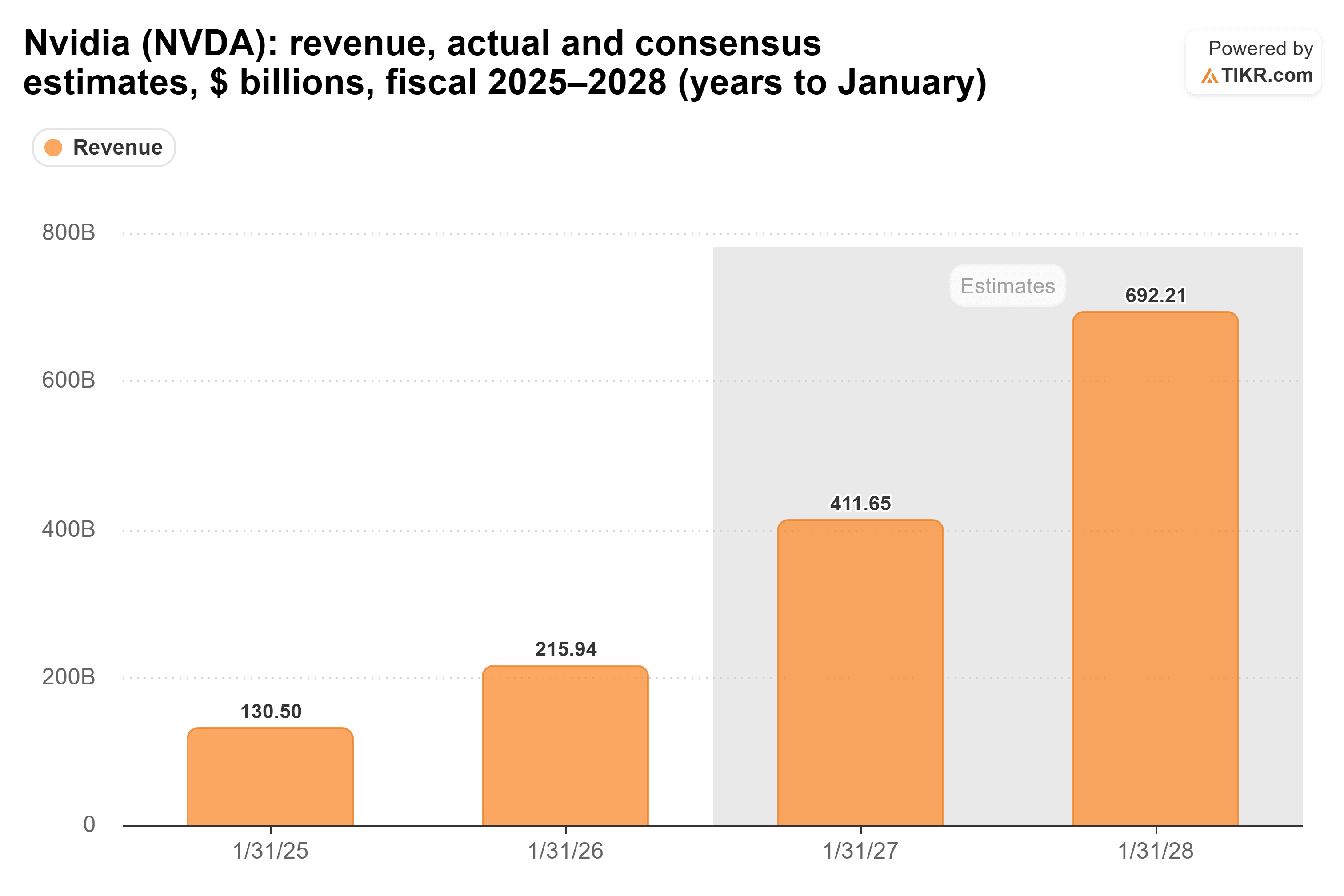
Nothing the buyers are saying points to cuts in those estimates. Another quarter of slower collections might.
The number to watch
So, are $200 billion of Nvidia’s chips sitting in warehouses? Nothing in Nvidia’s sales or what its biggest buyers are saying supports that.
The risk is still real. On Bloomberg Talks, Citadel CEO Ken Griffin compared today’s build-out to the fiber glut of 2000 and warned that “if we reach a point where the provisioning of GPUs exceeds demand for GPUs, marginal pricing will actually go into freefall.”
My take: the warehouse number doesn’t hold up, but Nvidia really is waiting longer to get paid. Nvidia’s next report, expected in late November, will show whether those 60 days come back toward 45 or stretch further.
So what is Nvidia stock actually worth?
TIKR lets you forecast the future price of any stock in less than a minute. Just enter a few assumptions into TIKR’s valuation model and see what Nvidia could be worth. Start from Wall Street consensus estimates, or adjust the inputs to reflect your own view of the business. It’s free to use.
Disclaimer:
Please note that the articles on TIKR are not intended to serve as investment or financial advice from TIKR or our content team, nor are they recommendations to buy or sell any stocks. We create our content based on TIKR Terminal’s investment data and analysts’ estimates. Our analysis might not include recent company news or important updates. TIKR has no position in any of the stocks mentioned. Thank you for reading, and happy investing!