
Key Takeaways
- Costco’s annual membership fee income rose from $3.88 billion in fiscal 2021 to $5.32 billion in fiscal 2025, with its fastest growth coming after the September 2024 fee increase.
- That fee increase has now fully cycled through, leaving fee growth to rely on new members and Executive upgrades, which grew fee income 6.8% in the fourth quarter.
- Operating income still grew about 12.5% in fiscal 2026, while Costco’s forward P/E has fallen from 48.66x a year ago to 40.53x.
Costco’s fee engine is losing its price-hike boost just as its valuation resets. See Costco’s annual membership revenue on TIKR for free →
Costco’s Fee Hike Boost Has Run Its Course
About halfway through Costco’s fourth-quarter call on September 24, between the tariff refunds and the return of the food court churro, CFO Gary Millerchip made an easy-to-miss remark: “Q4 marks the last quarter in which we will see a year-over-year benefit from the membership fee increase.”
That line matters because of how Costco makes money. The warehouses sell groceries, gas, and televisions at thin markups, and the membership card supplies much of the profit. In fiscal 2025, Costco collected $5.32 billion in membership fees against about $10.4 billion in operating income, roughly half of it.
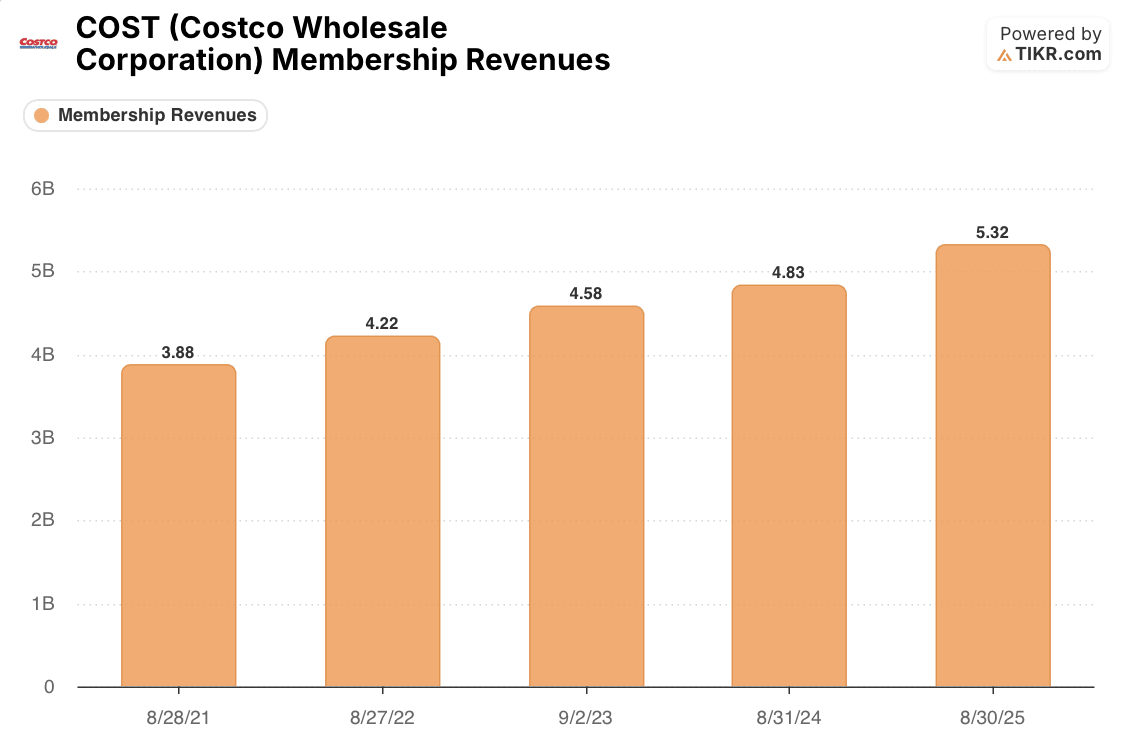
The five-year chart shows how that engine usually runs. Fee income grew 8.8% in fiscal 2022 and 8.5% in fiscal 2023, a year that included an extra week. By fiscal 2024, the last full year before the hike, growth had cooled to 5.5%, partly because it lapped that extra week, taking fees to $4.83 billion.
Then the US and Canada fee increase took effect in September 2024. Because Costco recognizes fees over each membership year, the boost spread across two fiscal years. Fee income jumped 10.1% to $5.32 billion in fiscal 2025, and the quarterly results put fiscal 2026 at about $5.9 billion, up roughly 11%.
That boost is now gone. The increase added less than 1% to fourth-quarter fee growth, and headline growth slowed to 7.3%. Excluding the hike and currency, fee income grew 6.8%, which is closer to the fiscal 2024 pace than to the double-digit growth of the last two years.
The growth inside that 6.8% is uneven. Total paid members rose 3.8% to 84.1 million, the eighth straight quarter of slowing growth, as Truist’s Scot Ciccarelli pointed out on the call. Paid Executive members, who pay a higher annual fee, rose 9.4% to 42.3 million. Upgrades are now doing more of the work than new sign-ups, and Millerchip called the recent growth rate “probably more typical of what we’d expect to see.”
Costco’s Warehouses Are Doing More of the Heavy Lifting
If fees had been the whole story, operating income would have cooled with them. It did not.
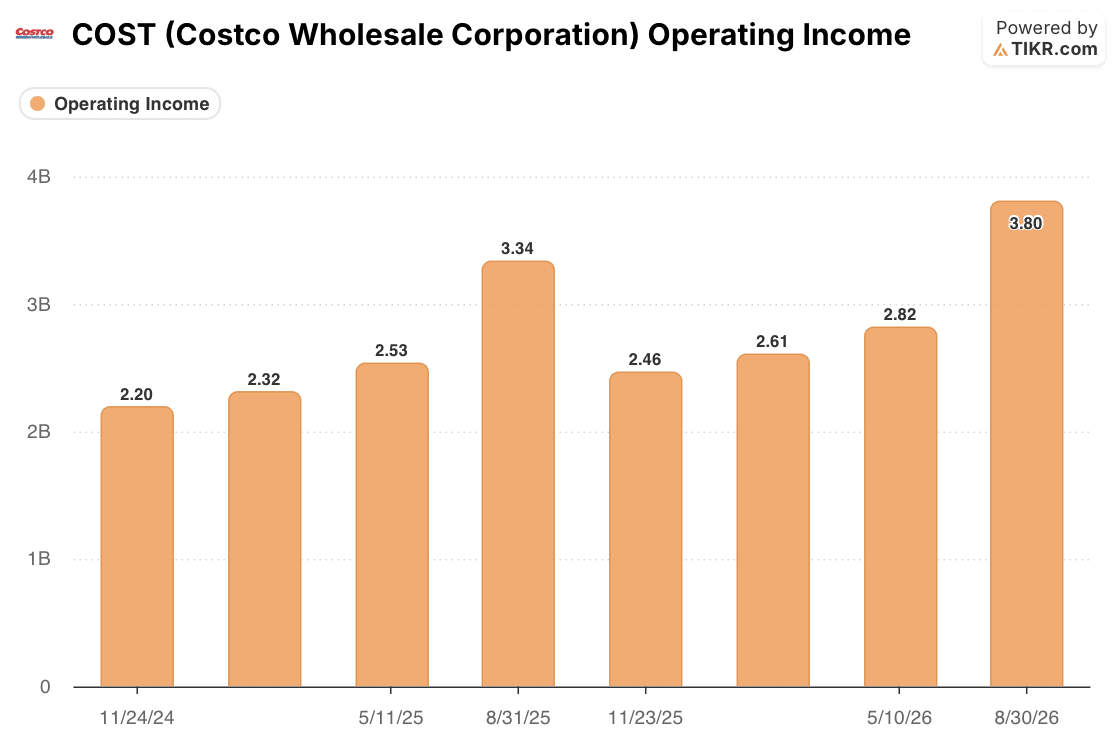
Operating income rose from about $10.4 billion in fiscal 2025 to about $11.7 billion in fiscal 2026, up roughly 12.5%, and increased year over year in every quarter. The fourth quarter reached $3.80 billion, up from $3.34 billion. Excluding membership fees, the rest of operating income grew about 20% in that quarter.
That figure needs a caveat. It includes a net 9-basis-point gross margin benefit from IEEPA tariff refunds, which Costco called nonrecurring. The underlying improvement still looks real: excluding tariff effects, core-on-core margins rose 18 basis points, helped by supply chain efficiencies and higher labor productivity in meat, bakery, and deli.
Costco’s merchandise profit sped up as fee growth slowed. Compare Costco’s quarterly operating income on TIKR for free →
Why the Multiple Came Down First
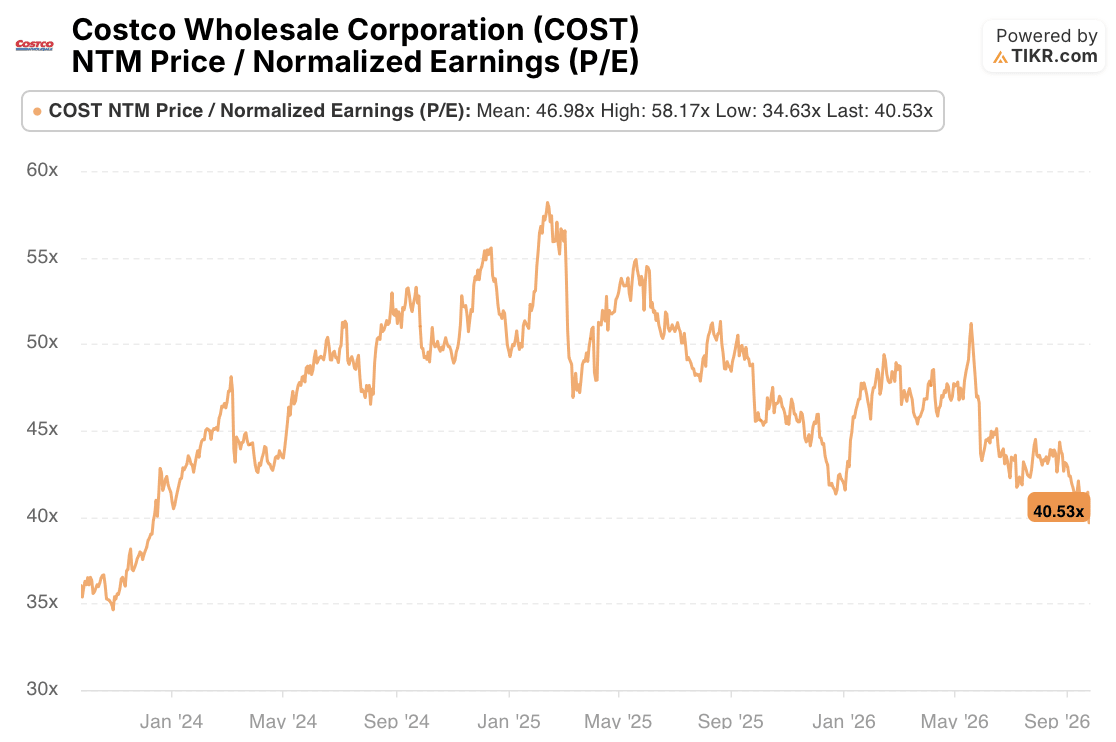
Costco’s valuation had already been resetting over the past year. Its NTM P/E stood at 48.66x at the end of August 2025 and 40.53x at Friday’s close of $922.77, down from a three-year high of 58.17x and below its 46.98x average. That same day, several brokerages cut their price targets after the report, even as the stock rose 2.93%.
The de-rating looks more like a reset to a slower fee engine than a verdict on a weakening business. Fee income is still growing close to 7% without a price increase, renewal rates edged up to 92.3% in the US and Canada, and merchandise margins are expanding.
But 40x still assumes the warehouses keep doing extra work, and some of that work is temporary. Tariff refunds will keep flowing into fiscal 2027 results, and Costco plans to reinvest most of them in lower prices. Capital spending is also set to climb to about $7.5 billion from $6.4 billion.
The cleanest test is Costco’s first-quarter fiscal 2027 report, the first with no fee-increase benefit at all. If fee income holds near the 6.8% organic pace, with Executive growth still well ahead of total paid members, the lower multiple will look like a fair price for a steadier compounder. If fee growth drifts back toward fiscal 2024’s 5.5%, the warehouses will need to carry even more of the thesis.
Costco’s valuation now leans on margins while fee growth resets. Track Costco’s forward P/E and membership revenue on TIKR for free →
Disclaimer:
Please note that the articles on TIKR are not intended to serve as investment or financial advice from TIKR or our content team, nor are they recommendations to buy or sell any stocks. We create our content based on TIKR Terminal’s investment data and analysts’ estimates. Our analysis might not include recent company news or important updates. TIKR has no position in any stocks mentioned. Thank you for reading, and happy investing!