Key Takeaways
- Citigroup earned $11.62 billion in net income in the first half of 2026, up about 44% from $8.08 billion a year earlier, on about 14% higher revenue.
- In July, Citi kept its 10% to 11% full-year RoTCE target despite a 13.1% RoTCE through the first half, and the stock slipped during the call. In September, CFO Gonzalo Luchetti said Citi will likely finish above 11%.
- Citi’s price-to-tangible-book multiple peaked at 1.47x in late June and sat at 1.33x on September 25, even though management’s full-year RoTCE outlook has since moved higher.
Citi’s earnings outlook improved while its valuation slipped from its peak. See Citigroup’s valuation history on TIKR for free →
Citigroup Stock Slipped on a Strong Quarter
On the morning of July 14, Citigroup (C) reported its best quarterly revenue in a decade. Net income came in at $5.8 billion, RoTCE hit 13%, and four of its five businesses grew revenue by double digits. Then the outlook slide came up, and the tone of the call changed.
Citi kept its full-year RoTCE target at 10% to 11%. Wells Fargo analyst Mike Mayo did the arithmetic out loud: a 13% first half and an 11% full year implied something closer to 9% in the second half. A few questions later, Bank of America’s Ebrahim Poonawala noted the stock was down 5%.
Management cited uncertainty in macro and market conditions, Markets revenue’s historical 20% decline from the first half to the second, and flexibility to pull investments forward if conditions stayed strong. “We’re playing the long game,” CEO Jane Fraser said. Investors heard a warning anyway.
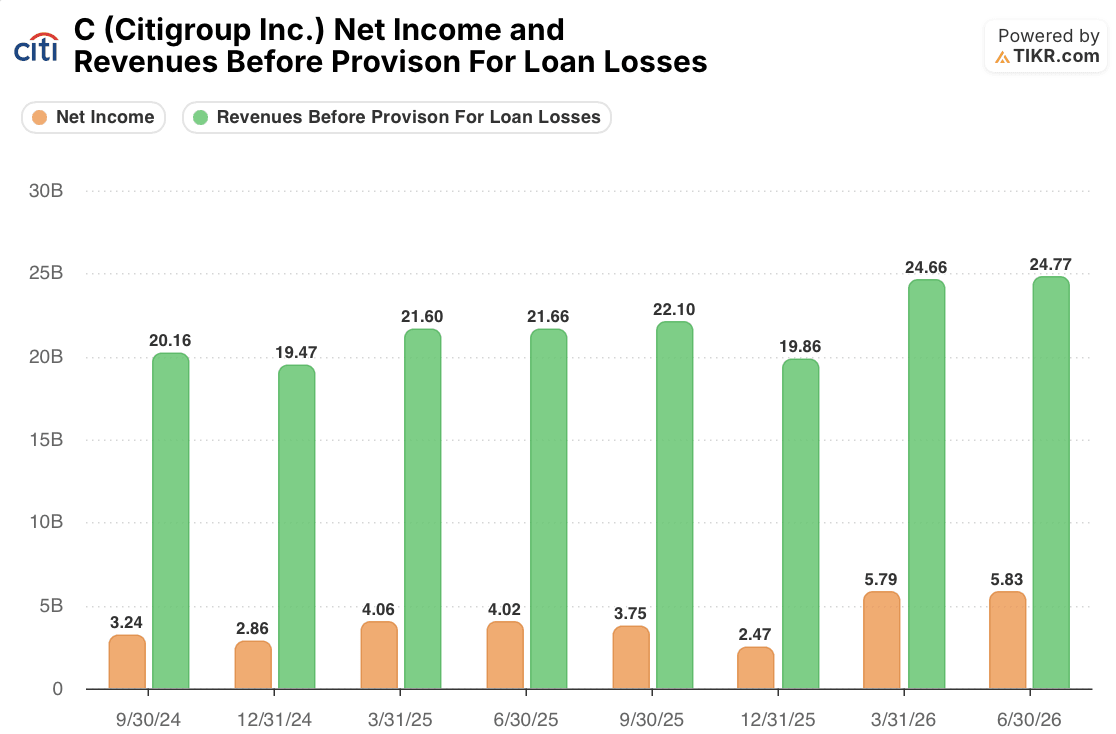
The first half the market doubted Citi could repeat was a real step up. Revenue before loan-loss provisions reached $24.77 billion in Q2 2026, up about 14% from $21.66 billion a year earlier. Net income rose 45% to $5.83 billion. Q1 told the same story: $5.79 billion of net income against $4.06 billion.
The chart also shows the base a softer second half would be measured against. In Q3 and Q4 2025, Citi earned a combined $6.22 billion, with Q4 falling to $2.47 billion. Even a seasonal slowdown would be compared with a modest year-earlier result.
Citi’s net income jumped 45% in Q2 while its full-year target stayed put. Compare Citigroup’s quarterly revenue and net income on TIKR for free →
The Upgrade Arrived, but the Multiple Hasn’t Followed— Yet
Two months later, at Barclays’ financial services conference on September 14, Luchetti sounded far more confident. With third-quarter momentum in view, he said Citi will likely end the year “a bit above our 11%” RoTCE. He expects NII excluding markets to land at the top of its 5% to 6% range or better, and the efficiency ratio to come in slightly better than 60%. Those forecasts already include about $500 million of investment and severance pulled into the second half.
In other words, the July caution covered a second half that Citi now expects to handle comfortably, even while spending more.

The valuation has not fully caught up. Citi traded at 0.93x tangible book at the end of June 2025 and peaked at 1.47x in late June 2026. After the July call, the multiple slid below 1.3x. At the September 25 close of $134.28, it stood at 1.33x. The trailing P/E fell from about 17.4x at the end of June to about 14.6x, though part of that drop reflects a higher earnings base rather than a lower price.
The evidence supports a narrow conclusion. Citi’s July guidance reflected caution, not trouble, and the stock has not returned to where it traded before that call. That does not make it cheap by default. At 1.33x, Citi trades well above the discount to tangible book it carried a year ago, and much of the turnaround is already reflected in the price.
The upgrade also leans on a strong September. Luchetti guided third-quarter investment banking revenue up only low single digits and called the final weeks of the quarter “very meaningful.” Markets revenue can swing quickly, and a softer fourth quarter combined with the pulled-forward spending could still push full-year returns back toward 11%.
The next test is Citi’s third-quarter report in October. The key figure is quarterly RoTCE after the extra $500 million of spending starts to land. If returns hold comfortably above 11%, the July selloff will look like a misreading of management’s caution. If they slide toward single digits, the market’s worry was justified.
Citi’s multiple sits below its June peak heading into Q3 results. Track Citigroup’s price-to-tangible-book multiple on TIKR for free →
Disclaimer:
Please note that the articles on TIKR are not intended to serve as investment or financial advice from TIKR or our content team, nor are they recommendations to buy or sell any stocks. We create our content based on TIKR Terminal’s investment data and analysts’ estimates. Our analysis might not include recent company news or important updates. TIKR has no position in any stocks mentioned. Thank you for reading, and happy investing!