
Key Stats for UNH Stock
- Past week’s performance: 2.8%
- 52-week range: $256 to $462
- Valuation model target price: $503
- Implied upside: 25.5% over 2.3 years
See how UnitedHealth’s turnaround stacks up against five years of analyst forecasts using TIKR’s Guided Valuation Model (It’s free) >>>
The Turnaround Is Starting to Show Up in the Numbers
UnitedHealth Group (UNH) spent 2026 climbing back from a brutal stretch. The second quarter gave shareholders their clearest sign yet that the recovery is real. Adjusted earnings per share jumped 56.4% year over year to $6.38, and that crushed Wall Street’s estimate of $4.85. Revenue held roughly flat at $112 billion, but profitability told the real story.
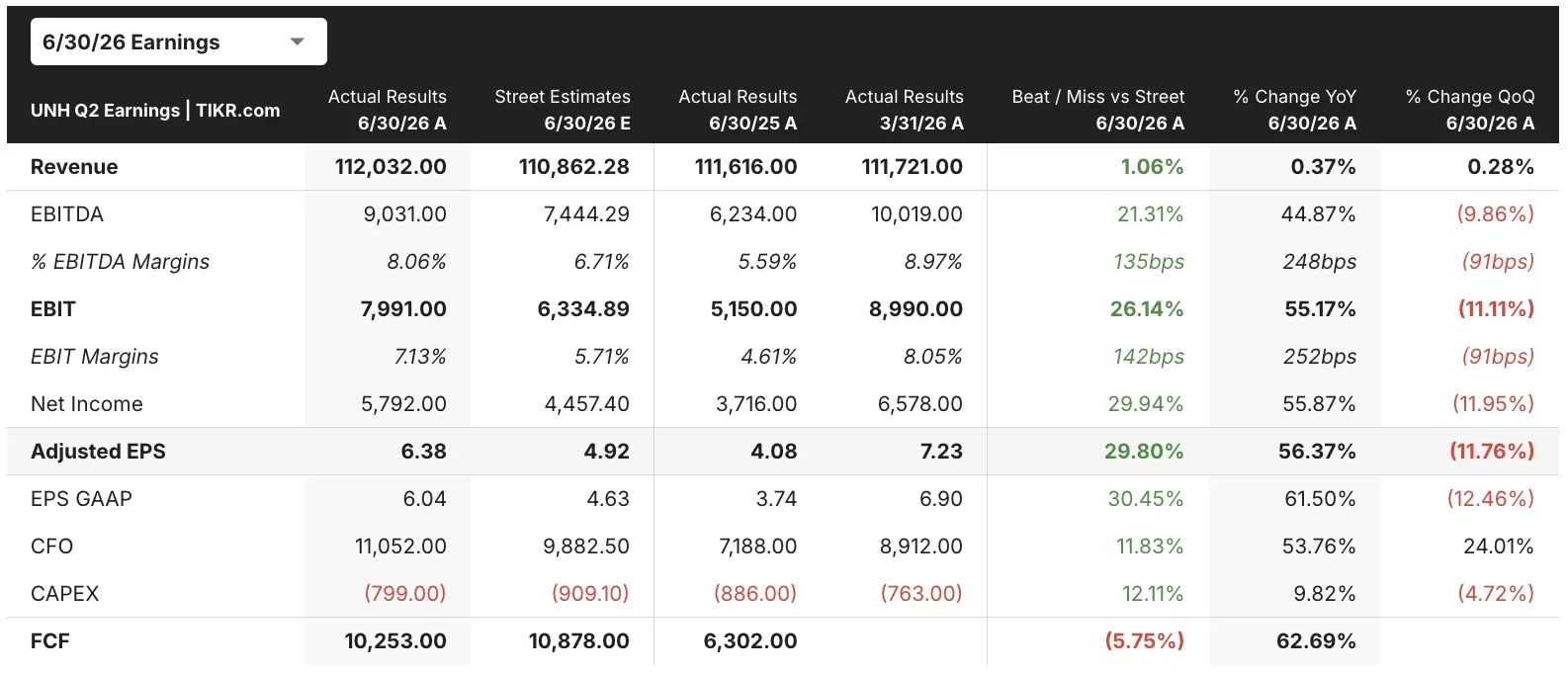
The company’s medical care ratio improved to 86.7% from 89.4% a year earlier. This ratio measures how much of every premium dollar goes toward member healthcare, so a lower number means UnitedHealth kept more of what it collected. Because of that shift, net earnings attributable to shareholders more than doubled to $5.48 billion, up from $3.41 billion in the same quarter last year.
Management didn’t just beat estimates. It also raised full-year adjusted EPS guidance to a range of $19.50 to $20, up from a prior outlook above $18.25. UnitedHealthcare’s operating earnings guidance rose to at least $12 billion, and Optum Health’s climbed to at least $2.2 billion. So the improvement isn’t a Q1 fluke.
Behind the scenes, the murder trial tied to former UnitedHealthcare CEO Brian Thompson took a significant turn. Luigi Mangione pleaded guilty in federal court on August 14 to stalking charges connected to Thompson’s December 2024 killing. The state murder trial was postponed indefinitely while lawyers argue over double jeopardy. CEO Stephen Hemsley told analysts, “Our second quarter results and updated full year 2026 outlook demonstrate continuing progress toward delivering more dependable performance.”
See analysts’ growth forecasts and price targets for UNH (It’s free) >>>
Is UNH Undervalued After the Rebound?
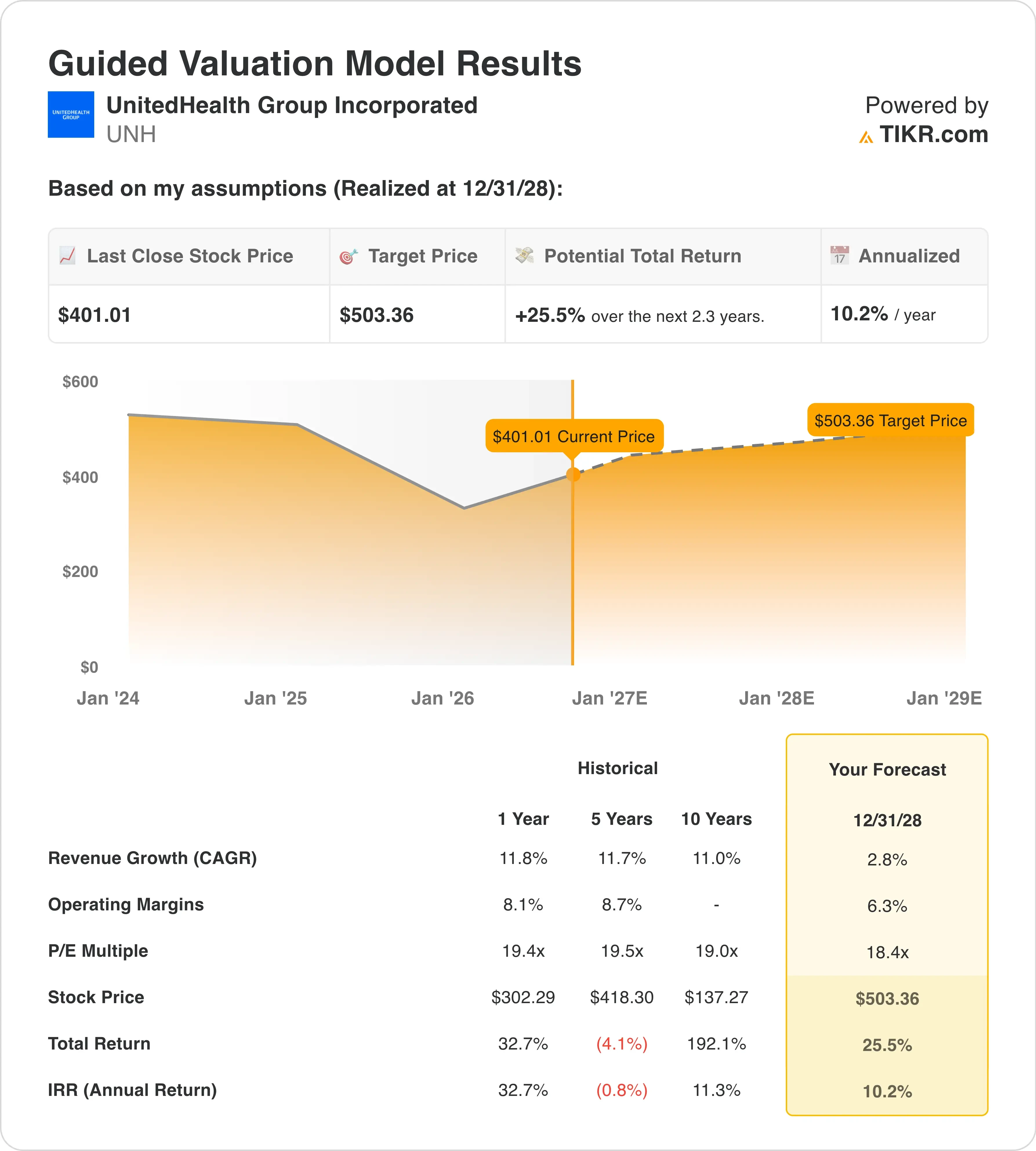
Under valuation model assumptions realized through 12/31/28, the stock is modeled using:
- Revenue Growth (CAGR): 2.8%
- Operating Margins: 6.3%
- Exit P/E Multiple: 18.4x
Based on these inputs, the model estimates a target price of $503. That implies 25.5% total upside from the current share price and a 10.2% annualized return over the next 2.3 years.
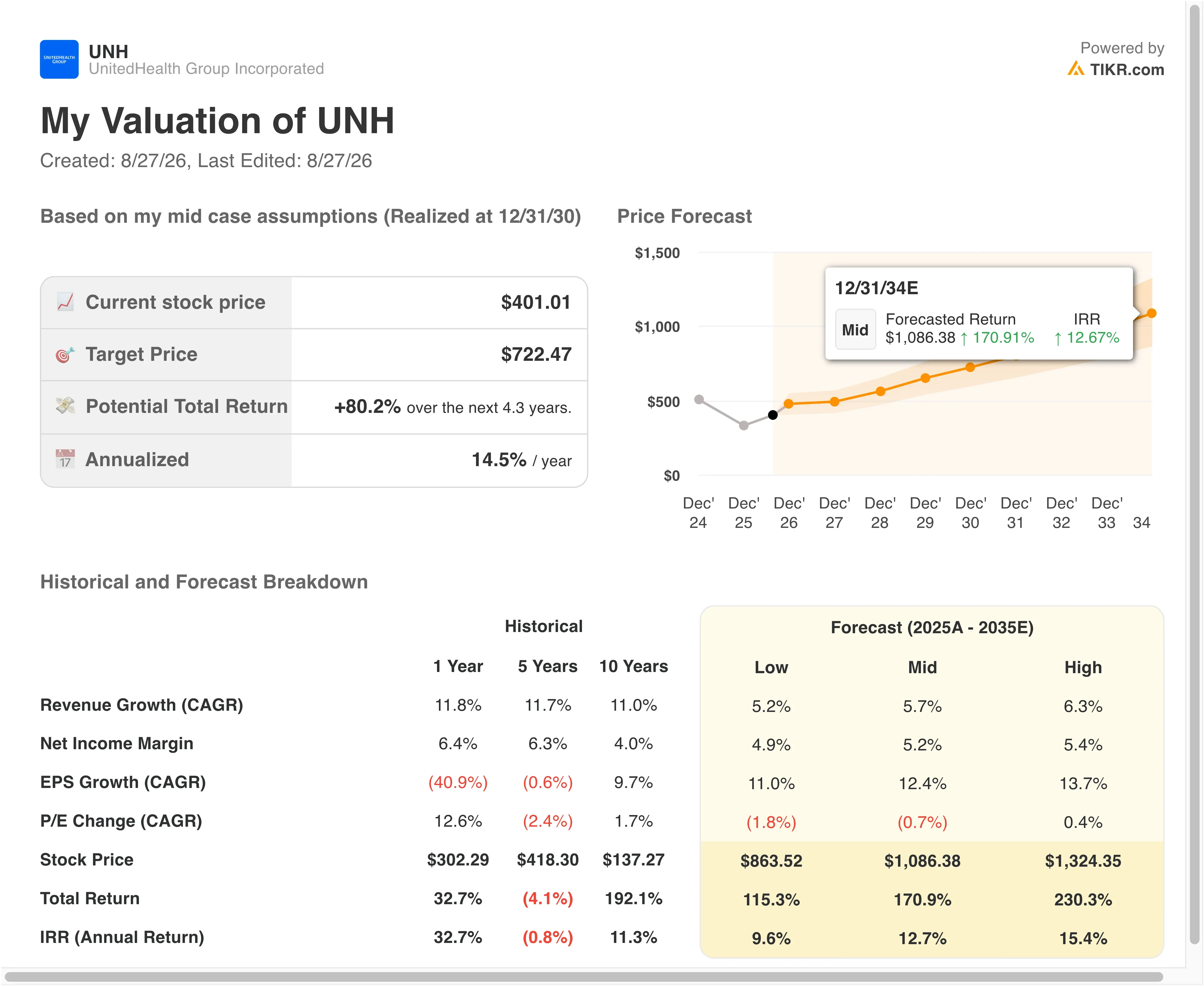
These assumptions look conservative next to UnitedHealth’s own history, but that’s the point. Revenue growth of just 2.8% reflects a company deliberately shrinking unprofitable Medicare Advantage and ACA exchange membership, so the model isn’t betting on a return to double-digit top-line growth anytime soon.
Margins carry more of the story here. An operating margin near 6.3% would still trail UnitedHealth’s historical 8% range, so the valuation doesn’t assume a full return to peak profitability. Instead, it credits partial recovery, and that’s a lower bar to clear because the medical cost ratio already improved by 270 basis points year over year.
The 18.4x exit multiple sits below UnitedHealth’s five-year and ten-year average P/E near 19x. Because the model isn’t paying up for a turnaround that hasn’t fully arrived, that combination produces a 10.2% annualized return. This lands in the moderately attractive range rather than screaming undervalued.
This is a margin recovery story more than a growth story. The stock’s own five-year chart backs that up, since shares delivered a negative 4.1% total return over five years even as revenue grew steadily.
Model your own margin assumptions for UnitedHealth’s recovery (Free with TIKR) >>>
How UNH Stacks Up Against Elevance and Humana
UnitedHealth’s rebound doesn’t happen in a vacuum. Elevance Health (ELV) and Humana (HUM) are both fighting the same Medicare Advantage cost pressures, so the comparison shows how far along each company is in its own recovery.
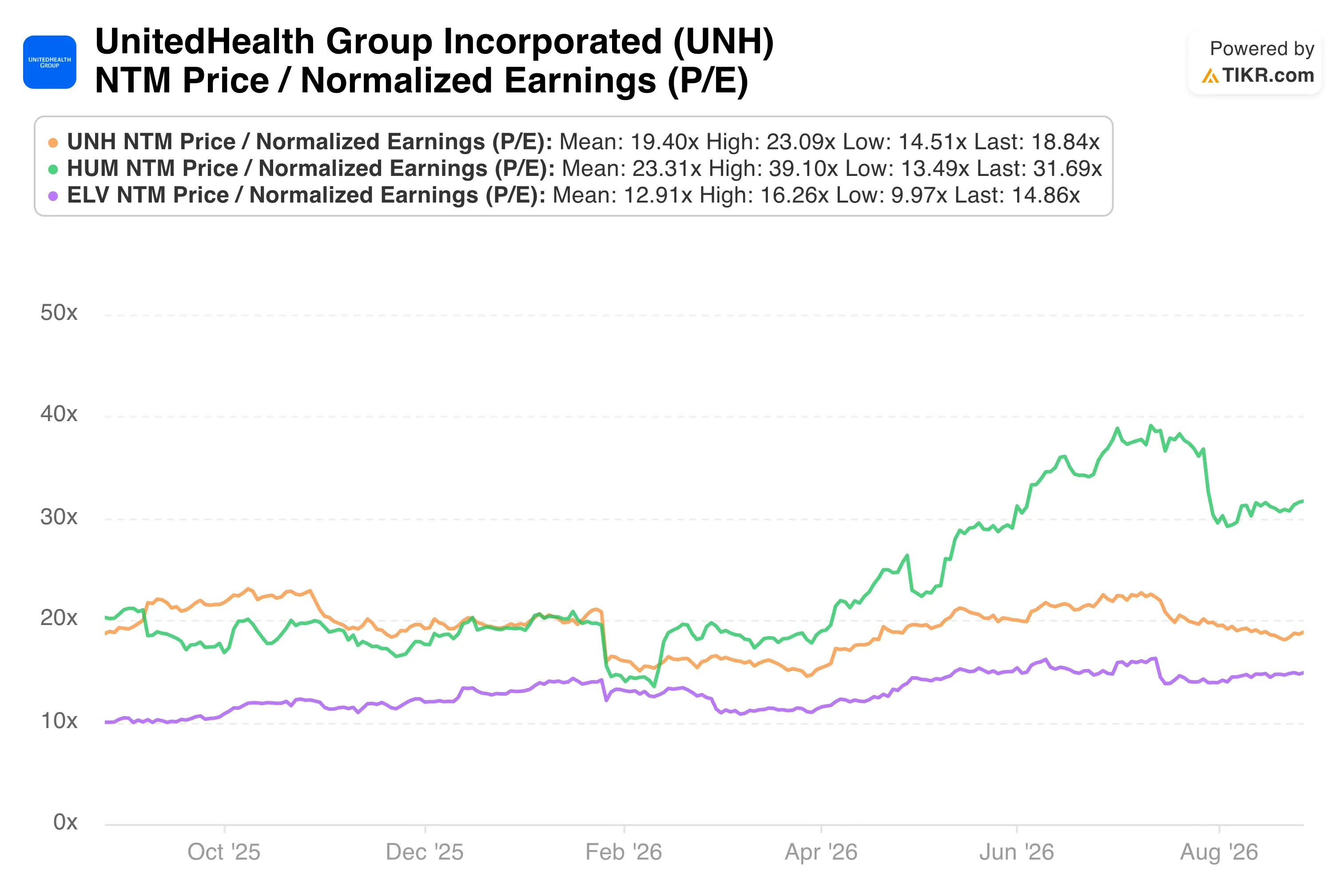
Elevance trades at a forward P/E near 11x, well below UnitedHealth’s 18.8x NTM multiple. This reflects the market’s view that UnitedHealth’s Optum segment justifies a premium over a pure insurance peer. Elevance’s medical loss ratio has also run hotter, since the company flagged elevated Medicaid and ACA cost trends through 2026. Humana trades near a 15x forward P/E and has leaned harder into shrinking its Medicare Advantage book, and its membership declines look even steeper than UnitedHealth’s projected 1.1 million drop this year.
UnitedHealth’s edge is Optum. The segment’s operating earnings guidance of at least $2.2 billion gives UnitedHealth a diversified profit engine that neither Elevance nor Humana can fully replicate. Because both peers stay more concentrated in pure insurance underwriting, that diversification helps explain UnitedHealth’s higher multiple.
Where UnitedHealth still lags is growth. Revenue guidance implies barely any top-line expansion in 2026, while Elevance and Humana each target low single-digit growth of their own. So the sector story right now isn’t about who grows fastest, but about who stabilizes medical costs first.
What’s Driving UNH Stock Going Forward?
The next real test comes in October, when UnitedHealth reports Q3 results. Investors will look for the medical care ratio to hold near 86.7% rather than drift back toward 2025 levels. Management’s full-year MCR guidance of 88.1%, plus or minus 25 basis points, suggests some seasonal cost pressure in the back half.
AI investment is also becoming a bigger part of the story. UnitedHealth has poured $1.5 billion into AI tools designed to speed up prior authorizations and detect billing errors. The company committed to eliminating 30% of total prior authorization volume by year-end, so faster approvals should reduce administrative costs without requiring membership growth.
Membership trends remain a swing factor. UnitedHealthcare expects to lose roughly 500,000 ACA exchange members and 1.1 million Medicare Advantage members in 2026 as it exits unprofitable contracts. That’s a deliberate trade of volume for profitability, and investors will want medical margins to keep improving even as the book shrinks.
Finally, the legal situation surrounding Brian Thompson’s killing remains a background factor rather than a fundamental one. Since the state trial got postponed indefinitely, the company can keep its public focus on operational execution.
Track UnitedHealth’s next earnings catalyst and build your own price target (Free with TIKR) >>>
Should You Invest in UnitedHealth?
The only way to really know is to look at the numbers yourself. TIKR gives you free access to the same institutional-quality financial data that professional analysts use to answer exactly that question.
Pull up UNH, and you’ll see years of historical financials, what Wall Street analysts expect for revenue and earnings in the quarters ahead, how valuation multiples have moved over time, and whether price targets are trending up or down.
You can build a free watchlist to track UNH alongside every other stock on your radar. No credit card required. Just the data you need to decide for yourself.
Analyze UNH stock on TIKR Free→
Disclaimer:
Please note that the articles on TIKR are not intended to serve as investment or financial advice from TIKR or our content team, nor are they recommendations to buy or sell any stocks. We create our content based on TIKR Terminal’s investment data and analysts’ estimates. Our analysis might not include recent company news or important updates. TIKR has no position in any stocks mentioned. Thank you for reading, and happy investing!