


Key Takeaways
- Summer Slide: United Airlines stock is down 11% since mid-June, last at $107.
- Consensus Gap: The mean Street target on United Airlines stock has climbed to $159 across 23 analysts, now sitting 48% above the current price after nearly converging with it in June.
- Rating Mix: Nineteen buy ratings, four outperforms, one hold, one no-opinion rating and one underperform rating make up the current tilt on United Airlines stock, the most lopsided bullish split of the past 15 months.
- Model Discount: TIKR’s mid-case model prices United Airlines stock at $120 by the end of 2030, a 12% total return and 3% annualized, well below what the Street’s own target implies.
Why United Airlines Stock Has Slid 11% Even as Street Targets Climb

United Airlines Holdings (UAL) stock has dropped 11% since mid-June, closing at $107 on September 15 even though the airline beat second-quarter estimates and its own analysts kept raising price targets through the summer. The slide traces back to jet fuel, not demand.
Fuel prices spiked in July after the Iran war closed off the Strait of Hormuz, and United absorbed the hit in real time. Chief Financial Officer Mike Leskinen laid out the damage on the second-quarter call: “At today’s prices, fuel remains almost $6 billion higher for the year compared to our outlook at the start of the year.” CEO Scott Kirby put a sharper number on the spike itself, telling analysts the fuel run-up that month alone equaled $1.12 of adjusted earnings per share for the third quarter.
United responded by changing its own guidance policy, tying quarterly EPS ranges to the Gulf Coast jet fuel forward curve instead of a fixed assumption. That decision signaled how unstable the input had become, and the stock traded accordingly through the back half of the summer.
September brought a second leg down. Barclays cut its United Airlines stock target to $160 from $175 on September 11, part of a broader round of airline target cuts that also hit Delta, Southwest, American and JetBlue. The cuts landed even as United’s own 23-analyst mean target kept rising, a split covered in the next section.
Management’s counterargument, made repeatedly on the call, is that the pressure comes from structural cost inflation across the industry, not from United-specific problems or from flyers pulling back. Kirby noted another round of fare increases went through this month as fuel climbed again, while no fare cuts followed the earlier drop, evidence he used to argue pricing power remains intact. The stock’s slide looks like a cost story playing out in real time, not a demand story, and the next two sections show how the Street and TIKR’s own model are pricing that distinction differently.
United Airlines Stock Faces a Fresh Air Traffic Control Funding Overhang
The slide has company from Washington. A Government Accountability Office report released this week found the Federal Aviation Administration needs billions more to complete the first phase of its $10.6 billion air traffic control modernization plan, and FAA Administrator Bryan Bedford told a House subcommittee on September 15 that phase one alone will cost $16 billion, well above the $12.5 billion Congress approved. That funding gap matters directly to United, whose Chicago O’Hare hub already operates under an FAA order cutting flights through October 2027. Chief Commercial Officer Andrew Nocella described the current plan on the July call: United will fly “650 flights per day, which is what we’re approved to fly almost indefinitely” at O’Hare, with similar caps extended in New York. A chronically underfunded modernization effort makes those caps harder to lift, not easier, layering a second cost variable on top of fuel.
United Airlines Stock’s Target Keeps Rising Even as Shares Retreat
United Airlines stock carries 19 buy ratings, 4 outperforms, 1 hold, 1 no-opinion rating and 1 underperform rating as of the most recent Street snapshot. Separately, 23 analysts publish a price target on the stock, and their mean sits at $159, 48% above the $107 close on September 15.

That gap has not always been this wide. On June 30, the mean target of $138 sat just 2% above the $136 close, nearly converged after the stock’s own rally through the spring. Fifteen months earlier, on June 30, 2025, the mean target of $95 stood 20% above an $80 close.
Analysts have raised that mean target at every step across the six quarterly snapshots on record, from $95 to $159, even as the price round-tripped from $80 through $136 and back down to $107. The Street kept marking United’s earnings power higher through the summer’s fuel shock rather than lower.
TIKR Values United Airlines Stock at $120, Below the Street’s Own Number
TIKR’s mid-case model values United Airlines Holdings at $120 by the end of 2030, implying 12% total return from the current price of $107, or 3% annualized over roughly four years.
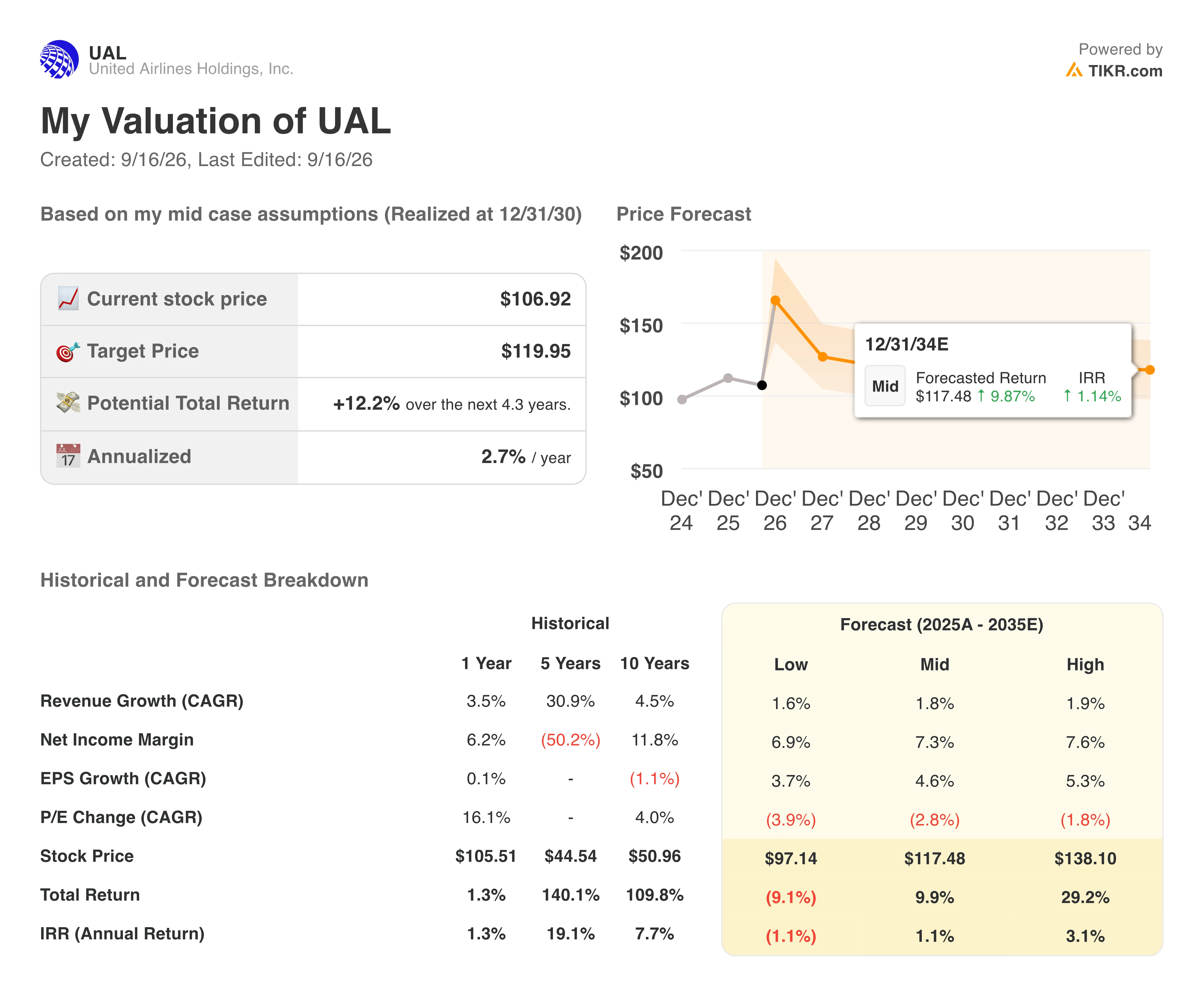
That mid-single-digit annualized path sits well below the mean Street target’s 48% implied upside, a rare instance of TIKR’s own model reading more cautious than sell-side consensus on an airline stock that has already given back a chunk of its summer gains.
The gap traces to the same cost pressure that dragged the stock down in the first place. TIKR’s model discounts for the fuel and structural cost inflation Kirby and Leskinen detailed on the July call, while the Street’s climbing target assumes United fully recaptures fuel costs by the fourth quarter, exactly as management guided.
Should You Invest in United Airlines Holdings, Inc.?
The only way to really know is to look at the numbers yourself. TIKR gives you free access to the same institutional-quality financial data that professional analysts use to answer exactly that question.
Pull up United Airlines Holdings, Inc. stock and you’ll see years of historical financials, what Wall Street analysts expect for revenue and earnings in the quarters ahead, how valuation multiples have moved over time, and whether price targets are trending up or down.
You can build a free watchlist to track United Airlines Holdings, Inc. alongside every other stock on your radar. No credit card required. Just the data you need to decide for yourself.
Access Professional Tools to Analyze UAL stock on TIKR for Free →
Looking for New Opportunities?
- See what stocks billionaire investors are buying so you can follow the smart money.
- Analyze stocks in as little as 5 minutes with TIKR’s all-in-one, easy-to-use platform.
- The more rocks you overturn… the more opportunities you’ll uncover. Search 100K+ global stocks, global top investor holdings, and more with TIKR.
Disclaimer:
Please note that the articles on TIKR are not intended to serve as investment or financial advice from TIKR or our content team, nor are they recommendations to buy or sell any stocks. We create our content based on TIKR Terminal’s investment data and analysts’ estimates. Our analysis might not include recent company news or important updates. TIKR has no position in any stocks mentioned. Thank you for reading, and happy investing!


