
Key Stats for UBER Stock
- Past-Week Performance: 6%
- 52-Week Range: $61 to $102
- Current Price: $74
What Happened to UBER Stock?
Uber (UBER) stock closed at $73.86, up 1.3% last Friday, as the company’s $100 million AV charging hub investment, seven-country European delivery expansion, and the launch of Uber Autonomous Solutions all landed within the same week, painting a picture of a company accelerating on multiple fronts simultaneously.
The most structurally significant announcement was Uber Autonomous Solutions on February 23, a full commercialization suite that lets AV partners plug directly into Uber’s demand marketplace, fleet operations, and customer support infrastructure rather than building those capabilities from scratch.
In addition, underpinning that AV push is a business already generating serious financial firepower, with FY2025 revenue hitting $52.0 billion, up 18%, free cash flow reaching $9.8 billion, up 42%, and adjusted EBITDA climbing 35% to $8.7 billion.
Uber no longer operates as a mere ride-hailing app; instead, its simultaneous expansion into seven new European delivery markets, an LA28 Olympic partnership, and a Mazda dealership courtesy-ride integration signal a platform company weaving itself into every mobility and logistics touchpoint.
CEO Dara Khosrowshahi stated on the Q4 2025 earnings call that “AVs amplify the fundamental strengths of our platform, global scale, deep demand density, sophisticated marketplace technology and decades of on-the-ground experience,” adding that AV trips on Uber’s network already run at 30% higher utilization than standalone first-party platforms.
Additionally, Soros Fund Management raised its Uber stake by 47.0% to 372,119 shares as of December 31, 2025, signaling growing institutional conviction heading into the company’s most aggressive AV deployment year yet.
Trading at $73.86 against a 52-week high of $102.0, Uber’s stock sits 27.6% below its peak even as the company posts record cash flows, targets 15 AV cities by year-end, and builds the infrastructure layer that could define autonomous mobility globally.
Wall Street’s Take on UBER Stock
Last week’s announcements, from the $100 million AV charging infrastructure investment to the Uber Autonomous Solutions launch, confirm that Uber is no longer just deploying AVs as a side experiment but actively building the commercial backbone to scale them globally.
The fundamental case for that ambition is grounded in a business already firing at full capacity, with FY2025 revenue reaching $52.0 billion, up 18%, EBITDA margins expanding to 16.8%, and forward estimates projecting revenue of $58.4 billion in FY2026, up another 12.3%.
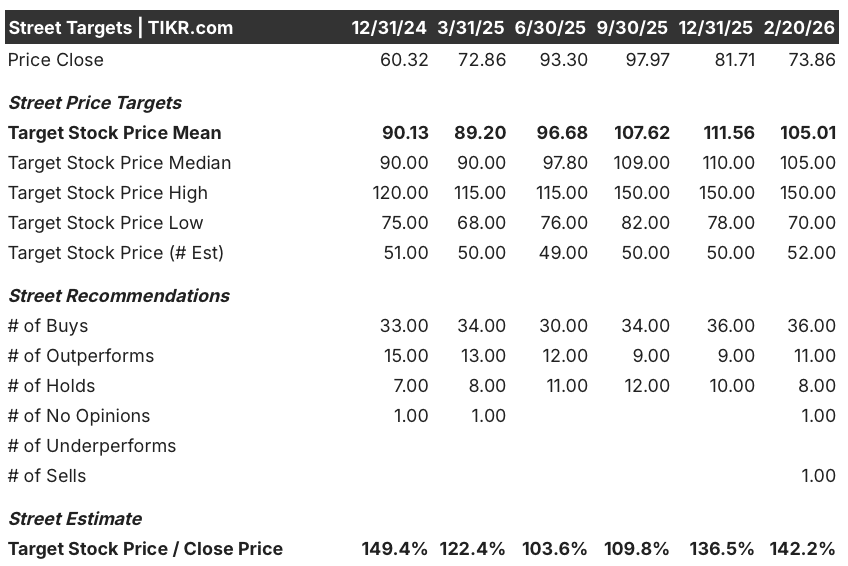
Wall Street is firmly behind the story, with 36 buy ratings and 11 outperform ratings among 52 analysts as of February 20, and a mean price target of $105.0 implying 42.2% upside from the current close of $73.86.
The target spread, however, signals diverging conviction, ranging from a bear-case low of $70.0 to a bull-case high of $150.0, reflecting genuine disagreement over how quickly AV economics will scale and whether Uber can defend its platform take-rate as autonomous supply floods the network.
What Does the Valuation Model Say?

Against the backdrop of record free cash flow and an accelerating AV partnership pipeline, a mid-case valuation model prices Uber at $206, projecting a 178.7% total return over 4.8 years at a 23.5% annualized IRR, a compelling setup for investors willing to underwrite the autonomous transition.
The key risk is normalized net income, which already dropped 59.5% in FY2025 and is projected to recover only partially to $6.9 billion in FY2026, suggesting that near-term AV capital commitments and vehicle purchase obligations will continue pressuring reported earnings even as operating leverage builds.
At $73.86, trading 27.6% below its 52-week high and at a steep discount to both analyst consensus and the valuation model’s mid-case target, Uber looks meaningfully undervalued for investors with a multi-year horizon on the autonomous mobility buildout.
Value Any Stock in Under 60 Seconds (It’s Free)
With TIKR’s new Valuation Model tool, you can estimate a stock’s potential share price in under a minute.
All it takes is three simple inputs:
- Revenue Growth
- Operating Margins
- Exit P/E Multiple
From there, TIKR calculates the potential share price and total returns under Bull, Base, and Bear scenarios so you can quickly see whether a stock looks undervalued or overvalued.
If you’re not sure what to enter, TIKR automatically fills in each input using analysts’ consensus estimates, giving you a quick, reliable starting point.