Key Stats for Disney Stock
- Past-Week Performance: 0.1%
- 52-Week Range: $80 to $125
- Current Price: $106
What Happened to Disney Stock?
Disney (DIS) stock closed at $105.58 on February 20, down 0.4% on the day and trading well below its 52-week high of $125, as a wave of mixed developments landed within the same week, including institutional stake cuts from ValueAct and Mubadala, a ByteDance IP dispute, and mounting FCC pressure on ABC.
On February 17, SEC filings revealed that ValueAct Holdings slashed its Disney stake by 29.9% to 3.1 million shares and Mubadala Investment cut its position by 48.7% to just 35,984 shares, while Viking Global moved in the opposite direction, raising its stake by 7.1% to 11.2 million shares.
The selling from major institutions followed a broader pattern of uncertainty around Disney’s international parks business, after CFO Hugh Johnston acknowledged limited visibility into international bookings for Q2 and the company shifted its marketing and sales focus toward domestic travelers.
The sentiment drag deepened as Disney’s ABC faced an active FCC enforcement investigation into “The View” over equal time rules, adding regulatory risk to a company already navigating the FCC’s broader pressure campaign against broadcast networks under Chair Brendan Carr.
Still, the bigger picture points to underlying operational momentum, with Q1 FY2026 delivering record Experiences revenue above $10 billion, a 13% SVOD subscription revenue gain, and a blockbuster 2025 box office haul of over $6.5 billion, keeping the bull case for DIS stock intact despite near-term headwinds.
Wall Street’s Take on Disney Stock
Despite near-term institutional selling pressure and FCC-related regulatory noise, Disney’s operational engines are clearly accelerating, with record Experiences revenue, a streaming business now targeting 10% margins, and a loaded 2026 theatrical slate that includes Avengers: Doomsday and Toy Story 5.

Analysts project revenue reaching $101.1 billion in FY2026, a 7% YoY jump from FY2025’s $94.4 billion, while normalized EPS is forecast to grow 12% to $6.64, continuing a multi-year earnings recovery that saw EPS surge from $2.33 in FY2021 to $5.93 in FY2025.
Wall Street remains broadly constructive on DIS stock, with 20 Buy ratings and 5 Outperforms against just 1 Sell as of February 20, and a mean analyst price target of $130.6 representing roughly 23.7% upside from the current $105.58 close.
However, the spread between the analyst low target of $77.00 and the high of $160.00 reflects genuine disagreement about how quickly streaming profitability, ESPN’s direct-to-consumer pivot, and international parks recovery can compound into sustained earnings growth.
What Does the Valuation Model Say?
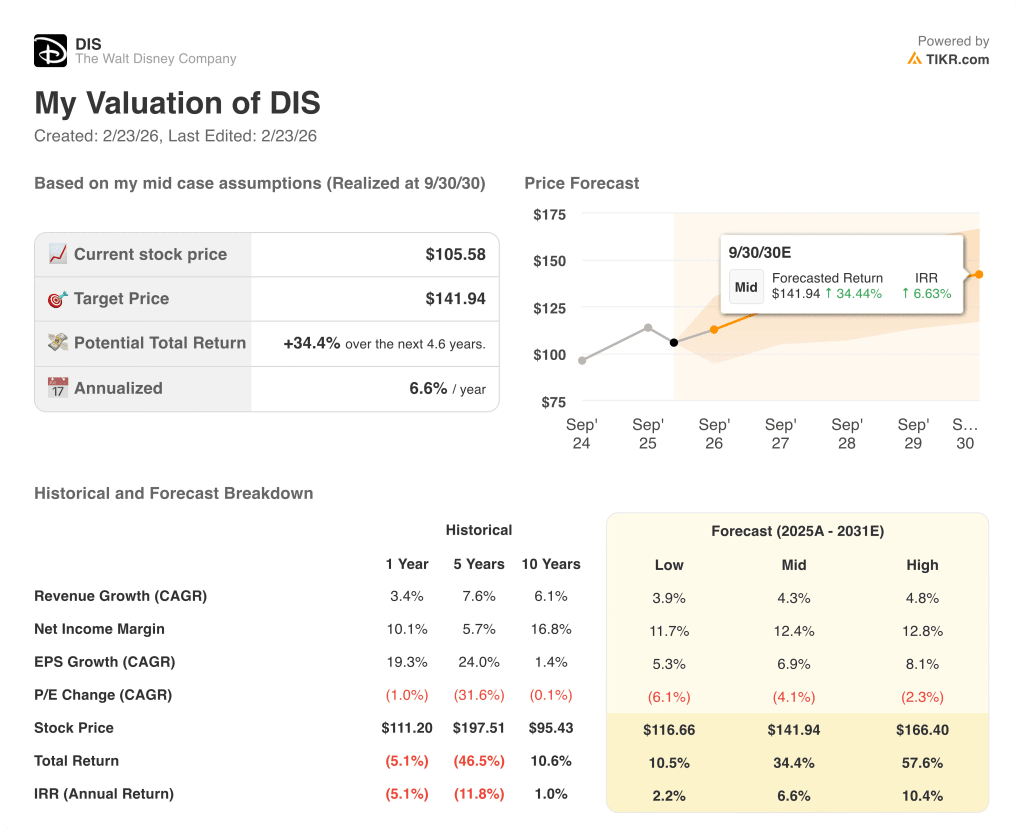
With Disney stock trading near multi-year lows despite record parks revenue and a recovering streaming business, a mid-case DCF model prices DIS at $141.94, implying a 34.4% total return through FY2030 at a 6.6% annualized IRR.
The clearest risk is multiple compression, as the FCC’s escalating pressure on ABC, declining international park visitation driven by geopolitical friction, and CEO succession uncertainty could weigh on investor confidence even as underlying fundamentals improve.
Altogether, DIS stock appears undervalued at current levels, but a meaningful re-rating likely requires streaming margins to hit their 10% target and the 2026 theatrical slate to deliver, making this a fundamentals-dependent recovery story rather than an immediate catalyst trade.
Value Any Stock in Under 60 Seconds (It’s Free)
With TIKR’s new Valuation Model tool, you can estimate a stock’s potential share price in under a minute.
All it takes is three simple inputs:
- Revenue Growth
- Operating Margins
- Exit P/E Multiple
From there, TIKR calculates the potential share price and total returns under Bull, Base, and Bear scenarios so you can quickly see whether a stock looks undervalued or overvalued.
If you’re not sure what to enter, TIKR automatically fills in each input using analysts’ consensus estimates, giving you a quick, reliable starting point.