


Key Takeaways for Uber Stock as of July 2026
- Trading at , Uber stock sits 41% below Wall Street’s mean target of set across 52 analysts, a gap that has barely narrowed even as the buy count climbed to 35 out of 52 total ratings.
- TIKR’s mid-case model values Uber at by year-end 2030, a 111% total return from current levels, or 18% annualized over the next 4.5 years.
- EBITDA margins have expanded every single quarter for six straight periods, from 17% in June 2025 to a projected 21% by June 2027, a trend the Street’s flat target price hasn’t fully credited.
- On July 16, Uber agreed to buy Germany’s Delivery Hero for .8 billion, adding 49 delivery markets and unlocking billion in expected run-rate synergies within 18 months of close.
Uber Stock Gains as It Agrees to Buy Delivery Hero for .8 Billion
Uber Technologies (UBER) agreed on July 16, 2026 to acquire Germany’s Delivery Hero at an equity value of .8 billion, a deal that closed the trading day with Uber stock up 1.9% to . The combination stitches together a platform spanning 99 countries, up from 50 markets today, with pro-forma gross merchandise value of 6 billion.
That scale jump did not happen in isolation. It follows a Q1 print in which Uber’s EBITDA of 2,481 million beat Street estimates by 1.9%, with margins landing at 19%, 44 basis points ahead of consensus and 259 basis points above the year-ago quarter.
CFO Balaji Krishnamurthy framed the acquisition math directly on the July 16 M&A call announcing the deal, telling investors: “Within 18 months, we do expect that we can generate run rate synergies of .2 billion. We’re highly confident that we can do more than that.” He tied the bulk of that figure to migrating Delivery Hero’s operations onto Uber’s existing global technology stack.
That migration matters because Delivery Hero currently runs a higher net take rate than Uber Eats yet produces materially thinner margins, a gap Krishnamurthy attributed mostly to tech cost leverage Uber already has in hand. Layering Uber’s cross-platform playbook onto Delivery Hero’s user base, where cross-platform consumers already spend three to four times what single-service users spend, gives the deal a second lever beyond cost cutting.
The transaction still has to clear German takeover rules and antitrust review before closing in the second half of 2027, with Prosus already committing its roughly 17% stake to the tender. Jefferies has called the approval path a “long slow march,” but the deal’s asset carve-outs to SSW Partners were built specifically to shorten that runway.
Delivery Hero adds capabilities Uber doesn’t have in-house, including a quick-commerce business already profitable on an adjusted EBITDA basis and an advertising unit running at roughly 3% of gross merchandise value, above Uber’s own ad penetration.
See how the Delivery Hero deal changes Uber stock’s growth math on TIKR for free →
Wall Street’s Rating Split on Uber Stock Leaves Room to Run
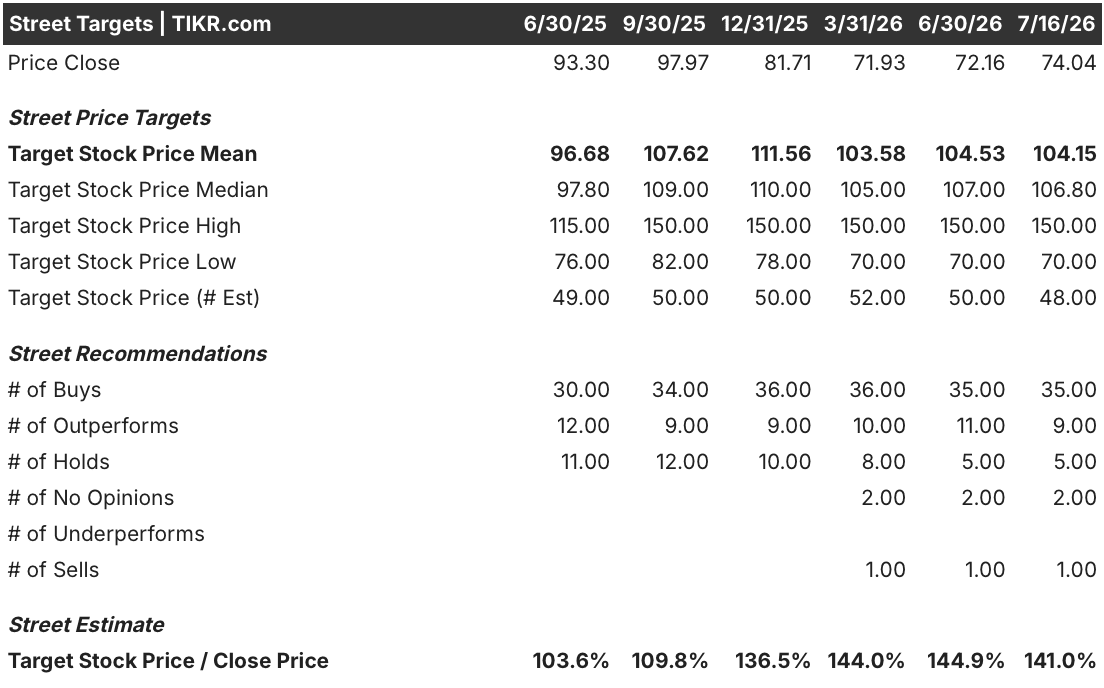
Wall Street holds 35 buy ratings and 9 outperform ratings on Uber stock against just 5 holds, 2 no-opinion ratings, and 1 sell, a lopsided split that has held steady since the start of the year. The mean target price sits at , with the median slightly higher at , implying roughly 41% upside from the current close. That target has actually drifted down slightly from in December 2025 even as Uber’s own operating numbers have improved, a divergence that leaves the rating count doing more of the bullish work than the price target itself.
Wall Street Expects Uber Stock’s EBITDA Margin to Reach 21% by Mid-2027

Uber’s EBITDA hit $2.48 billion in the quarter ended March 31, 2026, a result that beat Street estimates by 2% and pushed the margin to 19%, up 259 basis points from a year earlier. That acceleration is expected to continue.
By the June 2026 quarter, consensus models EBITDA climbing to $2.77 billion, a 31% year-over-year gain, with margins stepping up to 19%. The growth rate then decelerates gradually as the base gets larger.
Looking out to June 2027, the Street models EBITDA reaching $3.37 billion at a 21% margin, even as the year-over-year growth rate cools to 22% from the 35% pace Uber posted back in mid-2025. That deceleration in growth alongside continued margin expansion is the tension sitting underneath Uber stock right now.
The open question is whether Delivery Hero’s integration, expected to close in the second half of 2027, arrives in time to reaccelerate that growth curve before the Street’s current deceleration assumptions get baked permanently into the model.
TIKR Values Uber Stock at $155.86, Pricing In Sustained Margin Expansion Through 2030
TIKR’s mid-case model values Uber Technologies at $156 by December 2030, implying a 111% total return from the current price of $74, or 18% annualized over the next 4.5 years.

That annualized return outpaces what most mature, large-cap platform companies deliver over a similar stretch, and it rests on operating compounding rather than a bet on multiple expansion.
The target lines up with dynamics already visible in Uber’s own forecast: EBITDA margins climbing from 18.8% to 20.6% through mid-2027, combined with the $1.2 billion in run-rate synergies Uber expects from the Delivery Hero integration. Both feed the same margin story the model is pricing, without requiring any credit for autonomous vehicle economics that Uber itself has called years away from materiality.
See the full 10-year return breakdown behind Uber stock’s $155.86 target on TIKR for free →
Should You Invest in Uber Technologies, Inc.?
The only way to really know is to look at the numbers yourself. TIKR gives you free access to the same institutional-quality financial data that professional analysts use to answer exactly that question.
Pull up Uber Technologies, Inc. stock and you’ll see years of historical financials, what Wall Street analysts expect for revenue and earnings in the quarters ahead, how valuation multiples have moved over time, and whether price targets are trending up or down.
You can build a free watchlist to track Uber Technologies, Inc. alongside every other stock on your radar. No credit card required. Just the data you need to decide for yourself.
Access Professional Tools to Analyze UBER stock on TIKR for Free →
Looking for New Opportunities?
- See what stocks billionaire investors are buying so you can follow the smart money.
- Analyze stocks in as little as 5 minutes with TIKR’s all-in-one, easy-to-use platform.
- The more rocks you overturn… the more opportunities you’ll uncover. Search 100K+ global stocks, global top investor holdings, and more with TIKR.
Disclaimer:
Please note that the articles on TIKR are not intended to serve as investment or financial advice from TIKR or our content team, nor are they recommendations to buy or sell any stocks. We create our content based on TIKR Terminal’s investment data and analysts’ estimates. Our analysis might not include recent company news or important updates. TIKR has no position in any stocks mentioned. Thank you for reading, and happy investing!


