Dan Ives, senior managing director at Yorkville Ives, told Yahoo Finance yesterday that the AI trade is not a dot-com style bubble:
“We’re only 15% through the spending” of a $4-5 trillion AI buildout, he said, adding that “this is a 1997 moment, not a 2000 bubble moment.”
The revenue side of the buildout supports him so far. Research firm Exponential View estimates AI revenue hit a $229 billion annualized run rate at the end of August, up 3.5x from a year earlier.
Ives made the call as conditions for growth stocks get a little tougher. The Federal Reserve raised rates on Sept. 16 for the first time since 2023, and the 10-year Treasury yield hit 5.22% last week, its highest level since 2007. Several IPOs have been postponed, and Anthropic’s hotly anticipated listing has reportedly slipped to November.
Investors who own the AI leaders need two answers: is Ives right, and what would prove him wrong?
Where the 1990s comparison holds
At this point, every investor already knows the parallels being drawn to the 1990s. Amazon (AMZN), Microsoft (MSFT), Alphabet (GOOGL) and Meta (META) were on track for roughly $725 billion of combined 2026 capital spending after their spring reports, up 77% from 2025. Alphabet, Amazon and Meta raised their outlooks again in July, and Wall Street models now put the group’s 2027 spending above $1 trillion.
Market gains are also concentrated in a handful of winners. Nvidia (NVDA), Broadcom (AVGO), Meta, Alphabet and Microsoft drive a large share of index returns, much as a small group of internet leaders did in 1999.
The Fed is also tightening into the boom, as it did then. Policymakers raised rates six times between June 1999 and May 2000, from 4.75% to 6.5%, and the Nasdaq peaked in March 2000.
However, today’s AI leaders are highly profitable businesses with real cash flows. Many 1999 darlings were profitless startups valued on clicks and eyeballs.
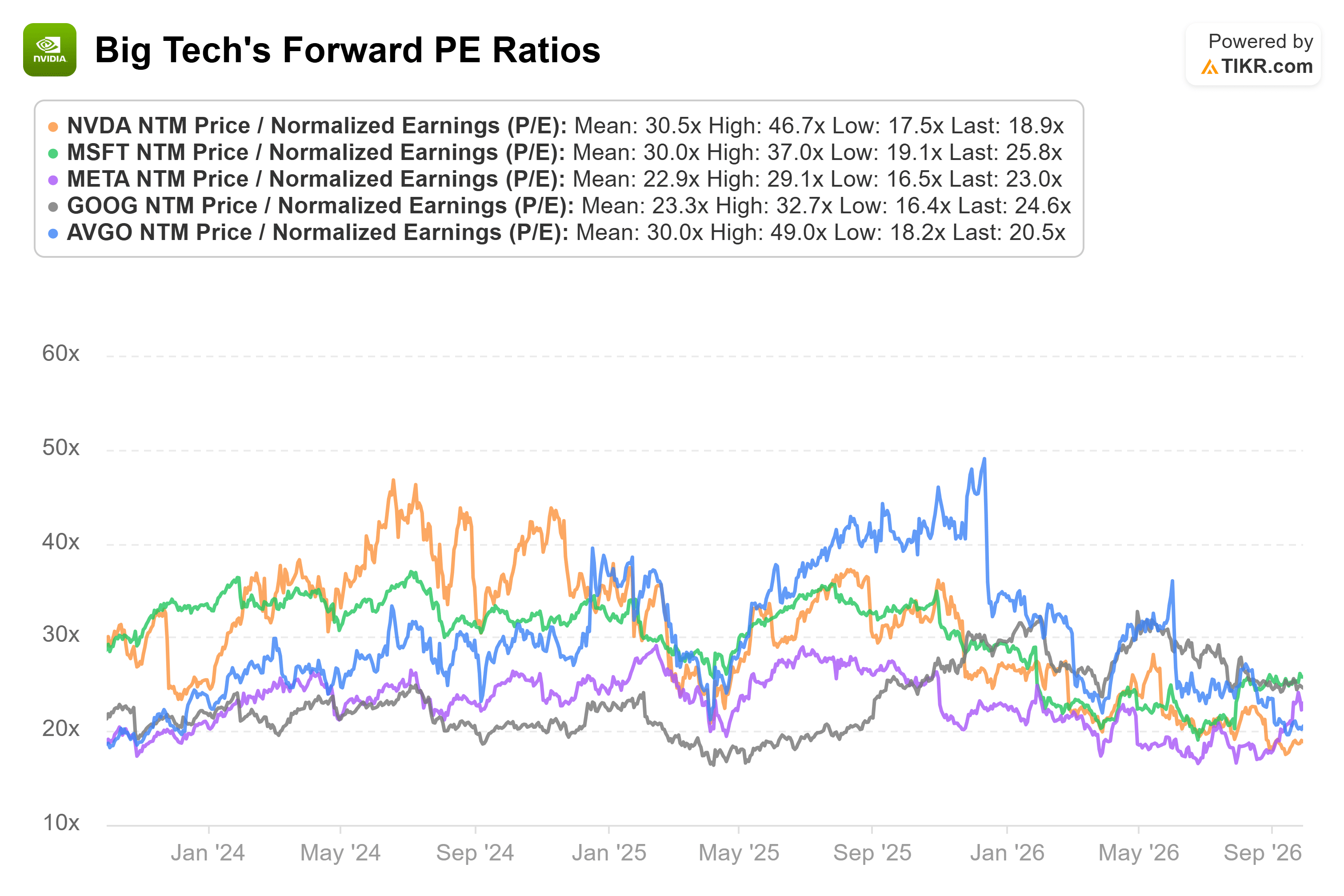
The chart above tracks next-twelve-month P/E ratios for Nvidia, Microsoft, Meta, Alphabet and Broadcom since late 2023, using TIKR data. The first thing that stands out is how much multiples have compressed, which means forward earnings have grown faster than share prices. Nvidia now trades at about 19x, well below its 30.5x average over the period, and Broadcom sits near 20.5x against a 30x average. Microsoft is below its average, while Meta and Alphabet trade roughly in line with theirs.
The second is that even the peaks stayed far from dot-com territory. Nvidia’s highest reading was 46.7x in mid-2024, and Broadcom topped out near 49x in late 2025. At its March 2000 peak, Cisco traded at well over 100x earnings.
Nvidia’s own board is acting on that valuation. On Sept. 28, the company added $150 billion to its buyback program, the largest repurchase authorization increase on record, bringing its remaining authorization to $235 billion. Buying back stock at about 19x forward earnings stands in sharp contrast to the late 1990s, when tech companies were busy issuing stock through IPOs, secondary offerings and stock-funded deals.
Investors are paying up for growth, but they are paying for earnings that mostly exist today, supported by strong balance sheets and high operating margins.

Ives is right on valuation: the AI leaders are priced on real profits. But a “1997 moment” still brings sharp drops (the Nasdaq fell nearly 30% in 1998), and bubble warnings will likely show up in earnings guidance, credit markets and IPOs before they show up in multiples.
3 signs the AI trade is turning into a bubble
1. Spending keeps rising while the payoff slows (Oct. 28 to Dec. 9)
Microsoft, Alphabet and Meta are expected to report on Oct. 28, followed by Amazon, Nvidia and Broadcom. The warning sign is 2027 capex guidance jumping again while cloud growth slows and the stocks rally anyway.
2. The buildout leans harder on debt as rates climb (Fed meetings Oct. 27-28 and Dec. 8-9)
The Fed meets twice more this year with the 10-year yield above 5%, just as hyperscalers borrow at a record pace (Goldman Sachs expects $420 billion in 2027). Watch for wider spreads on AI-related debt, now about 115 basis points versus 78 for the broader investment-grade market, and bond deals that struggle to find buyers.
3. The IPO market turns euphoric (Anthropic’s listing, expected in November)
Anthropic’s IPO, reportedly targeting a valuation of about $2 trillion, is the market’s next big sentiment test, and Ives also called a listing bullish for tech because it brings more transparency. A sharply raised price range, a huge first-day pop and a rush of copycat AI listings would echo 1999, when the average IPO jumped more than 70% on day one.
Bottom line
Today’s AI leaders are priced on real profits, and the setup still looks closer to the early innings of a long infrastructure cycle than to the euphoria of early 2000. That does not make the trade risk free. Concentration, rising rates and debt-funded spending can all produce sharp drawdowns.
Over the next 10 weeks, watch three things: whether spending keeps paying off at earnings, whether credit markets keep funding the buildout on good terms, and whether the Anthropic IPO is priced with discipline. If all three hold, the 1997 comparison stands. If two or more crack, investors should get more selective about which AI stocks they own.
So what are these AI companies actually worth?
TIKR lets you forecast the future price of any stock in less than a minute.
Just enter a few assumptions into TIKR’s valuation model and see what any of these big tech names could be worth. Start from Wall Street consensus estimates, or adjust the inputs to reflect your own view of the business.
It’s free to use. Value companies now!
Disclaimer
Please note that the articles on TIKR are not intended to serve as investment or financial advice from TIKR or our content team, nor are they recommendations to buy or sell any stocks. We create our content based on TIKR Terminal’s investment data and analysts’ estimates. Our analysis might not include recent company news or important updates. TIKR has no position in any of the stocks mentioned. Thank you for reading, and happy investing!