Key Takeaways
- McDonald’s just raised its dividend for the 50th straight year, while Starbucks’ latest increase was only $0.01 per share.
- Starbucks paid out 113% of its free cash flow in fiscal 2025, although falling capital spending has since brought its TTM cash dividend payout ratio down to 77%.
- McDonald’s TTM cash dividend payout ratio stands at a more comfortable 67%, although slowing U.S. traffic and roughly $8.5 billion of planned franchisee support create new demands on its cash.
- Starbucks’ CFO has emphasized dividend stability and “measured increases,” making future free cash flow growth especially important for shareholders.
McDonald’s (MCD) raised its quarterly dividend to $1.93 from $1.86 on Sept. 17, marking its 50th consecutive annual increase. The company called the achievement “a golden milestone,” pointing to “the resiliency of its cash flow.”
Starbucks (SBUX) has built an impressive dividend streak of its own, but maintaining it has become more difficult. Its 15th consecutive annual increase took the quarterly dividend from $0.61 to $0.62 in October 2025, following several years of much larger increases. CFO Cathy Smith has since said Starbucks will balance growth investments “with dividend stability” and use “measured increases” as it works toward its long-term payout target.
Both companies are still raising their dividends.
The bigger question for investors is which business can afford meaningful increases from here.
| Metric | Starbucks (SBUX) | McDonald’s (MCD) |
|---|---|---|
| Forward dividend yield | 2.7% | 3.3% |
| 5-yr dividend growth | about 6.6% a year | 7.3% a year |
| Streak | 15 straight annual raises | 50 straight years of raises |
| Cash dividend payout ratio, TTM | 77% | 67% |
| Cash dividend payout ratio, forward | 87% | 73% |
| Net debt ÷ EBITDA, TTM | 2.13x | 3.23x |
| Interest coverage, TTM | 7.2x | 7.8x |
Source: TIKR, prices at the Sept. 29, 2026 close; streaks from the companies’ own releases.
Starbucks is winning customers back
Starbucks’ Back to Starbucks turnaround is showing signs of progress.
Global comparable store sales increased 7.9% in fiscal Q3 2026, with transactions rising 4.2%. That marked the company’s fourth consecutive quarter of comparable-sales growth.
But rebuilding Starbucks has required significant investment. The company has announced roughly $1.7 billion of restructuring charges since September 2025, and in September it disclosed plans to close about 250 additional North American coffeehouses.
Those pressures arrived during a period when Starbucks’ dividend consumed more cash than the business generated.
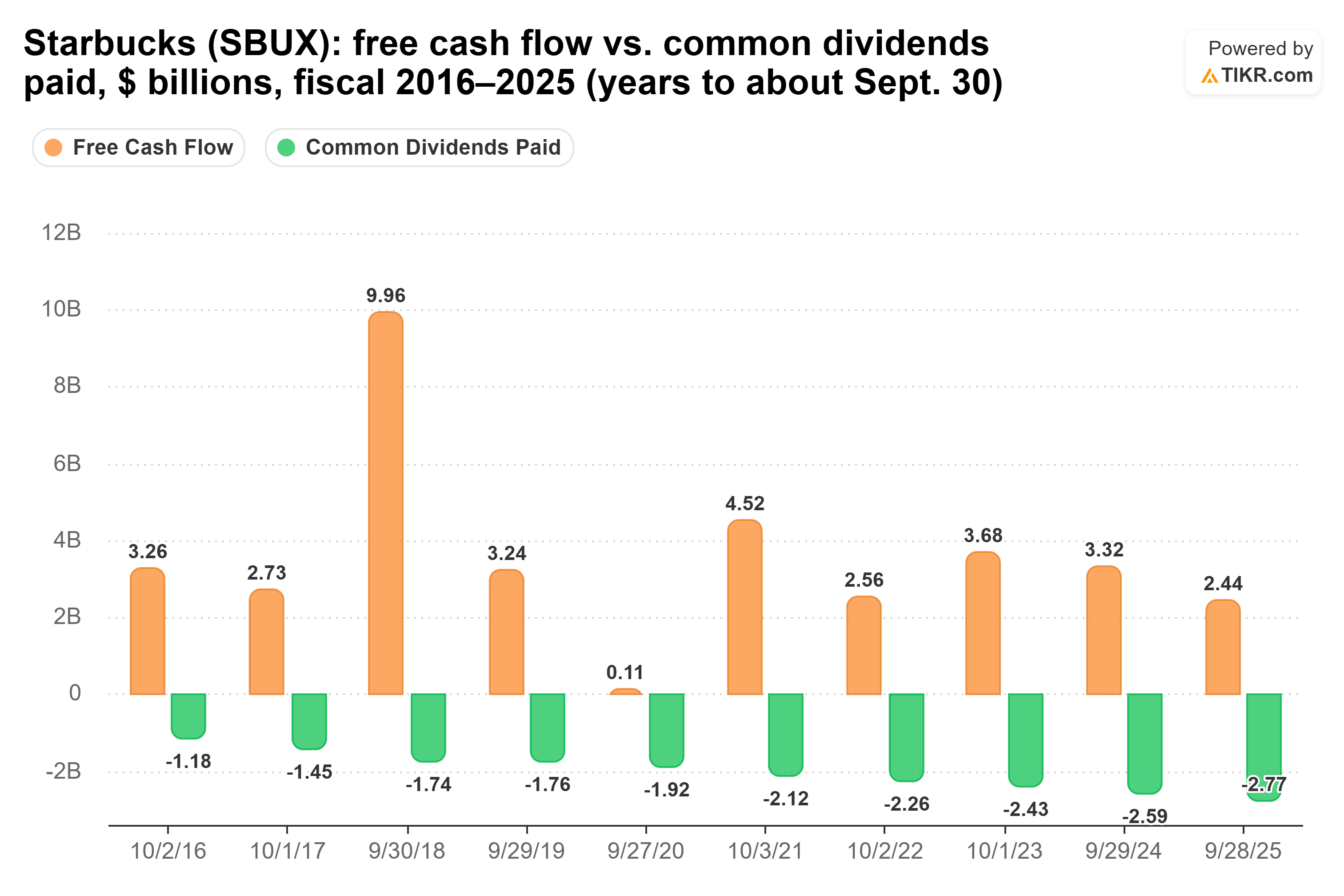
Starbucks paid $2.77 billion of common dividends in fiscal 2025 against $2.44 billion of free cash flow.
That means the company returned approximately 113% of its free cash flow through dividends.
It was also the second time in six years that free cash flow failed to cover the dividend. The other was fiscal 2020. Fiscal 2018’s unusually large free cash flow figure includes Nestlé’s $7.15 billion upfront payment associated with Starbucks’ packaged-coffee partnership.
The good news is that Starbucks’ cash generation is recovering.
Capital expenditures fell to about $888 million during the first nine months of fiscal 2026, down from $1.85 billion a year earlier. Starbucks also shifted its China business into a joint venture and has begun replacing expensive store remodels with smaller “Uplifts” that COO Mike Grams said cost roughly $150,000 each.
Analysts currently expect approximately $3.26 billion of fiscal 2026 free cash flow, up 33% from fiscal 2025.
That improvement has brought Starbucks’ TTM cash dividend payout ratio down to 77%.
Still, the forward payout ratio stands at roughly 87%, leaving less room for aggressive dividend increases while management continues investing in the turnaround and reducing debt.
McDonald’s lives on rent and royalties
McDonald’s dividend is supported by a very different business model.
Around 95% of McDonald’s restaurants are franchised. In 2025, the company generated $10.44 billion of rent revenue and $6.02 billion of royalties, totaling roughly $16.46 billion, or more than 60% of company revenue.
That asset-light structure has historically produced dependable free cash flow.
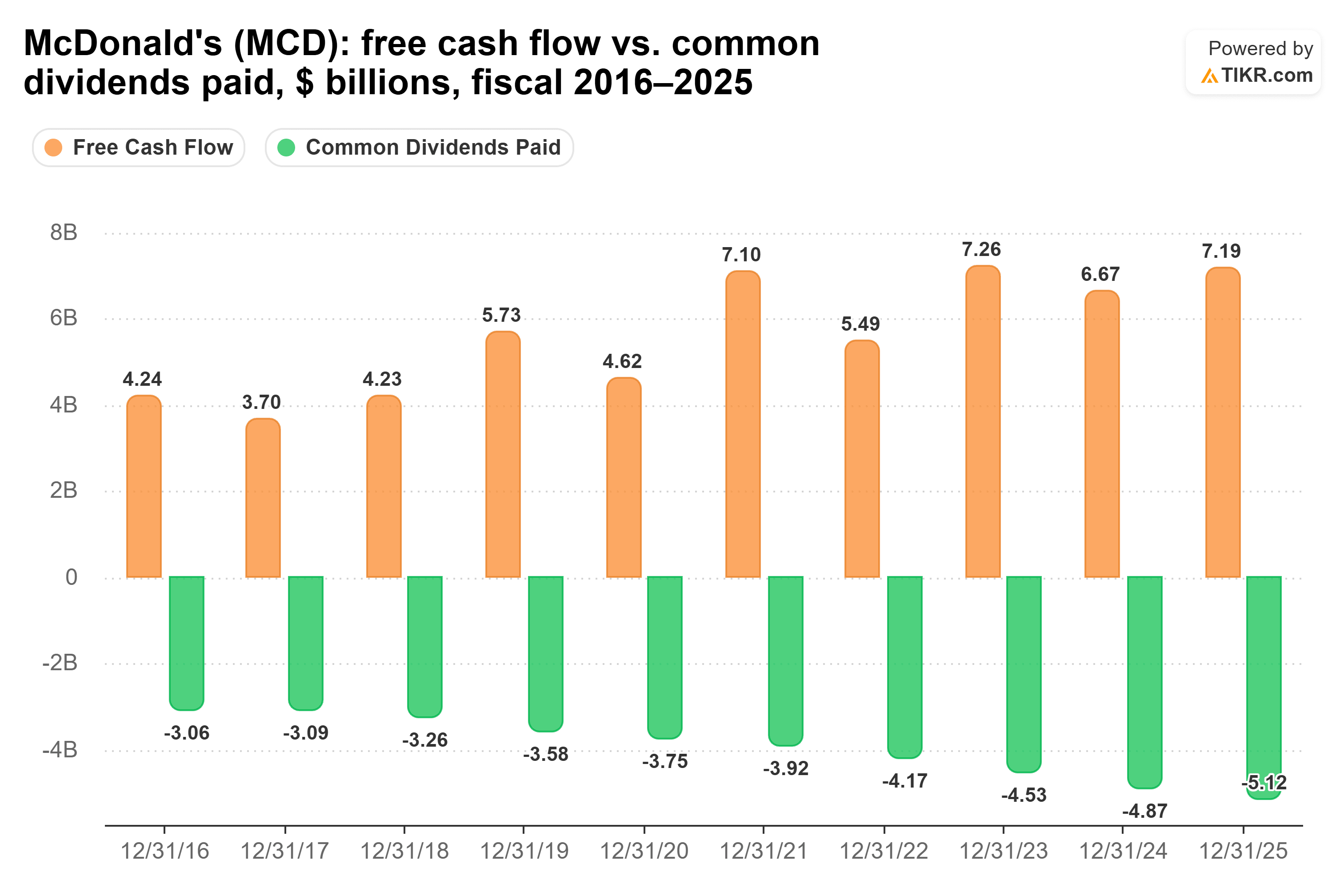
Free cash flow covered McDonald’s dividend in every year shown in the 10-year chart.
In 2025, McDonald’s produced $7.19 billion of free cash flow while paying $5.12 billion in dividends.
That works out to a 71% cash dividend payout ratio, leaving roughly $2.07 billion of free cash flow after dividends.
Its payout ratio remains comfortable today at 67% TTM and approximately 73% on forward estimates.
McDonald’s also repurchased $2.33 billion of stock over the last 12 months, illustrating the additional flexibility its cash generation provides.
The underlying business is not without challenges.
U.S. comparable sales increased only 0.8% in Q2 2026, with fewer guests visiting restaurants. Management attributed roughly two-thirds of the traffic shortfall to the execution of a value relaunch that was offered by only about 60% to 65% of restaurants.
CEO Chris Kempczinski acknowledged the execution problem directly saying “We don’t have a strategy problem. We simply didn’t execute at the level we needed to in the second quarter.”
McDonald’s has also committed approximately $8.5 billion of franchisee support through 2036, adding another long-term use of cash.
So which dividend wins?
McDonald’s is the better dividend stock today.
For investors focused on dividend strength, coverage, and the ability to fund meaningful increases, McDonald’s has the advantage over Starbucks right now.
McDonald’s paid out roughly 71% of its free cash flow last year and still had about $2 billion remaining after dividends. Its current payout ratios also leave more room for future increases, at 67% TTM and 73% forward, compared with 77% and 87% for Starbucks.
That extra cushion gives McDonald’s more flexibility to raise its dividend, reinvest in the business, support franchisees, and still return additional cash to shareholders.
Starbucks’ dividend does not appear to be in immediate trouble. Its cash generation has improved as capital expenditures have fallen, free cash flow has recovered, and customer trends have strengthened. Starbucks also carries less net debt relative to EBITDA than McDonald’s.
But management has made its near-term priorities clear. At its 2026 Investor Day, CFO Cathy Smith said Starbucks plans to balance growth investments with dividend stability, use measured increases, and prioritize deleveraging over share repurchases.
McDonald’s is the stronger dividend stock today, while Starbucks remains the turnaround story with more work to do before it can support similarly meaningful dividend growth.
The bigger question for Starbucks shareholders is how quickly its turnaround can expand free cash flow enough to close that gap.
Starbucks could make its next dividend decision around its Oct. 29 fiscal Q4 report. If it does, investors will get another indication of just how “measured” those increases will be.
So what is McDonald’s stock actually worth?
TIKR lets you forecast the future price of any stock in less than a minute. Just enter a few assumptions into TIKR’s valuation model and see what McDonald’s could be worth. Start from Wall Street consensus estimates, or adjust the inputs to reflect your own view of the business. It’s free to use.
Disclaimer:
Please note that the articles on TIKR are not intended to serve as investment or financial advice from TIKR or our content team, nor are they recommendations to buy or sell any stocks. We create our content based on TIKR Terminal’s investment data and analysts’ estimates. Our analysis might not include recent company news or important updates. TIKR has no position in any of the stocks mentioned. Thank you for reading, and happy investing!