


Key Takeaways:
- Agentic Commerce Push: Shopify is positioning its platform for agent-driven shopping flows after management highlighted multi-year investments in catalog, payments, and merchant tools, following a 9% stock decline tied to AI competition concerns in early February.
- Earnings Catalyst Ahead: Shopify will report fourth-quarter and full-year 2025 results on February 11, an event that resets expectations after LTM revenue reached $11 billion and operating margins expanded to 16%.
- Price Framework: Based on 26% revenue growth, 18% operating margins, and a 66x exit multiple, Shopify stock could reach $139 by late 2027 as profitability scales.
- Return Math: From the current $112 price, the model implies 24% total upside, equating to a 12% annualized return over roughly 2 years.
Shopify Inc. (SHOP) provides a commerce platform that generates revenue from subscriptions and merchant solutions, enabling millions of businesses across 175 countries to sell online, in-store, and through digital channels.
The company serves small businesses and enterprises, and its scale matters as global e-commerce penetration rises, with LTM revenue of $11 billion reflecting sustained demand for integrated commerce infrastructure.
Financially, Shopify’s revenue of $11 billion produced gross profit of $5 billion, while operating expenses of $4 billion supported operating income of $2 billion and a 16% operating margin, marking a sharp recovery from losses in 2022.
Management has emphasized execution discipline and product readiness for AI-driven commerce, with CFO Jeff Hoffmeister at 53rd Annual Nasdaq Investor Conference stating, “we can continue to be disciplined on headcount and continue to deliver on the top line,” referencing more than 2 years without headcount growth.
Currently, Shopify stock trades at $112 with a modeled 66x exit multiple while operating margins sit near 16%, raising debate over whether current pricing already reflects sustained margin expansion and execution through 2027.
What the Model Says for SHOP Stock
Shopify stock’s improving operating discipline and platform scale elevate expectations, despite capital intensity constraining near-term margins at 18.3%.
Still, the model assumes 26.2% revenue growth, 18.3% margins, and a 66.3x exit multiple, producing a $138.89 target.
The modeled 23.9% total upside and 12.0% annualized return modestly exceed opportunity costs for equity risk.
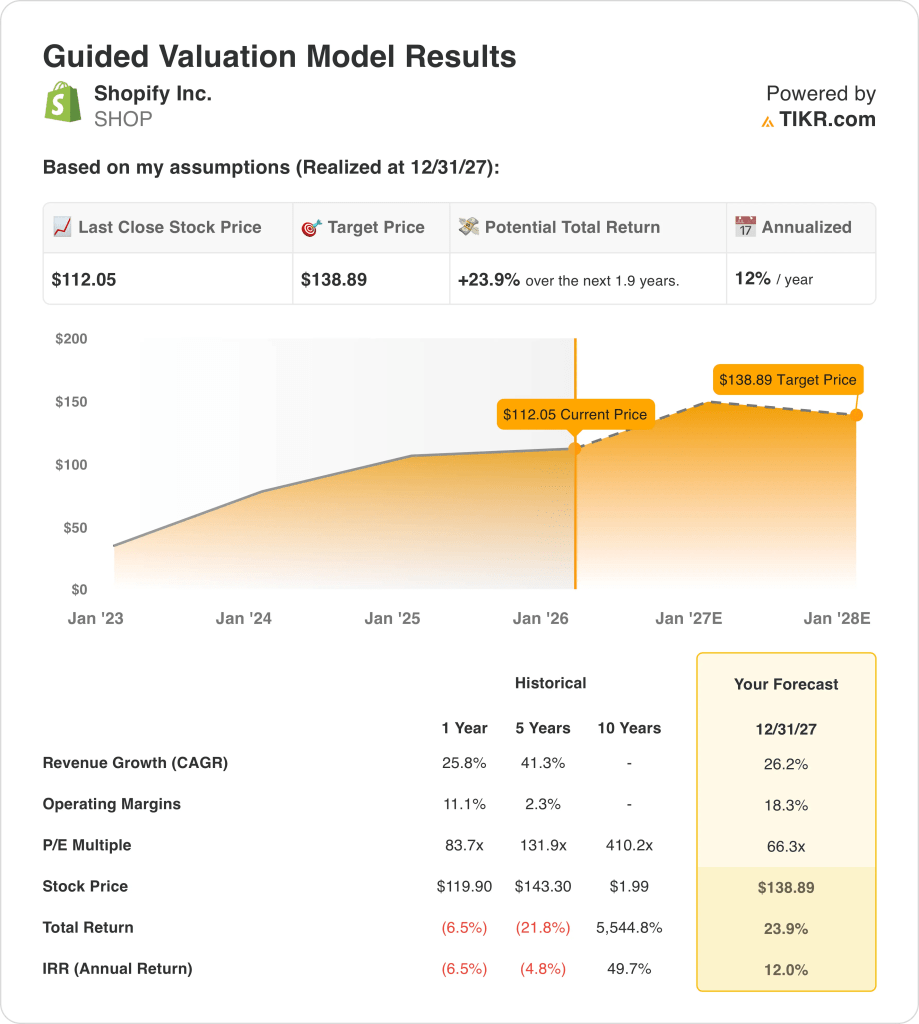
With these, the model signals a Buy, as a 12.0% annualized return compensates for execution risk.
A modeled 12.0% annualized return exceeds a typical 10% equity hurdle, compensates execution risk, favors capital appreciation over preservation, and justifies a Buy under disciplined valuation logic.
Our Valuation Assumptions
TIKR’s Valuation Model lets you plug in your own assumptions for a company’s revenue growth, operating margins, and P/E multiple, and calculates the stock’s expected returns.
Here’s what we used for Shopify stock:
1. Revenue Growth: 26.2%
Shopify’s revenue base expanded 25.8% over the last year, supported by merchant additions, enterprise wins, and rising payments penetration across core geographies.
Current execution reflects sustained GMV growth, steady merchant cohort expansion, and increased contribution from merchant solutions, supporting a forward 26.2% revenue growth assumption.
Achieving this path requires continued enterprise adoption, stable consumer demand, and no material slowdown in merchant acquisition or cross-sell momentum.
The 26.2% revenue growth assumption is in line with the 1-year historical rate of 25.8%, indicating durable growth rather than acceleration.
2. Operating Margins: 18.3%
With operating margins averaging 11.1% over the last year, Shopify stock reflects disciplined cost control following workforce reductions and tighter expense management.
Recent performance shows operating income expansion driven by flat headcount, improving gross profit mix, and scaling merchant solutions, supporting an 18.3% margin outlook.
Margin expansion depends on sustained revenue growth, limited reinvestment creep, and no reacceleration in sales and marketing or platform infrastructure spending.
Based on street consensus estimates, slower revenue growth or renewed cost pressure would compress margins quickly, reducing earnings power and eroding return expectations.
This is above the 1-year historical operating margin of 11.1%, indicating the model assumes meaningful efficiency gains rather than steady reinvestment.
3. Exit P/E Multiple: 66.3x
Shopify stock’s valuation has normalized from elevated levels as profitability improved, with the stock trading at 83.7× trailing earnings over the last year.
The 66.3× exit multiple reflects capitalizing higher earnings durability while recognizing slower growth and reduced multiple expansion compared to earlier cycles.
This multiple assumes margins stabilize near 18.3% and revenue growth moderates toward 26.2%, without requiring renewed sentiment-driven re-rating.
Per compiled analyst estimates, any margin or growth shortfall would drive multiple compression rather than upside expansion, making valuation sensitive to execution slippage.
Additionally, this is below the 1-year historical P/E of 83.7×, which says that the model assumes valuation compression alongside maturing growth and profitability.
What Happens If Things Go Better or Worse?
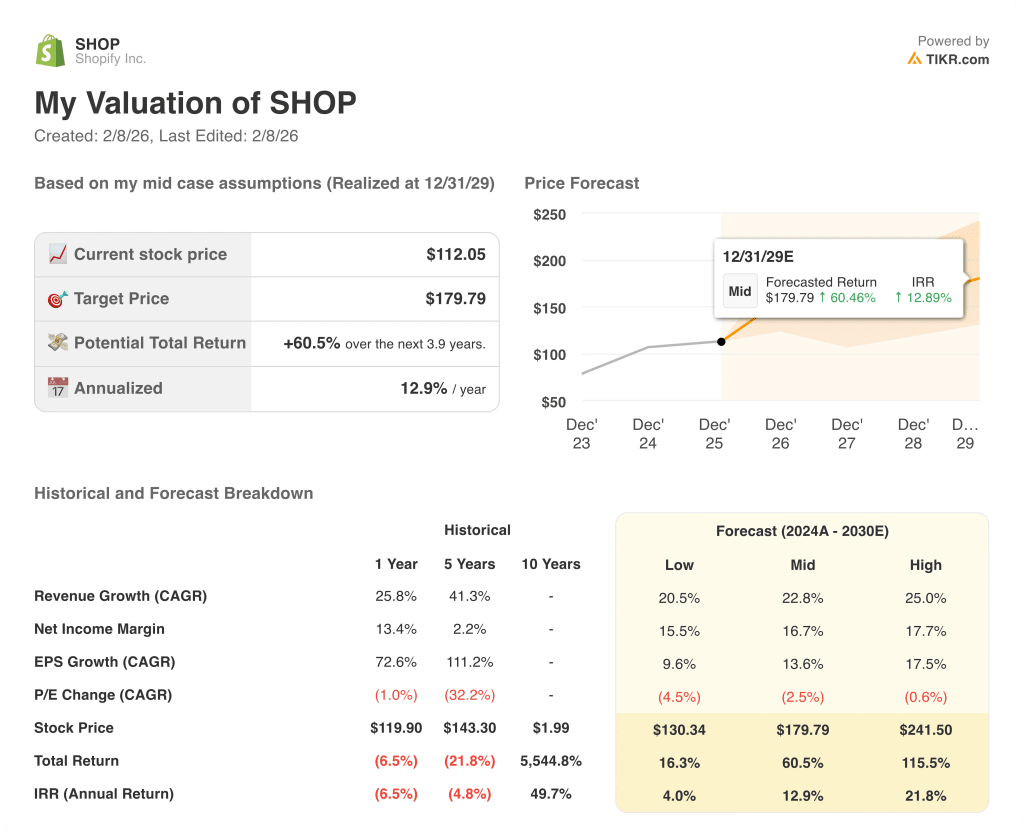
Shopify stock outcomes depend on merchant growth, payments penetration, and cost discipline, setting up a range of possible paths through 2029.
- Low Case: If consumer demand softens and enterprise adoption slows, revenue grows near 20.5% and margins hold around 15.5% → 4.0% annualized return.
- Mid Case: With merchant additions and payments penetration progressing steadily, revenue growth near 22.8% and margins improving toward 16.7% → 12.9% annualized return.
- High Case: If enterprise wins accelerate and cost discipline holds, revenue reaches 25.0% and margins approach 17.7% → 21.8% annualized return.
How Much Upside Does Shopify Stock Have From Here?
With TIKR’s new Valuation Model tool, you can estimate a stock’s potential share price in under a minute.
All it takes is three simple inputs:
- Revenue Growth
- Operating Margins
- Exit P/E multiple
If you’re not sure what to enter, TIKR automatically fills in each input using analysts’ consensus estimates, giving you a quick, reliable starting point.
From there, TIKR calculates the potential share price and total returns under Bull, Base, and Bear scenarios so you can quickly see whether a stock looks undervalued or overvalued.
Looking for New Opportunities?
- See what stocks billionaire investors are buying so you can follow the smart money.
- Analyze stocks in as little as 5 minutes with TIKR’s all-in-one, easy-to-use platform.
- The more rocks you overturn… the more opportunities you’ll uncover. Search 100K+ global stocks, global top investor holdings, and more with TIKR.
Disclaimer:
Please note that the articles on TIKR are not intended to serve as investment or financial advice from TIKR or our content team, nor are they recommendations to buy or sell any stocks. We create our content based on TIKR Terminal’s investment data and analysts’ estimates. Our analysis might not include recent company news or important updates. TIKR has no position in any stocks mentioned. Thank you for reading, and happy investing!


