Key Stats for RTX Stock
- Current Price: $223.25
- Target Price (Mid): ~$238
- Street Target: ~$232
- Potential Total Return: ~7%
- Annualized IRR: ~1% / year
Now Live: Discover how much upside your favorite stocks could have using TIKR’s new Valuation Model (It’s free) >>>
What Happened?
RTX Corporation (RTX) closed August 6, 2026, at $223.25, about a percent below its 52-week high and up roughly 44% over the past year. The aerospace and defense giant behind Pratt & Whitney engines, Collins Aerospace avionics, and Raytheon missiles gave investors every reason for the run. Its July 23 report beat on every line, guidance went up across the board, and the backlog hit a record. The uncomfortable part is what follows a move like that: the reasons to own RTX are now widely known, the stock has already repriced for them, and the multiple sits well above where defense peers trade.
That is the honest tension today. The business is executing, but the entry price has moved a long way in twelve months. A buyer needs to know how much good news is already in the stock, and what still has to go right to earn a return from here.
A Beat That Sent Guidance Up Across the Board
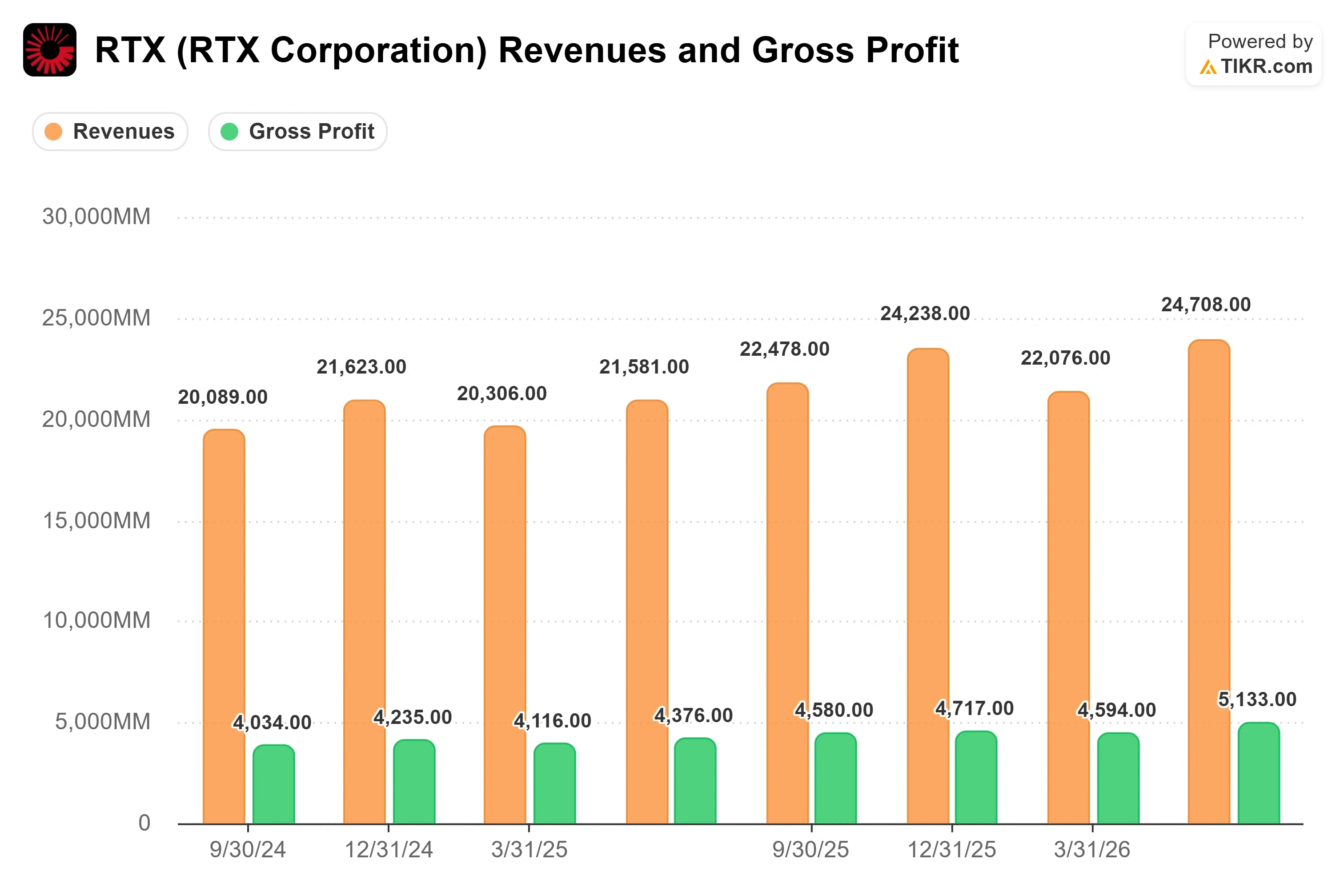
The quarter was strong on its own terms. RTX reported adjusted revenue of $24,708 million, up 14% on an adjusted basis and 16% organically, with adjusted EPS of $1.89, up 21% year over year. Revenue beat consensus by about 8% and adjusted EPS by about 14%, and free cash flow came in at $2,878 million. All three channels grew, with commercial aftermarket up 18%, defense up 16%, and commercial original equipment up 9%.
Management then raised the full-year outlook, lifting adjusted sales guidance to $95 billion to $96 billion from $92.5 billion to $93.5 billion and pushing organic growth to 8% to 9% from a prior 5% to 6%. Adjusted EPS guidance rose to $7.10 to $7.25, and free cash flow guidance moved to $8.5 billion to $8.75 billion.
The number underpinning it all was the backlog, a record $289 billion, up 22% year over year, and split roughly $170 billion commercial and $119 billion defense. That balance is unusual for a defense prime and is a large part of why RTX carries a different valuation than a pure-play contractor. CEO Chris Calio framed the demand backdrop directly: “We have strong conviction in the long-term demand across our commercial and defense markets, and we believe that RTX is exceptionally well positioned with leading franchises, a growing installed base, a record backlog and the scale to invest in capacity and technology.”
See historical and forward estimates for RTX stock (It’s free!) >>>
The Premium Is Real, and the Multiple Has Already Expanded
RTX trades at about 30 times NTM earnings and roughly 19.6 times NTM EV/EBITDA. Lockheed Martin trades near 18.9 times NTM earnings and Northrop Grumman near 19.4 times, according to TIKR’s competitor data, so RTX commands a premium of more than 50% to both on forward earnings.
The premium is not baseless. RTX earns part of it on the commercial side, where Pratt’s aftermarket and Collins’ content give it a growth profile most defense names lack. Commercial aftermarket grew 18% in the quarter, Pratt’s MRO output rose more than 40% year over year, and GTF aircraft-on-ground counts fell 25% in the first half. That recovery in Pratt’s most profitable revenue stream separates RTX from a company selling only into the Pentagon budget.
The real question is whether a buyer paying 30 times earnings is buying growth or a multiple that has already expanded to price it in. Over the past year, RTX’s P/E climbed at a 43% annual rate, showing how much of the recent return came from the market paying more for the same earnings rather than from earnings growth itself. Multiples that expand that fast rarely keep expanding.
Two recent catalysts feed the momentum but carry timing caveats. On August 3, 2026, Raytheon installed the first SPY-6(V)4 radar array at the Navy’s Wallops Island test site, a genuine long-term win whose testing runs through mid-2028 and so does not move near-term revenue. Separately, post-earnings target hikes (TD Cowen to $240, RBC to $250, Argus to $245) arrived even as several firms held ratings at Hold or Market Perform. The larger, less-priced lever is the five framework agreements RTX signed with the Department of War for munitions like Tomahawk, AMRAAM, and the Standard Missile family, which Calio noted “aren’t even in our backlog today” and are still being converted into definitive contracts.

See how RTX performs against its peers in TIKR (It’s free!) >>>
TIKR Advanced Model Analysis
- Current Price: $223.25
- Target Price (Mid): ~$238
- Potential Total Return: ~7%
- Annualized IRR: ~1% / year

See analysts’ growth forecasts and price targets for RTX stock (It’s free!) >>>
Two revenue drivers carry the case: defense, where the record backlog and framework agreements support a multiyear production ramp, and commercial aftermarket, where the GTF recovery and V2500 shop visits feed Pratt’s highest-margin revenue. The margin driver is Raytheon’s shift toward mature, high-volume, increasingly international programs, which management says supports expansion past the 12.6% posted this quarter. The primary risk is the multiple: the model assumes P/E compression of about 3% per year as the premium normalizes, and if that runs faster, the modest return disappears.
The upside is that framework agreements convert, defense margins keep climbing, and the aftermarket holds, lifting the stock toward the model’s high-case scenario well above the mid-case target. The downside is that the premium unwinds while second-half growth decelerates as guided, from 13% organic in the first half toward roughly 5% in the second, leaving a buyer at today’s price waiting years for earnings to grow into the multiple.
Conclusion
The business is not the problem. The price is the question. RTX is executing across all three segments, and the backlog gives it visibility that most companies never have. But at 30 times forward earnings and a 50%-plus premium to its closest peers, much of that is already paid for. The near-term test is the next quarterly report, due around late October: watch whether the guided second-half deceleration to roughly 5% organic growth lands as management framed it, and whether Raytheon margins hold in the mid-12% range. If growth slows while the premium compresses, the model’s thin 1% annual return is the warning. A buyer here is betting the framework agreements convert into backlog before the multiple normalizes. That is a reasonable bet, but no longer a cheap one.
See what stocks billionaire investors are buying so you can follow the smart money with TIKR.
Should You Invest in RTX?
The only way to really know is to look at the numbers yourself. TIKR gives you free access to the same institutional-quality financial data that professional analysts use to answer exactly that question.
Pull up RTX, and you’ll see years of historical financials, what Wall Street analysts expect for revenue and earnings in the quarters ahead, how valuation multiples have moved over time, and whether price targets are trending up or down.
You can build a free watchlist to track RTX alongside every other stock on your radar. No credit card required. Just the data you need to decide for yourself.
Looking for New Opportunities?
- See what stocks billionaire investors are buying so you can follow the smart money.
- Analyze stocks in as little as 5 minutes with TIKR’s all-in-one, easy-to-use platform.
- The more rocks you overturn… the more opportunities you’ll uncover. Search 100K+ global stocks, global top investor holdings, and more with TIKR.
Disclaimer:
Please note that the articles on TIKR are not intended to serve as investment or financial advice from TIKR or our content team, nor are they recommendations to buy or sell any stocks. We create our content based on TIKR Terminal’s investment data and analysts’ estimates. Our analysis might not include recent company news or important updates. TIKR has no position in any stocks mentioned. Thank you for reading, and happy investing!