
Key Stats for Block Stock
- Current Price: $79.02
- Target Price (Mid): ~$200
- Street Target: ~$93
- Potential Total Return: ~154%
- Annualized IRR: ~23% / year
Now Live: Discover how much upside your favorite stocks could have using TIKR’s new Valuation Model (It’s free) >>>
What Happened?
Block (XYZ) walked into its Q2 2026 report on August 5 trading near a 52-week high, up close to 30% for the year, then did the one thing a stock at that altitude cannot afford to do: it beat, and it wasn’t enough. The company posted the most profitable quarter in its history, topped Wall Street on its headline numbers, and raised full-year guidance for the third straight quarter. Shares fell 6.15% the next session to close at $79.02.
Even after that drop, the stock holds a gain of about 21% in 2026 from its $65.09 close at the end of last year, so this was a single-session give-back from a high, not a reversal of the year. Nothing in the numbers broke. What broke was the assumption that a stock already priced for strong execution would reward more of it. The setup around the print was demanding, and that gap is why it is worth reading twice.
The Headline Beat the Stock Had Already Bought
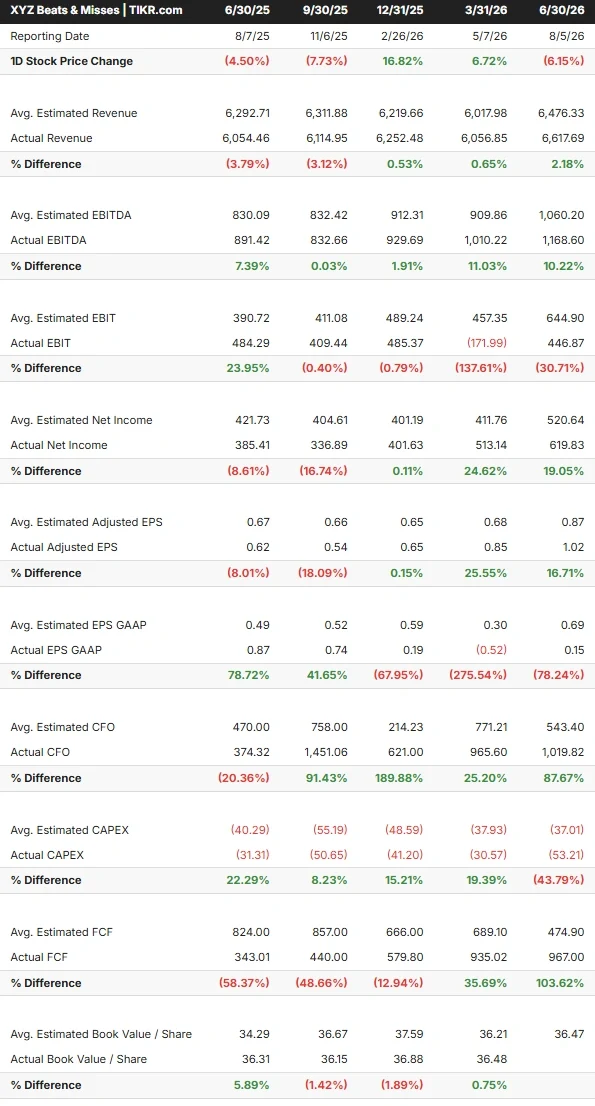
The operating results were not the problem. Block reported revenue of $6.62 billion against a Street estimate near $6.48 billion, adjusted diluted EPS of $1.02 versus $0.87 expected, and adjusted EBITDA of roughly $1.17 billion. Adjusted EPS grew 65% year over year, and the company hit an all-time high 27% adjusted operating income margin, the profitability proof point investors had waited all year to see. Management then raised full-year guidance to $12.51 billion in gross profit, up 21% year over year, with adjusted operating income of $3.47 billion at a 28% margin. CFO Amrita Ahuja put it plainly: “We outperformed our guidance and achieved record profitability in the second quarter.”
One caveat sits underneath the adjusted numbers. GAAP earnings were just $0.15 per share, dragged down by an $88.5 million unrealized loss on Block’s Bitcoin holdings and restructuring costs, so the “record profitability” headline is an adjusted-margin story, not a GAAP one. That gap is the bear’s standing objection, and it did not close this quarter.
The selloff itself traces to the guidance detail. Block guided third-quarter gross profit growth to around 18%, a step down from the 25% it just delivered, and Ahuja framed the Q4 exit rate as “mid-teens” growth. Two other lines gave a stretched stock something to flinch at: Bitcoin gross profit fell 31% to $72 million on deliberate Cash App fee cuts, per Block’s shareholder letter, and Cash App monthly actives grew only about 3% year over year, leaving engagement, not new users, to carry the consumer business. None of that is a crack in the business. It is a reason for a stock at highs to pause.
See historical and forward estimates for Block stock (It’s free!) >>>
The Products That Have to Carry the Back Half
The deceleration matters less if the newer engines are real, and this is where the quarter got interesting. Owen Jennings, Block’s Business Lead, gave the first hard numbers on Neighborhoods, the program that connects the Square seller base to Cash App consumers. Annualized seller GPV on the platform crossed $1 billion in June, up 220% year over year, and new sellers onboarding in July ran at eight times the March pace. “It feels like the early days of peer-to-peer,” Jennings said. For a company whose bear case is Square’s slow growth, a working bridge between its two ecosystems is the most important new variable on the board.
The banking build is the quieter lever. Block now lets sellers earn 3.5% APY on Square savings balances above $10,000, roughly eight times the national average, and Square Financial Services processed its first in-house acquiring transactions in June. Ahuja’s point is that cheap deposits eventually fund the lending book at a lower cost of capital, turning lending growth that dilutes margins into growth that compounds them.
The reason the whole model ships faster is AI. Block put out 130 Square features in the first half of 2026, more than three times the year-earlier pace, and CEO Jack Dorsey said, “AI is involved in basically every single production code change or production code review.” After the early-2026 layoffs cut 40% of the workforce, that velocity is management’s proof that the leaner company builds more, not less.
What the Regulatory Picture Actually Looks Like Now
One overhang that dogged Block through the spring has changed shape rather than lifted. In July, the company reached a $45 million settlement with 46 states over allegations it misled Cash App users about fraud protection, claims Block denied, and the SEC ended its own investigation in March with no enforcement action. But the open federal Department of Justice matter, tied to a 2023 short-seller report, is getting more expensive: Block’s Q2 10-Q raised the accrued loss estimate to $526 million, up from $240 million in Q1, and says it is now negotiating whether the matter can be settled. Fewer probes are outstanding, but the one that remains carries more than double last quarter’s reserve, and Block warns the ultimate loss could exceed even that.
On valuation, Block trades at around 17 times next-twelve-month earnings and about 9 times NTM EV/EBITDA per TIKR. Against 65% adjusted EPS growth and a 70% full-year guide, that forward multiple is the crux of the argument.

See how Block performs against its peers in TIKR (It’s free!) >>>
TIKR Advanced Model Analysis
- Current Price: $79.02
- Target Price (Mid): ~$200
- Potential Total Return: ~154%
- Annualized IRR: ~23% / year
See analysts’ growth forecasts and price targets for Block stock (It’s free!) >>>
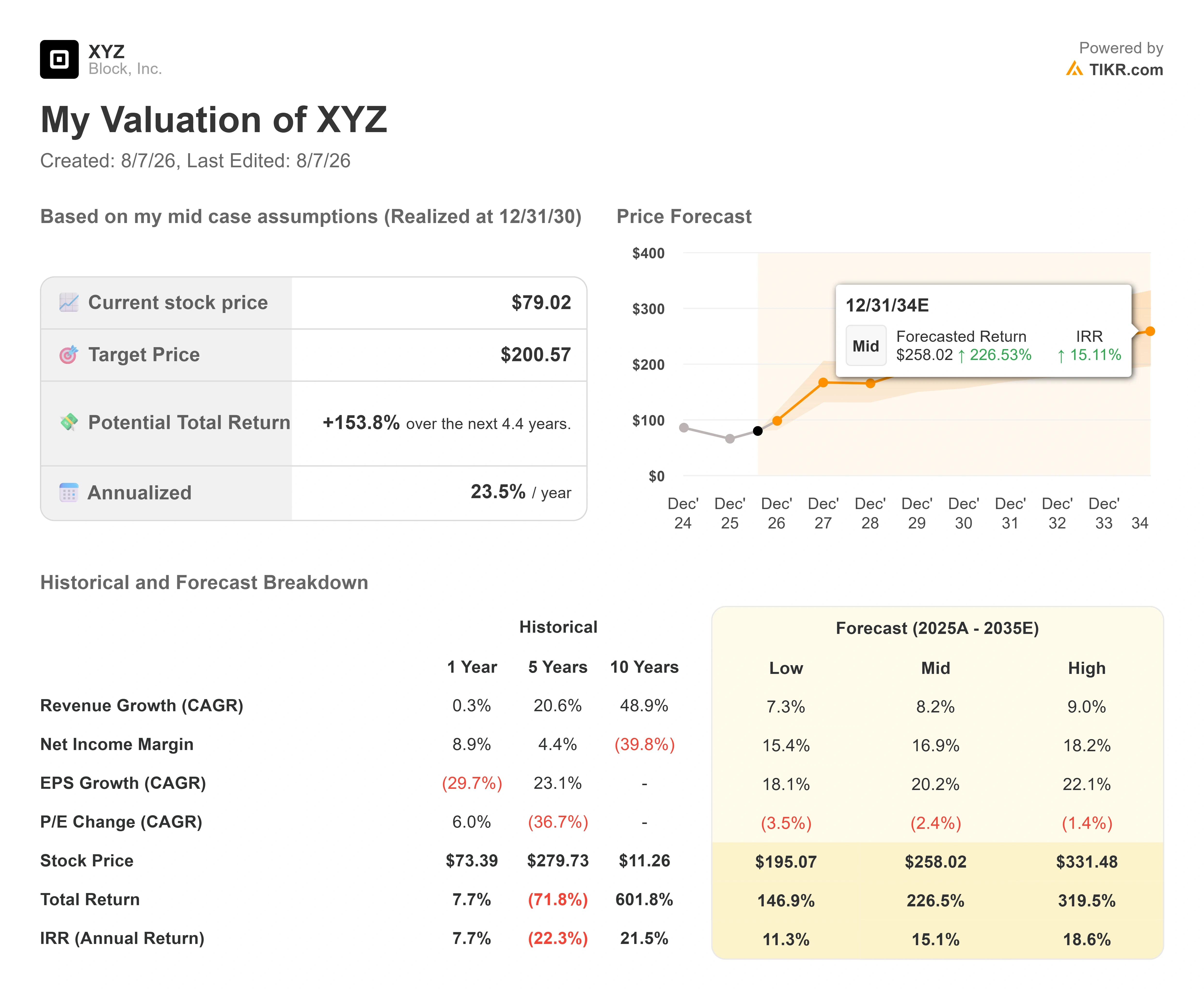
TIKR’s valuation model, on its mid-case assumptions, points to a target near $200 and a total return of roughly 154% over about four and a half years, an annualized return near 23%. That is a scenario built on stated assumptions, not a forecast of where the stock will trade.
The math leans on two revenue drivers: Cash App monetization deepening across lending, commerce, and banking, with Neighborhoods and the SFS deposit engine widening what the company can charge for, and a Square reacceleration, with GPV growth already back to 13% globally in Q2. The margin driver is the AI-led operating leverage that took adjusted operating margin to a record 27%. The primary risk is the back-half deceleration becoming a trend rather than a comp effect, especially if Cash App Borrow loss rates drift higher as the book matures.
The upside: a leaner Block compounds gross profit in the high teens while margins expand and the network products turn Square into a growth segment again. The downside: growth normalizes toward the mid-teens the model assumes, the DOJ matter resolves expensively, and a stock at highs digests its run. Wall Street’s mean target near $93 sits well below the model’s mid-case because the Street underwrites the next twelve months while the model underwrites five years.
Conclusion
The number that decides the next leg is Q3 gross profit growth, reported on November 3 after the close. Management guided to about 18%, so anything holding near that line with Neighborhoods GPV still inflecting reads as the deceleration being a comp story the market can look through. A print that slips toward the low-teens with no offset from the new products would confirm the bear case that the easy profitability gains are behind the company. November is when investors find out whether the leaner Block is still growing fast enough to justify a stock that has already run.
See what stocks billionaire investors are buying so you can follow the smart money with TIKR.
Should You Invest in Block?
The only way to really know is to look at the numbers yourself. TIKR gives you free access to the same institutional-quality financial data that professional analysts use to answer exactly that question.
Pull up Block, and you’ll see years of historical financials, what Wall Street analysts expect for revenue and earnings in the quarters ahead, how valuation multiples have moved over time, and whether price targets are trending up or down.
You can build a free watchlist to track Block alongside every other stock on your radar. No credit card required. Just the data you need to decide for yourself.
Looking for New Opportunities?
- See what stocks billionaire investors are buying so you can follow the smart money.
- Analyze stocks in as little as 5 minutes with TIKR’s all-in-one, easy-to-use platform.
- The more rocks you overturn… the more opportunities you’ll uncover. Search 100K+ global stocks, global top investor holdings, and more with TIKR.
Disclaimer:
Please note that the articles on TIKR are not intended to serve as investment or financial advice from TIKR or our content team, nor are they recommendations to buy or sell any stocks. We create our content based on TIKR Terminal’s investment data and analysts’ estimates. Our analysis might not include recent company news or important updates. TIKR has no position in any stocks mentioned. Thank you for reading, and happy investing!