Key Takeaways for ResMed Stock as of August 2026
- Top and Bottom Line Beat: RMD posted $1.46 billion in Q4 revenue, up 9% YoY and 0.22% above the $1.46 billion Street estimate, while adjusted EPS of $2.95 topped the $2.89 estimate by 2% and grew 16% YoY.
- First-Ever Guide Undercuts True Growth: Management issued RMD’s first formal annual guidance, projecting FY27 core revenue growth of 5%-7% and non-GAAP EPS of $12-$12.25, though core EPS growth actually runs ~12%-14% once ~$0.30 of MatrixCare divestiture dilution and ~$0.20 of Noctrix dilution get excluded.
- Margin Engine Keeps Humming: Non-GAAP gross margin hit 62.3% in Q4, up 90bps YoY, pushing EBITDA to $584.23M and a 39.92% margin, 144bps better than a year ago.
- Astral Drag Quantified: CFO Aaron Bloomer pegged underlying growth at “north of 6% to north of 8%” excluding Astral.
ResMed’s real fiscal 2027 growth story is buried under a self-imposed Astral pause. Dig into the full guidance breakdown on TIKR for free →
ResMed Trades Near-Term Astral Pain for Long-Term Sleep Health Growth

ResMed (RMD) closed fiscal 2026 with fourth-quarter revenue of $1,463.65 million, up 9% on a headline basis and edging past the Street’s $1,460.39 million estimate, while non-GAAP earnings per share climbed 16% year over year to $2.95, itself a beat against the $2.89 estimate. Full-year revenue grew 10% headline and operating margin expanded 180 basis points, funding $1.6 billion in free cash flow. But the number that mattered most on the August 6 call arrived later: RMD stock’s first-ever annual guidance, and it comes wrapped around a business deliberately holding one of its own product lines back.
CFO Aaron Bloomer framed that tension directly on the Q4 earnings call: “So overall, we’re guiding to 5% to 7%. And importantly, that includes a pretty material headwind that we’re seeing from the action that we’re taking to focus on patients with Astral. And so if you back out that impact, kind of the underlying core growth of the business is north of 6% to north of 8%.” That headwind traces to a field safety corrective action on the Astral ventilator line, which triggered a $42 million provision in the quarter and will keep ResMed from selling any new Astral units through all of fiscal 2027, a roughly $75 million, or 130 basis point, drag on revenue worth about $0.15 of earnings per share.
Management is reshaping the rest of the portfolio around that gap. ResMed closed its acquisition of Noctrix, maker of the RLS (restless legs syndrome) device Nidra, on June 1, and announced the divestiture of its MatrixCare software business on July 7, a unit that generated $220 million in revenue and $58 million in non-GAAP operating profit during fiscal 2026. Proceeds are funding a $450 million accelerated share repurchase, part of a $1.5 billion buyback plan that, combined with a dividend raised 10% to $0.66 per share, will return over $1.85 billion to shareholders in fiscal 2027, up more than 75% year over year.
Underneath the portfolio churn, the demand funnel keeps widening. Across a cohort of 2.5 million de-identified patients, those on both PAP therapy and GLP-1 prescriptions were 11% more likely to start PAP than patients on PAP alone, and 6% more likely to still be resupplying at three years, evidence that GLP-1 adoption is filling ResMed’s funnel rather than emptying it.
TIKR just quantified ResMed’s Astral field action at $75 million and $0.15 of EPS for fiscal 2027. See the full breakdown on TIKR for free →
TIKR Prices RMD Stock at $345, Betting on Volume Over Astral Noise
TIKR’s mid-case model values ResMed stock at $345 by mid-2031, implying a 55% total return from the current price of $223, or 9% annualized over roughly five years.
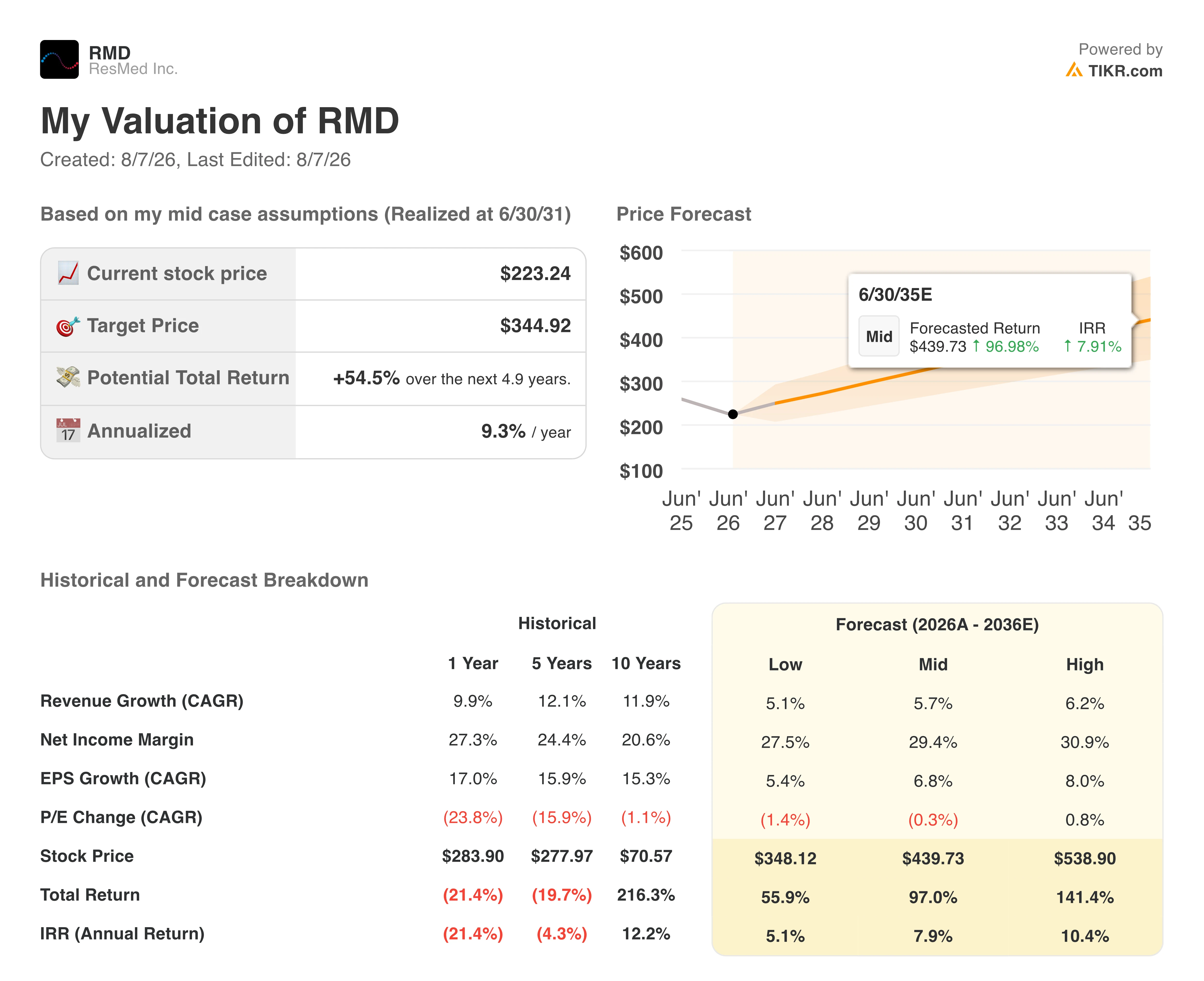
That annualized pace sits well above what a mature medical device name typically hands buy-and-hold investors, positioning RMD stock as a volume-driven compounder rather than a bet on multiple expansion.
The target rests on units, not re-rating. GLP-1 and wearable-driven demand keeps ResMed’s funnel full while the Astral suspension unwinds and MatrixCare proceeds fund faster buybacks, and management’s own 12% to 14% core EPS growth guide already points toward that trajectory without any help from a higher multiple.
TIKR’s model puts RMD stock’s target at $345, a 55% return by 2031. Explore the full valuation model on TIKR for free →
Should You Invest in ResMed Inc.?
The only way to really know is to look at the numbers yourself. TIKR gives you free access to the same institutional-quality financial data that professional analysts use to answer exactly that question.
Pull up ResMed Inc. stock and you’ll see years of historical financials, what Wall Street analysts expect for revenue and earnings in the quarters ahead, how valuation multiples have moved over time, and whether price targets are trending up or down.
You can build a free watchlist to track ResMed Inc. alongside every other stock on your radar. No credit card required. Just the data you need to decide for yourself.
Access Professional Tools to Analyze RMD stock on TIKR for Free →
Looking for New Opportunities?
- See what stocks billionaire investors are buying so you can follow the smart money.
- Analyze stocks in as little as 5 minutes with TIKR’s all-in-one, easy-to-use platform.
- The more rocks you overturn… the more opportunities you’ll uncover. Search 100K+ global stocks, global top investor holdings, and more with TIKR.
Disclaimer:
Please note that the articles on TIKR are not intended to serve as investment or financial advice from TIKR or our content team, nor are they recommendations to buy or sell any stocks. We create our content based on TIKR Terminal’s investment data and analysts’ estimates. Our analysis might not include recent company news or important updates. TIKR has no position in any stocks mentioned. Thank you for reading, and happy investing!