
Key Stats for Dell Stock
- Current Price: $462.70
- Target Price (Mid): ~$630
- Street Target: ~$500
- Potential Total Return: ~36% (over ~4.5 years)
- Annualized Return: ~7% / year
Now Live: Discover how much upside your favorite stocks could have using TIKR’s new Valuation Model (It’s free) >>>
What Happened?
Dell Technologies (DELL) closed at $462.70 on August 5, one session after setting an all-time closing high of $467.27 that capped an 8.92% single-day jump. Anyone searching the stock now is asking the uncomfortable version of a good question: the easy money looks gone, so is any left? Shares are up more than 260% year to date, and the record was not empty momentum. On August 4, Dell was named the technology provider on a new $10 billion AI-factory deal, and the broader AI hardware tape rallied hard the same day.
That combination is the tension. Three weeks earlier, the stock fell to roughly $405 on memory-pricing fears, and on June 25, a bank cut it to Hold on valuation after a 200% run. Dell did not just survive both scares. It set a new closing high backed by a real contract win. Buyers today are paying a record price for a business whose demand story keeps getting louder, which makes the valuation question harder, not easier.
The Record Came With a Real Deal Behind It
The August 4 catalyst was concrete. AI cloud startup Volta emerged from stealth with a $10 billion partnership to build a 133-megawatt AI factory in Norway, naming Dell as the technology provider, with Michael Dell’s family office among the backers. It landed on a broad risk-on day for AI infrastructure, so sentiment amplified the move. But this was not the July pattern, when Dell rose several percent purely on a rival’s order news. This time, the company was in the headlines.
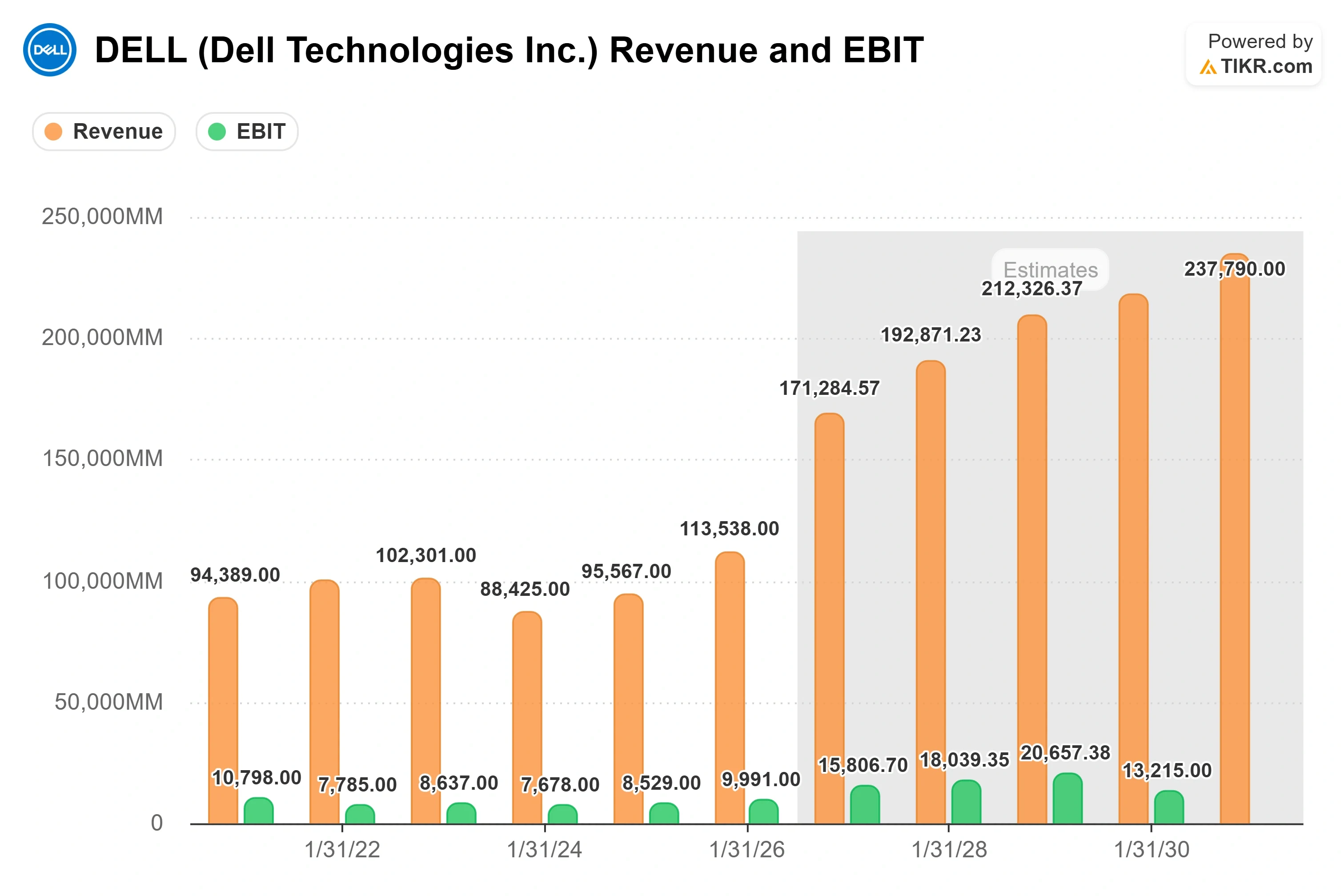
The earnings underneath are strong. Fiscal Q1 2027 revenue of $43,842 million rose 87.54% year over year and beat the Street by 22.58%, adjusted EPS of $4.86 beat by roughly 64%, and the stock gained 32.76% on that print. Management raised full-year revenue guidance toward a $167 billion level and now expects about $60 billion of AI server revenue. So the question a record price forces is not whether the business is good. It is whether the durability is priced.

See historical and forward estimates for Dell stock (It’s free!) >>>
What Makes the Demand Durable, and What Could Break It
At the Bank of America technology conference on June 2, Infrastructure Solutions Group head Arthur Lewis argued the runway outlasts any single AI cycle, telling investors Dell now has demand visibility “into ’26, into ’27, into parts of ’28.” Two structural points support that. First, most of Dell’s installed base “still sits on servers that are 7 years and older,” a refresh wave that runs independent of AI. Second, agentic workloads pull in traditional CPU servers, not just GPUs, because an agentic task with “50 calls to the model” can trigger “250, 300 calls to the tools” that run better on a CPU. That widens Dell’s market beyond the AI-server headline.
The risk sits where the upside does: the memory cycle. Dell has been passing higher component costs to customers, so if memory prices roll over, year-over-year comparisons get messy, and the premium multiple compresses fast. And the premium is real. Dell trades near 24.85 times NTM P/E ratio against visible peers like NetApp at 20.95 times, Lenovo at 17.06 times, and HPE at 13.79 times. Some of that gap is earned, because Dell is taking AI-server share those peers are not, and rival Super Micro’s sub-10% gross margin shows how thin AI-system economics run. But at a record, buyers pay an AI-platform multiple for a company that still books most revenue from hardware.
See how Dell performs against its peers in TIKR (It’s free!) >>>
TIKR Advanced Model Analysis
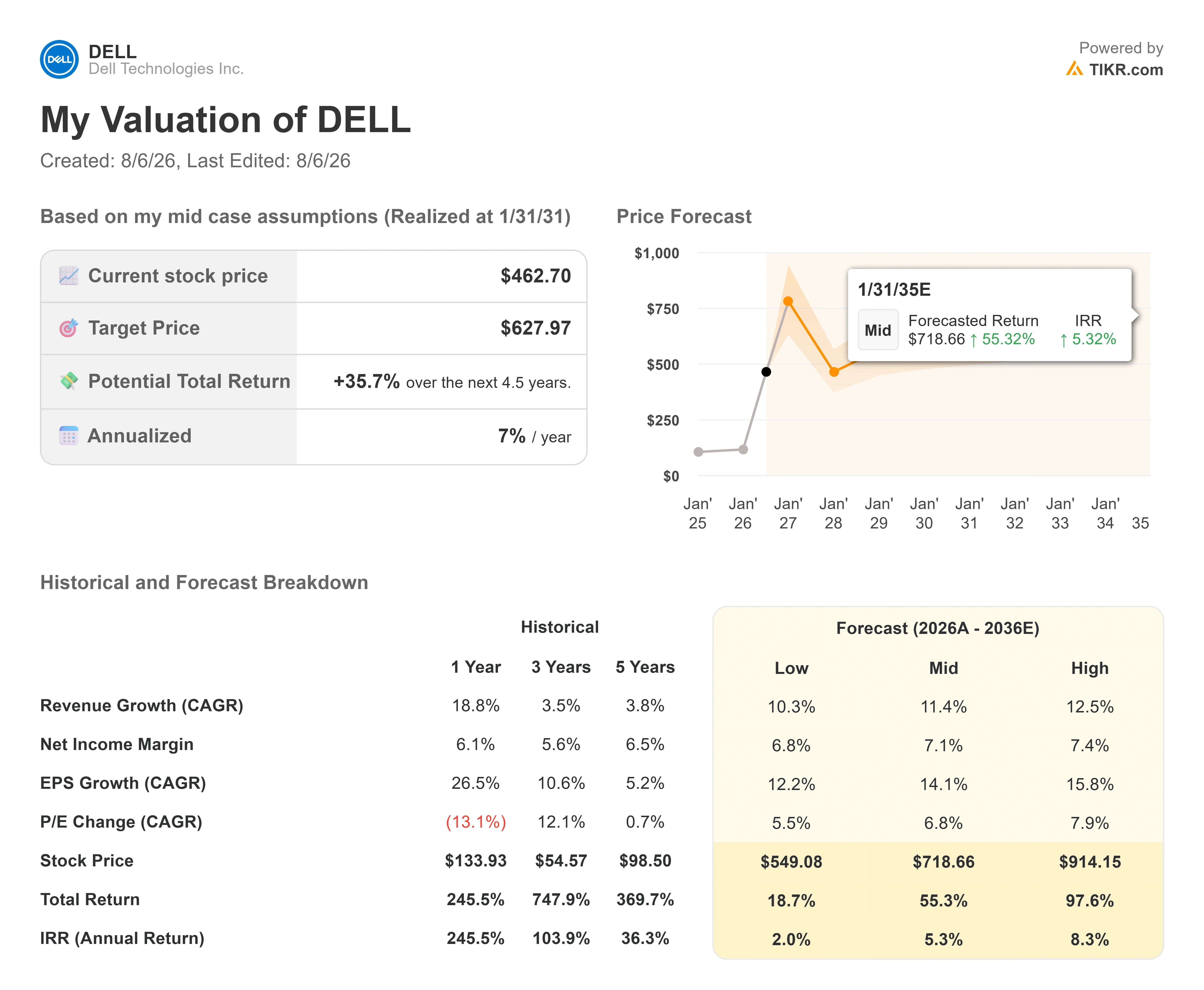
- Current Price: $462.70
- Target Price (Mid): ~$630
- Potential Total Return: ~36%
- Annualized Return: ~7% / year
See analysts’ growth forecasts and price targets for Dell stock (It’s free!) >>>
Using the TIKR mid-case scenario, the model lands on a target near $630, about 36% above the current price. The number that should govern a buy-here decision is not the target but the pace: that return spreads over roughly 4.5 years, only about 7% per year. A 260% trailing run and a mid-single-digit forward return can coexist, and here they do.
Two revenue drivers carry the case: AI server demand management says it is gated only by supply, and the installed-base refresh pulling both CPU and GPU servers. The margin driver is a richer mix of higher-value storage and services, lifting net income margin toward around 7% in the mid case from 6.1% last year. The primary risk is the memory cycle rolling over and compressing the premium multiple.
- Upside case: supply-gated demand and a richer mix push the model toward its high scenario near $914 and a low-teens annual return.
- Downside case: the premium normalizes toward hardware peers while margins stay thin, roughly the low scenario near $550 and a low-single-digit annual return.
Conclusion
The next real test is fiscal Q2 earnings, which Dell reports in late August. Watch whether operating margins expand as AI revenue tracks toward the $60 billion full-year target, and whether higher-value storage holds its growth as memory contracts reset. Margins expanding on that mix would justify the record and give the model room higher. Margins slipping as server mix climbs would hand the bears their case. At nearly 25 times forward earnings, the stock is no longer cheap enough to forgive a miss.
See what stocks billionaire investors are buying so you can follow the smart money with TIKR.
Should You Invest in Dell?
The only way to really know is to look at the numbers yourself. TIKR gives you free access to the same institutional-quality financial data that professional analysts use to answer exactly that question.
Pull up Dell, and you’ll see years of historical financials, what Wall Street analysts expect for revenue and earnings in the quarters ahead, how valuation multiples have moved over time, and whether price targets are trending up or down.
You can build a free watchlist to track Dell alongside every other stock on your radar. No credit card required. Just the data you need to decide for yourself.
Looking for New Opportunities?
- See what stocks billionaire investors are buying so you can follow the smart money.
- Analyze stocks in as little as 5 minutes with TIKR’s all-in-one, easy-to-use platform.
- The more rocks you overturn… the more opportunities you’ll uncover. Search 100K+ global stocks, global top investor holdings, and more with TIKR.
Disclaimer:
Please note that the articles on TIKR are not intended to serve as investment or financial advice from TIKR or our content team, nor are they recommendations to buy or sell any stocks. We create our content based on TIKR Terminal’s investment data and analysts’ estimates. Our analysis might not include recent company news or important updates. TIKR has no position in any stocks mentioned. Thank you for reading, and happy investing!