Key Stats for Uber Stock
- One-Day Performance: -5%
- 52-Week Range: $65 to $102
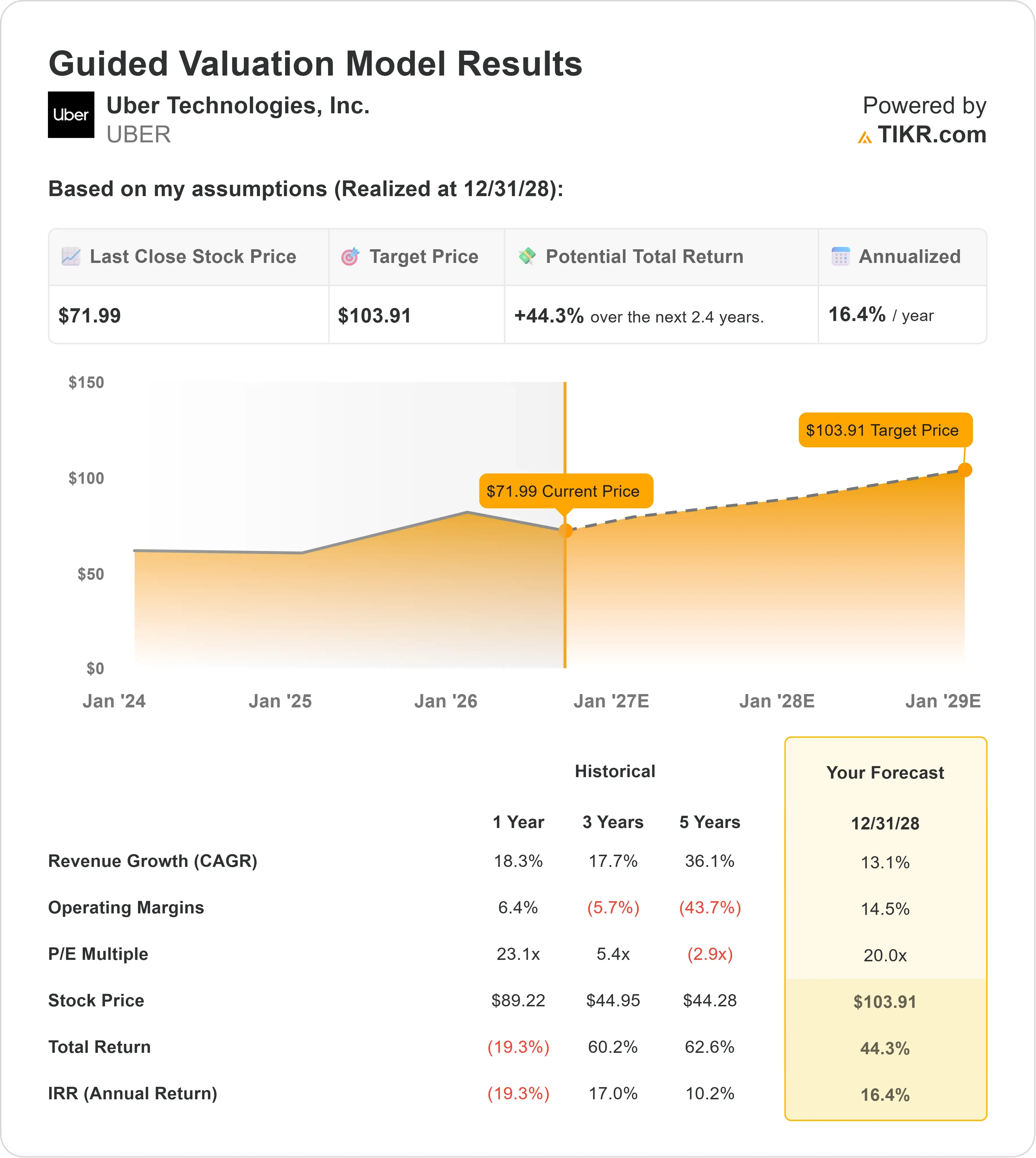
- Valuation Model Target Price: Around $104
- Implied Upside: Around 44%
Analyze your favorite stocks like Uber Technologies with TIKR (It’s free) >>>
What Happened?
Uber Technologies has become the focus of a new market debate over whether it can remain the main marketplace for autonomous rides as Waymo and Tesla develop competing robotaxi services. Uber stock fell about 5% today to close near $68 per share as investors looked past healthy customer demand and focused on softer profit guidance, a slight revenue miss, and the capital required to expand its autonomous-vehicle strategy.
Uber stock dropped specifically because its third-quarter profit forecast came in slightly below Wall Street’s expectations while management outlined a capital-intensive robotaxi strategy. Uber guided for non-GAAP EPS of $0.84 to $0.88, compared with the $0.89 consensus estimate cited by Reuters, while gross bookings guidance of $58.25 billion to $60.25 billion was broadly consistent with market forecasts. Management also plans to invest more than $10 billion over several years through stakes in autonomous-driving developers and support for fleet operations, raising concern that robotaxis could consume substantial capital before producing meaningful returns.
This week, Uber reported Q2 gross bookings of $58.02 billion, up 24% as reported and 22% on a constant-currency basis, while non-GAAP EPS increased 35% to $0.81 and trailing 12-month free cash flow surpassed $10 billion for the first time. CFO Balaji Krishnamurthy described U.S. Mobility momentum as “broad and sustainable,” supported by insurance savings, lower-cost ride options, and expansion into less densely populated markets. Uber for Business, which manages employee rides and meal spending for companies, grew 40%, while Uber remained on track to expand its autonomous-vehicle partner presence from 7 cities to 15 by year-end.
Competition adds another layer to the story. Lyft remains Uber’s closest U.S. ride-hailing rival, with its Q1 gross bookings increasing 19% to $4.9 billion, while Uber’s broader global platform delivered 24% reported bookings growth in Q2. Waymo provides autonomous rides through Uber in Austin and Atlanta while also operating its own customer-facing service, and Tesla is developing a separate robotaxi network. Uber is spreading its exposure across partners including Wayve, Zoox, Nuro, Baidu, Pony.ai, Rivian, and Lucid, while autonomous vehicles still represent less than 0.5% of Uber’s roughly 300 million weekly trips.
Value Uber Technologies instantly (Free with TIKR) >>>
Is Uber Undervalued?
Under valuation assumptions, the stock is modeled using:
- Revenue Growth (CAGR): Around 13%
- Operating Margins: Around 15%
- Exit P/E Multiple: Around 20x
Uber’s revenue is projected to rise from about $52 billion in 2025 to around $76 billion in 2028, supported by more users, higher trip frequency, Delivery expansion, and greater use of rides and food delivery by the same customers.
Insurance savings, disciplined hiring, and AI-assisted productivity could allow costs to grow more slowly than the platform, while Uber for Business, Uber One memberships, and advertising can generate additional revenue without carrying the same driver and courier costs as the underlying transactions.
The roughly 20x exit P/E multiple keeps the model defensible by relying on earnings growth and margin execution rather than requiring investors to award Uber a dramatically richer valuation.
See analysts’ growth forecasts and price targets for Uber Technologies (It’s free) >>>
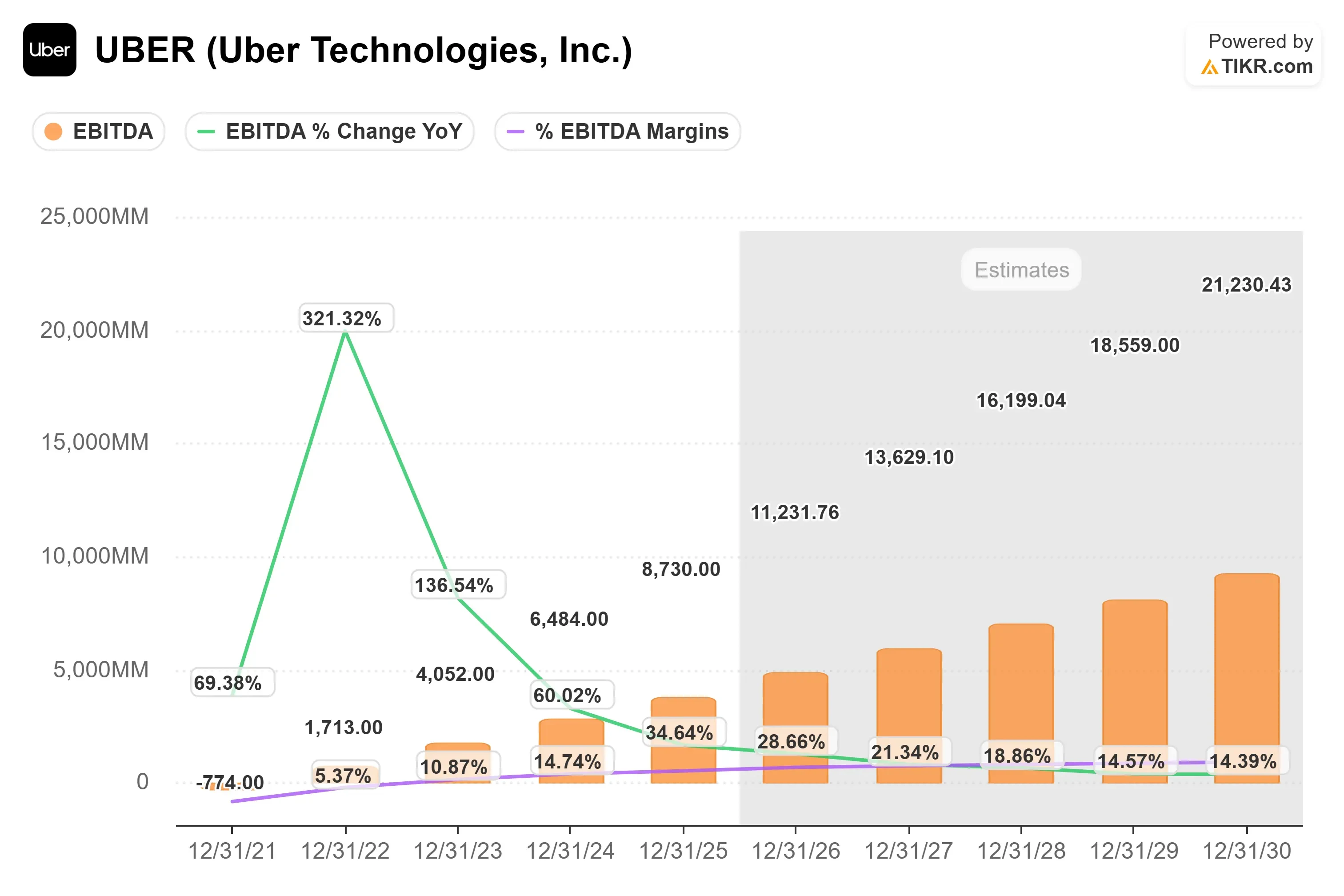
Analysts also expect EBITDA to increase from around $9 billion in 2025 to about $16 billion in 2028, showing that future returns depend on Uber converting marketplace growth into profits rather than simply generating more bookings.
Based on these assumptions, TIKR’s model estimates a target price of around $104, implying around 44% upside from its $72 reference price over about 2.4 years and indicating that Uber appears undervalued if operating leverage continues to outweigh the cost of its robotaxi expansion.
How Much Upside Does UBER Stock Have From Here?
Investors can estimate Uber Technologies’ potential share price, or what any stock could be worth, in under a minute using TIKR’s New Valuation Model tool.
All it takes is three simple inputs:
- Revenue Growth
- Operating Margins
- Exit P/E Multiple
From there, TIKR calculates the potential share price and total returns under Bull, Base, and Bear scenarios so you can quickly see whether a stock looks undervalued or overvalued.
If you’re not sure what to enter, TIKR automatically fills in each input using analysts’ consensus estimates, giving you a quick, reliable starting point.
Value Uber Technologies in under 60 seconds with TIKR (It’s free) >>>