Key Stats for CAVA Stock
- Current Price: $64.47
- Target Price (Mid): ~$224
- Street Target: ~$92
- Potential Total Return: ~247%
- Annualized IRR: ~33% / year
Now Live: Discover how much upside your favorite stocks could have using TIKR’s new Valuation Model (It’s free) >>>
What Happened?
CAVA Group (CAVA) reports second-quarter results after the close on August 11, and the stock walks in from an odd place. Shares sit near $64, down about 34% from their 52-week high of $98.79, even though the last report was a clear beat with traffic still climbing. The business keeps accelerating while the stock keeps getting cheaper.
That gap is why this print matters. Wall Street cannot agree on the name. Morgan Stanley upgraded CAVA to Overweight on July 15 with a $90 target, calling it “not a cheap stock” worth owning anyway, while Citi cut its target to $79 on July 28 as an earnings-preview de-risk.

See historical and forward estimates for CAVA stock (It’s free!) >>>
Traffic and the Margin Line Decide This Print
For CAVA, the tell is not the headline beat. It is whether comps stay traffic-led. Last quarter, same-restaurant sales grew 9.7% with 6.8 points coming from more guests rather than higher prices, and repeating that mix is what justifies the multiple. Traffic-driven comps signal a brand taking share. Price-driven comps signal a company leaning on pricing power before it runs out. Salmon is the wildcard: CAVA rolled out its first seafood protein nationally at the start of Q2, and whether it reads as a traffic pull or a cost headwind shows up here.
The margin line is where the quarter can break. CAVA held restaurant-level margin at 25.1% last quarter while wages rose and digital mix climbed toward 40% of sales, and holding that again is harder because management has chosen to spend rather than optimize. CFO Tricia Tolivar gave investors the math that matters: “margin flow-through, generally, is about 40% on incremental activity and sales.” That flow-through is the lever. If strong comps drop through at roughly 40% and margin holds near the prior quarter’s level despite salmon costs, the bears lose their clearest argument. If margin gives way as those absorbed costs flow through, the “too expensive for what it delivers” case gets louder into a richly valued stock.
Tolivar framed the ceiling herself, noting that the top quartile of restaurants already runs above $4 million in average unit volume and above 30% restaurant-level margin. That says the model can expand; the question is timing, not capability. New units are the third dial, running above 100% of mature-unit volumes with system average unit volume above $3 million, against guidance of 75 to 77 net openings this year.
The valuation gap is stark. CAVA trades around 37 times forward EV/EBITDA versus roughly 21 times for Chipotle and about 14 times for Shake Shack, per TIKR’s competitor data. That premium is only defensible if CAVA keeps growing revenue far faster than Chipotle, which it did last quarter at 32%. The premium is a bet that the growth gap persists, and August 11 is a checkpoint on that bet.
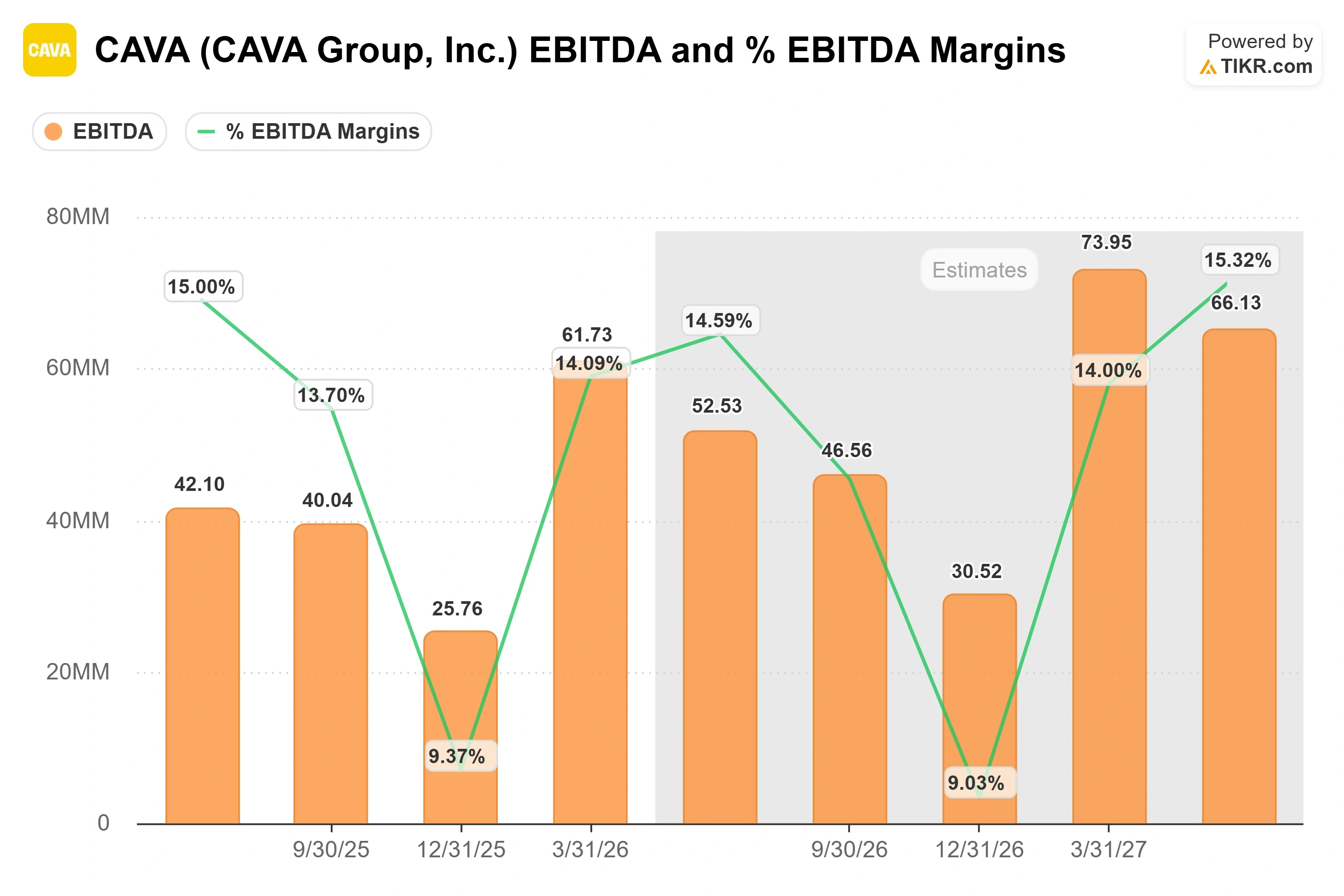
See how CAVA performs against its peers in TIKR (It’s free!) >>>
TIKR Advanced Model Analysis
- Current Price: $64.47
- Target Price (Mid): ~$224
- Potential Total Return: ~247%
- Annualized IRR: ~33% / year

See analysts’ growth forecasts and price targets for CAVA stock (It’s free!) >>>
TIKR’s mid-case model values CAVA at around $224 by the end of 2030, implying roughly 247% total return from today’s price, or about 33% annualized over 4.4 years. This is the mid-case, sitting between a low case built on decelerating comps and a high case where the data platform unlocks margin early.
- Revenue drivers: net new unit growth of 75 to 77 restaurants a year at above-100% productivity, and same-restaurant sales holding in the mid-to-high single digits on traffic momentum. The model assumes revenue compounds at around 19% annually.
- Margin driver: operating leverage as average unit volumes climb toward the $4 million top-quartile mark, lifting net income margin toward roughly 7% from around 5% today.
- Upside: CAVA sustains traffic-led comps while its CAVA Core data foundation pulls margin forward faster than modeled, and the multiple holds
- Primary risk: the premium itself. At a triple-digit forward earnings multiple, even steady revenue growth cannot hold the stock up if guest counts cool and the market reprices what that growth is worth.
Conclusion
The number to watch on August 11 is same-restaurant sales. Anything holding near high-single-digit comps with traffic still positive confirms the thesis and hands Morgan Stanley its argument. A print that fades toward the mid-single digits, especially with traffic turning negative, validates Citi’s caution, and the multiple has room to fall. Watch restaurant-level margin alongside it: holding near last quarter’s level is a win, a slip as salmon and wage costs flow through is the crack the bears have waited for. The report lands after the close, and for a stock this richly valued, the reaction will be fast and large.
See what stocks billionaire investors are buying so you can follow the smart money with TIKR.
Should You Invest in CAVA?
The only way to really know is to look at the numbers yourself. TIKR gives you free access to the same institutional-quality financial data that professional analysts use to answer exactly that question.
Pull up CAVA, and you’ll see years of historical financials, what Wall Street analysts expect for revenue and earnings in the quarters ahead, how valuation multiples have moved over time, and whether price targets are trending up or down.
You can build a free watchlist to track CAVA alongside every other stock on your radar. No credit card required. Just the data you need to decide for yourself.
Looking for New Opportunities?
- See what stocks billionaire investors are buying so you can follow the smart money.
- Analyze stocks in as little as 5 minutes with TIKR’s all-in-one, easy-to-use platform.
- The more rocks you overturn… the more opportunities you’ll uncover. Search 100K+ global stocks, global top investor holdings, and more with TIKR.
Disclaimer:
Please note that the articles on TIKR are not intended to serve as investment or financial advice from TIKR or our content team, nor are they recommendations to buy or sell any stocks. We create our content based on TIKR Terminal’s investment data and analysts’ estimates. Our analysis might not include recent company news or important updates. TIKR has no position in any stocks mentioned. Thank you for reading, and happy investing!