Key Stats for Oracle Stock
- Current Price: $141.85
- Target Price (Mid): ~$486
- Street Target: ~$248
- Potential Total Return: ~243%
- Annualized IRR: ~29% / year
Now Live: Discover how much upside your favorite stocks could have using TIKR’s new Valuation Model (It’s free) >>>
What Happened?
Oracle Corporation (ORCL) closed up 9.22% on August 3 at $141.85, its sharpest one-day gain of the year, on a day when two forces pulled in the same direction. Investors were still rewarding a deal signed on July 30, when Oracle and Google Cloud expanded their partnership to bring Google’s Gemini models into Oracle’s Fusion Applications, NetSuite, and AI Agent Studio. A broad cloud rally, sparked by Amazon crossing a $3 trillion valuation on 37% AWS growth, supplied the rest.
Even after that jump, the stock is down about 28% in 2026 and sits 59% below its 52-week high of $345.72. One strong day does not undo a year in which Oracle spent its way into deeply negative cash flow. The question is whether the Google deal changes the thesis or just hands a beaten-down stock an excuse to bounce.
Why the Gemini Deal Hit a Nerve the Backlog Never Did
Most of the Oracle debate in 2026 has centered on infrastructure: the remaining performance obligations that hit $638 billion last quarter, the data center gigawatts, the GPU contracts with names like OpenAI and Meta. The Google deal points somewhere different. It targets the applications layer, the part of Oracle that already prints cash.
Under the July 30 agreement, Gemini 3.1 Flash-Lite and Gemini 3.5 Flash become available inside Oracle AI Agent Studio, with plans to embed them in Fusion and NetSuite. Customers can build AI agents on software they already run, without separately sourcing a foundation model. Chris Leone, Oracle’s EVP of Applications Development, framed the logic around choice: “organizations need the flexibility to choose the AI model best suited to each problem.” That matters because it monetizes AI on the higher-margin side of the house, not just the capital-hungry infrastructure side. Cloud applications revenue was $4.1 billion last quarter, up 10%, with SaaS deferred revenue up 16%, so the base this AI layer sells into is already growing.

See historical and forward estimates for Oracle stock (It’s free!) >>>
The Cash Flow Problem the Rally Did Not Fix
None of that changes the math that drove Oracle down 59% from its peak. Free cash flow is deeply negative because capital spending is overwhelming operating cash flow. Management guided fiscal 2027 net cash outlay for capital expenditures to around $70 billion, with reported capex higher once you add back $20 billion to $25 billion in customer prepayments. To fund it, CFO Hilary Maxson said Oracle expects to raise around $40 billion in debt and equity this fiscal year, against net debt of roughly $135 billion and net debt to EBITDA of 4.07x.
The bull answer is that the spending is contracted demand, not speculation. Maxson pegged steady-state return on invested capital in the high 20s once projects ramp, and Clay Magouyrk said GPU utilization runs at 97.5%, with freed capacity snapped up almost immediately on renewal. The risk sits in customer concentration: much of the $638 billion backlog ties to a small number of hyperscale accounts, so one delayed ramp moves the whole cash flow curve. On valuation, Oracle trades at 17.6x NTM earnings and 11.0x NTM EV/EBITDA, below Microsoft at 24.8x earnings and ServiceNow at 25.2x, per TIKR’s Competitors page. The catch is that both peers generate cash today while Oracle burns it, so the discount is the market demanding proof before it pays up.
See how Oracle performs against its peers in TIKR (It’s free!) >>>
TIKR Advanced Model Analysis
- Current Price: $141.85
- Target Price (Mid): ~$486
- Potential Total Return: ~243%
- Annualized IRR: ~29% / year

See analysts’ growth forecasts and price targets for Oracle stock (It’s free!) >>>
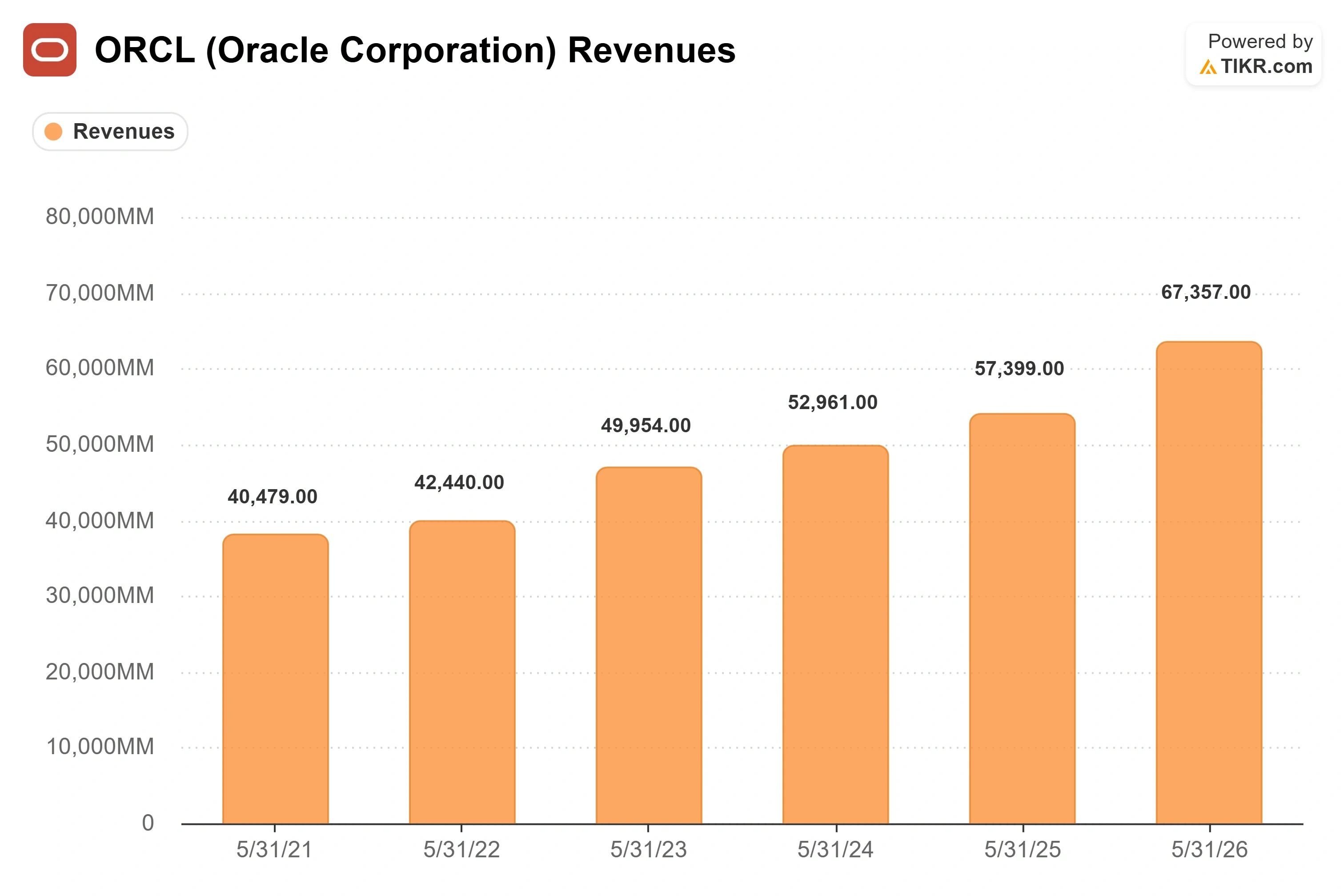
TIKR’s model, using mid-case assumptions realized in 2031, points to a price of around $486, implying roughly 243% total upside and a 29% annualized return over the next 4.8 years. That sits far above the Street mean target of around $248, which reflects the same setup on a shorter horizon and lower assumed growth. The gap between the two is the entire Oracle disagreement: how much of the backlog converts, and how fast.
The model leans on two revenue drivers: cloud infrastructure scaling as contracted capacity comes online, and the applications suite compounding as AI monetization through deals like the Gemini partnership lifts attach rates. The margin driver is operating leverage as data centers reach full contractual revenue. The primary risk is customer concentration in the backlog. Upside is a business compounding revenue above 20% with margins recovering as capex normalizes. Downside is a leveraged balance sheet funding capacity that ramps slower than contracted, keeping free cash flow negative and the multiple compressed.
Conclusion
The next real test is Q1 fiscal 2027 earnings, which Oracle is scheduled to report in September. Management guided total revenue growth of 27% to 29% and cloud revenue growth of 58% to 64%, the fastest of this cycle. Hitting the high end would confirm the backlog is converting on schedule and give the applications-plus-Gemini story room to run. Slipping below it, or any softening in cash flow guidance, would signal the ramp is stalling and send the stock back toward the lows it just bounced off. One 9% day proved the market wants to believe. September proves whether it should.
See what stocks billionaire investors are buying so you can follow the smart money with TIKR.
Should You Invest in Oracle?
The only way to really know is to look at the numbers yourself. TIKR gives you free access to the same institutional-quality financial data that professional analysts use to answer exactly that question.
Pull up Oracle, and you’ll see years of historical financials, what Wall Street analysts expect for revenue and earnings in the quarters ahead, how valuation multiples have moved over time, and whether price targets are trending up or down.
You can build a free watchlist to track Oracle alongside every other stock on your radar. No credit card required. Just the data you need to decide for yourself.
Looking for New Opportunities?
- See what stocks billionaire investors are buying so you can follow the smart money.
- Analyze stocks in as little as 5 minutes with TIKR’s all-in-one, easy-to-use platform.
- The more rocks you overturn… the more opportunities you’ll uncover. Search 100K+ global stocks, global top investor holdings, and more with TIKR.
Disclaimer:
Please note that the articles on TIKR are not intended to serve as investment or financial advice from TIKR or our content team, nor are they recommendations to buy or sell any stocks. We create our content based on TIKR Terminal’s investment data and analysts’ estimates. Our analysis might not include recent company news or important updates. TIKR has no position in any stocks mentioned. Thank you for reading, and happy investing!