


Key Stats for Visa Inc. Stock
- Current Price: $370.47
- Target Price (Mid): ~$695
- Street Target: ~$415
- Potential Total Return: ~88%
- Annualized IRR: ~16% / year
Now Live: Discover how much upside your favorite stocks could have using TIKR’s new Valuation Model (It’s free) >>>
What Happened?
Visa Inc. (V) closed at $370.47 on August 6, just below its 52-week high of $373.97 and about 26% above the $293.89 low it touched in the spring. Anyone looking at the chart is asking the same thing: the easy money off the lows is gone, so is buying here just paying up for a great business at a full price? Visa beat on its fiscal third quarter, lifted its full-year outlook, then six days later agreed to spend $2.4 billion in cash on a fraud-detection company. The business is firing, and the stock already knows it.
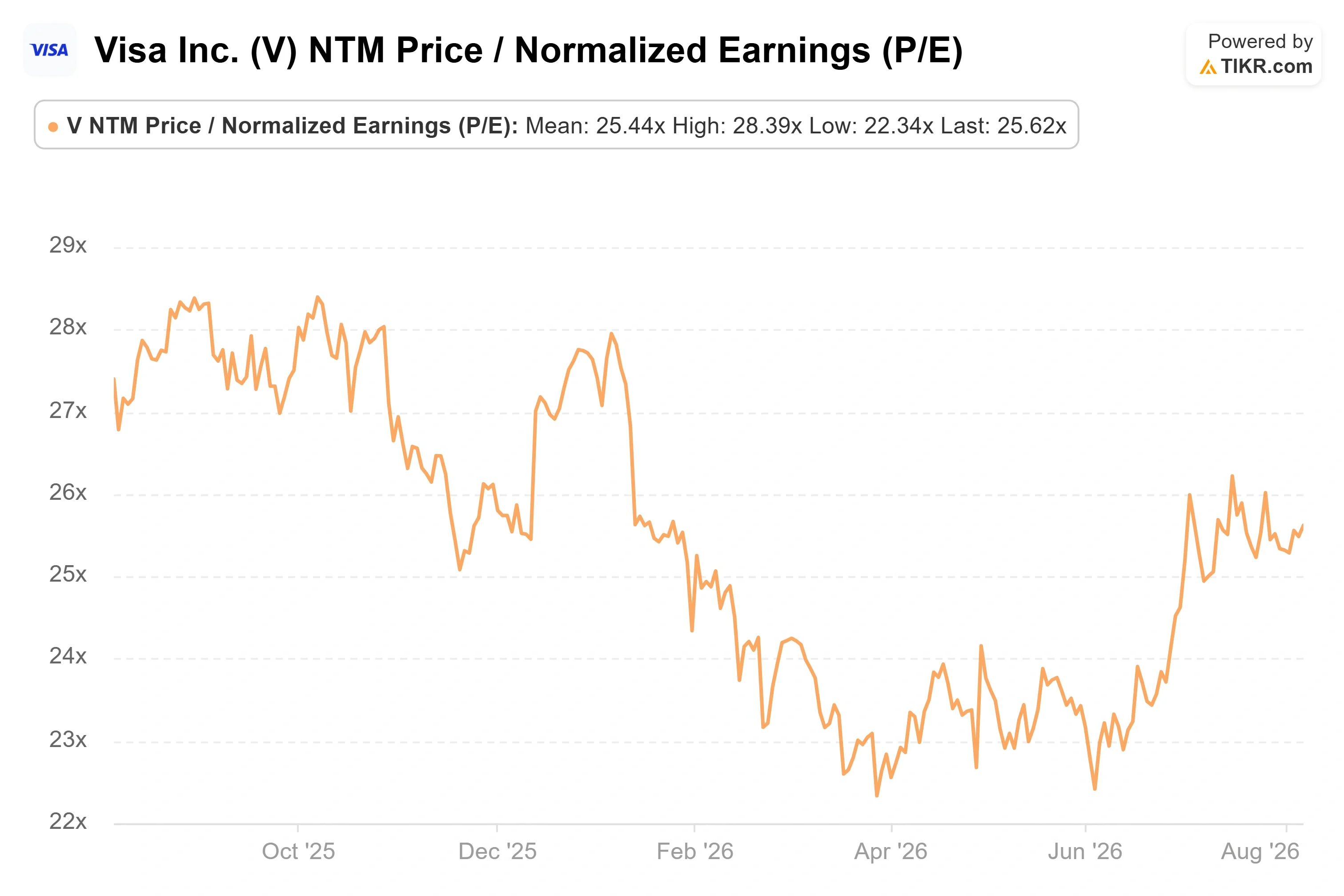
That is the discomfort worth naming. Visa trades near 25.6 times next-twelve-month earnings and about 31.5 times trailing earnings, close to the top of its recent range, at a moment when almost nothing is going wrong operationally. Buying now means betting the good news keeps compounding. That bet has more support than the multiple alone suggests, but it is still a bet, and it is worth walking through what has to keep going right.
A Beat That Was Won in Value-Added Services, Not the Volume Line
Visa reported fiscal Q3 2026 net revenue of $11,633 million on July 28, up 14.36% year-over-year and ahead of the roughly $11.40 billion the Street modeled. Adjusted EPS was $3.32, up 11.41% and past the $3.23 consensus. Payments volume crossed $4 trillion in a single quarter for the first time in company history. Strong numbers, but not where the quarter was actually won.
The engine was value-added services, the segment selling fraud tools, consulting, and issuer processing rather than simply moving money. VAS revenue grew 34% in constant dollars to $3.8 billion and now makes up close to a third of total revenue. CFO Chris Suh told analysts that all four VAS portfolios have individually grown faster over the past twelve months than the rates Visa disclosed at its February 2025 Investor Day. When a business this large accelerates its highest-value segment rather than its most commoditized one, the mix is improving, not just the totals.
The reaction was muted by design. Shares moved just 0.58% in reaction to the print, a shrug from a stock already near its high. Investors focused on a 19% rise in GAAP operating expenses, which included $563 million in severance tied to a roughly 2,600-role workforce reduction, about 7% of staff. On a non-GAAP basis, operating expenses grew 17%. CEO Ryan McInerney framed the cuts as freeing capital for AI, stablecoins, and agentic commerce.

See historical and forward estimates for Visa Inc. stock (It’s free!) >>>
The BioCatch Deal Shows Where the Next Leg Comes From
On August 3, Visa signed a definitive agreement to acquire BioCatch, a behavioral-fraud intelligence firm, for $2.4 billion in cash from funds advised by Permira and other shareholders. This is an announced agreement, not a closed deal; it is expected to close in Visa’s fiscal second quarter of 2027, subject to regulatory approval. BioCatch reads signals like keystroke timing and how a user holds a device to separate real account holders from scammers, and it currently protects 1.8 billion devices across more than 350 banks.
The logic connects straight back to the earnings call. Andrew Torre, Visa’s president of value-added services, said account takeovers and scams cost the global economy more than $1 trillion a year, with AI scaling those attacks fast. Visa is buying a way to stop fraud before a payment is even attempted, then folding it into the exact segment that just grew 34%. Wall Street read it as a growth investment: in the days after, Cantor Fitzgerald raised its target to $445, TD Cowen to $420, and Clear Street to $406. This is the “what’s left” a buyer near the highs needs. The volume business is mature; the story from here is Visa layering higher-margin security and software revenue onto rails that reach nearly 14,500 financial institutions, and BioCatch is a funded example rather than a slide.
What Investors Are Paying for at 25 Times Forward Earnings
Visa’s NTM P/E near 25.6x sits above where the stock traded during the 2026 pullback, when fear pulled the forward multiple down toward 23x in March. The premium is the crux of the chase question. That multiple buys a business with a 97.7% LTM gross margin, a 66.9% LTM operating margin, and a 61.2% return on equity, from a network that earns fees on spending without lending money or carrying credit risk. Businesses with those economics rarely stay cheap, and Visa spends most of its life at a premium because the cash generation is so durable.
The offset is that the multiple now does less of the work, so earnings must do more. Visa’s own Street targets reflect that tension: the mean sits at $414.12, only about 12% above the current price. Consensus is not calling for a top here, but it is pricing steady compounding, which is exactly what a buyer at $370 underwrites.
See how Visa Inc. performs against its peers in TIKR (It’s free!) >>>
TIKR Advanced Model Analysis
- Current Price: $370.47
- Target Price (Mid): ~$695
- Potential Total Return: ~88%
- Annualized IRR: ~16% / year

See analysts’ growth forecasts and price targets for Visa Inc. stock (It’s free!) >>>
Using the mid case, the TIKR model puts Visa’s fair value near $695, roughly 88% total return, and about 16% annualized over a horizon of about four years. The mid case is the honest number here, because Visa is neither a deep-value rebound nor a moonshot; it is a high-quality compounder priced for durability.
- Revenue drivers: value-added services, growing north of 20% across its core portfolios and now scaling through BioCatch, and cross-border volume, up 12% in constant dollars in Q3, excluding intra-Europe.
- Margin driver: a structurally high net income margin, near 54% in the mid case, sustained by operating leverage over a fixed-cost network.
- Primary risk: regulatory and litigation exposure, the interchange and antitrust pressure that has periodically capped the multiple, no matter how well the business executes.
The upside case: VAS keeps compounding above 20% and the multiple holds, letting earnings carry the stock toward the target. The downside case: a regulatory ruling or a spending slowdown compresses growth and the multiple at once, which is how a premium stock gives back a run quickly.
Conclusion
The next real test is fiscal Q4, which Visa reports this fall and already guided to EPS growth in the low end of the mid-teens. Watch the value-added services growth. If VAS holds above 20% in constant dollars, the mix-shift thesis that justifies paying 25 times forward earnings stays intact, and buying near the high looks reasonable rather than reckless. If VAS slips toward the high teens while operating expenses keep climbing, the premium gets hard to defend.
See what stocks billionaire investors are buying so you can follow the smart money with TIKR.
Should You Invest in Visa Inc.?
The only way to really know is to look at the numbers yourself. TIKR gives you free access to the same institutional-quality financial data that professional analysts use to answer exactly that question.
Pull up Visa, and you’ll see years of historical financials, what Wall Street analysts expect for revenue and earnings in the quarters ahead, how valuation multiples have moved over time, and whether price targets are trending up or down.
You can build a free watchlist to track Visa alongside every other stock on your radar. No credit card required. Just the data you need to decide for yourself.
Looking for New Opportunities?
- See what stocks billionaire investors are buying so you can follow the smart money.
- Analyze stocks in as little as 5 minutes with TIKR’s all-in-one, easy-to-use platform.
- The more rocks you overturn… the more opportunities you’ll uncover. Search 100K+ global stocks, global top investor holdings, and more with TIKR.
Disclaimer:
Please note that the articles on TIKR are not intended to serve as investment or financial advice from TIKR or our content team, nor are they recommendations to buy or sell any stocks. We create our content based on TIKR Terminal’s investment data and analysts’ estimates. Our analysis might not include recent company news or important updates. TIKR has no position in any stocks mentioned. Thank you for reading, and happy investing!


