Key Stats for P&G Stock
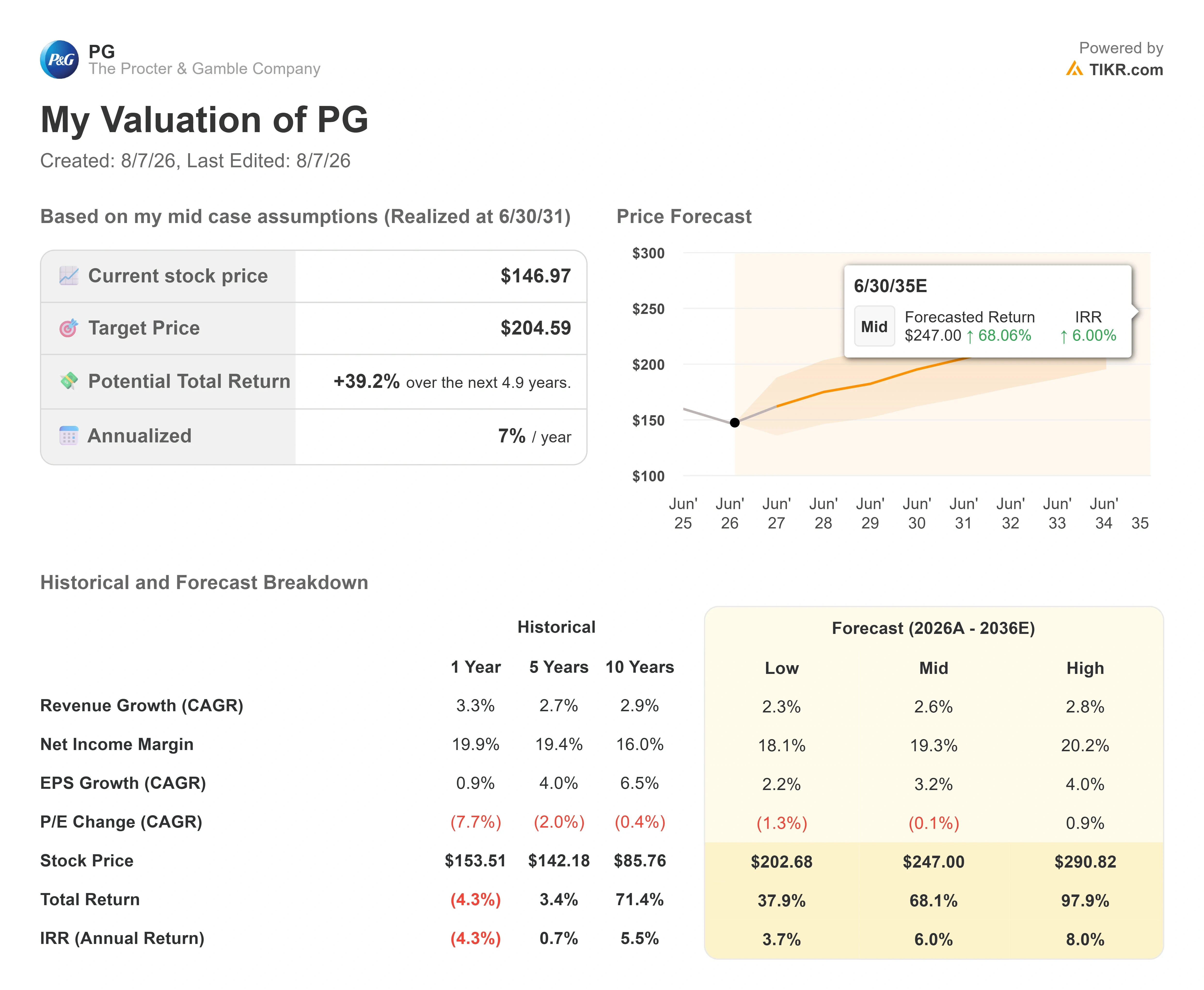
- Current Price: $146.97
- Target Price (Mid): ~$205
- Street Target: ~$161
- Potential Total Return: ~39%
- Annualized IRR: ~6% / year
Now Live: Discover how much upside your favorite stocks could have using TIKR’s new Valuation Model (It’s free) >>>
What Happened?
The Procter & Gamble Company (PG) agreed on August 4 to buy Thorne, a science-backed supplements brand, for $3.8 billion in cash, and the market barely moved. Shares rose about 1.5% intraday and closed the next session at $146.97, roughly where they sat before the announcement. For a deal this size at one of the world’s largest consumer staples companies, a shrug is the reaction, and it is worth understanding why.
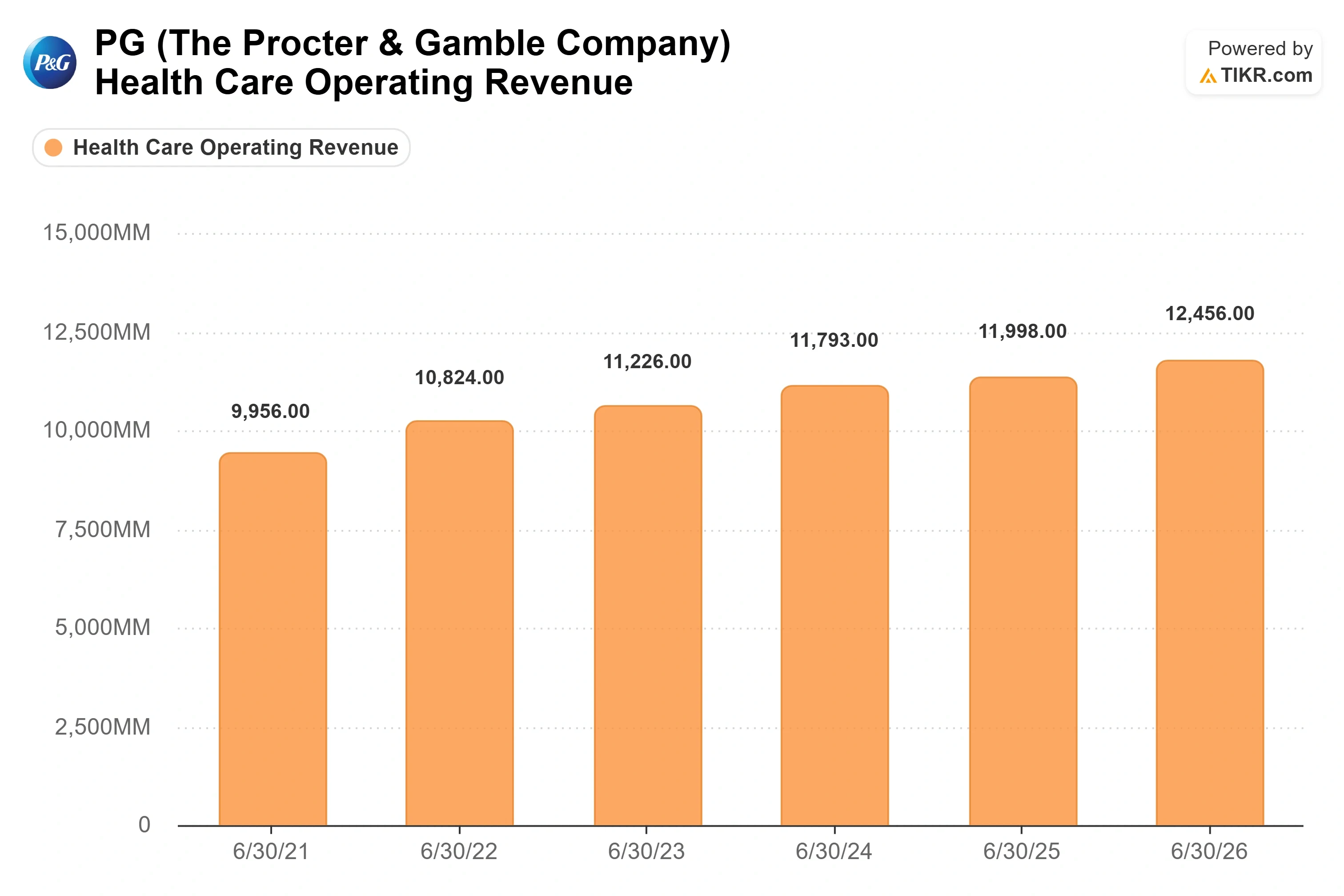
The context makes the deal more interesting than the price tag. Five days earlier, P&G reported a fourth quarter with organic sales rounding down to flat and its healthcare division, the very unit Thorne slots into, down 3% and standing out as the weakest performer. The question is not whether $3.8 billion is a lot of money. It is whether P&G can buy the growth its own portfolio has stopped generating.
The Division Thorne Is Meant to Rescue
P&G’s healthcare unit houses Metamucil, Align Probiotic, New Chapter, Oral-B, and Vicks. It was the clear laggard in the fourth quarter, with volume down 3% as oral care softened in North America and Greater China. Thorne is a direct answer to that weakness. The brand generated more than $500 million in revenue in 2025 and, by its own projection, is targeting around $650 million in 2026, with the majority of sales coming from shoppers under 40, a demographic P&G has struggled to reach through its legacy brands.
The strategic logic tracks with what management said on the earnings call. CEO Shailesh Jejurikar told analysts that P&G expects higher growth rates in segments like Beauty and Health and plans to accelerate that part of the portfolio. Thorne is that plan made concrete. Paul Gama, CEO of P&G Health Care, framed the deal around demand the company is not fully capturing: “Consumer interest in self-care, prevention, wellness, and personalized health continues to grow, and Thorne strengthens our position in premium wellness with a trusted, science-backed brand that complements our existing portfolio.” Premium supplements also carry higher margins than traditional packaged goods, and Thorne’s fast-growing direct-to-consumer channel hands P&G a digital-native asset it can scale globally.
The price deserves scrutiny. L Catterton took Thorne private in 2023 in a deal valued at $680 million, so P&G is paying a figure that hands the seller more than a 5x return in roughly two years. In 2026, target sales are expected to be near $650 million; the $3.8 billion price works out to close to 6 times revenue, rich for an asset P&G still has to integrate and, by the terms disclosed, expects to close later in 2026 pending regulatory approval. The bet is that Thorne compounds toward the billion-dollar brand its management has described, not that it stays a niche.
See historical and forward estimates for P&G stock (It’s free!) >>>
Why the Core Still Decides the Stock
Thorne, even at $650 million, is small against P&G’s $87 billion in annual revenue. It does not move the growth algorithm alone. What it signals is a company reaching outside its walls because the inside is stuck, and fiscal 2026 explains the urgency: full-year organic sales grew about 1%, and management guided fiscal 2027 to organic growth of 1% to 3% and core EPS growth of 0% to 3%.
The near-term shape is front-loaded with pain. Management guided first-quarter EPS down 5% or more, weighed by roughly $1 billion after-tax in higher input costs tied to elevated oil, part of a total earnings headwind near $1.4 billion after-tax, or about $0.56 per share. Jejurikar’s framing of building “a stronger core and a bigger more” is the strategy, and Thorne is the “bigger more.” The flat market reaction suggests investors want the core to inflect before paying up for the acquisitions bolted onto it.
The skepticism has a name. On the print, HSBC downgraded P&G to Hold from Buy and cut its target to $149 from $182, arguing the quarter reversed the volume recovery that had supported its more constructive stance. That is one view against a Street that stayed constructive: 8 buys, 6 outperforms, 11 holds, and no sells, with a mean target near $161.
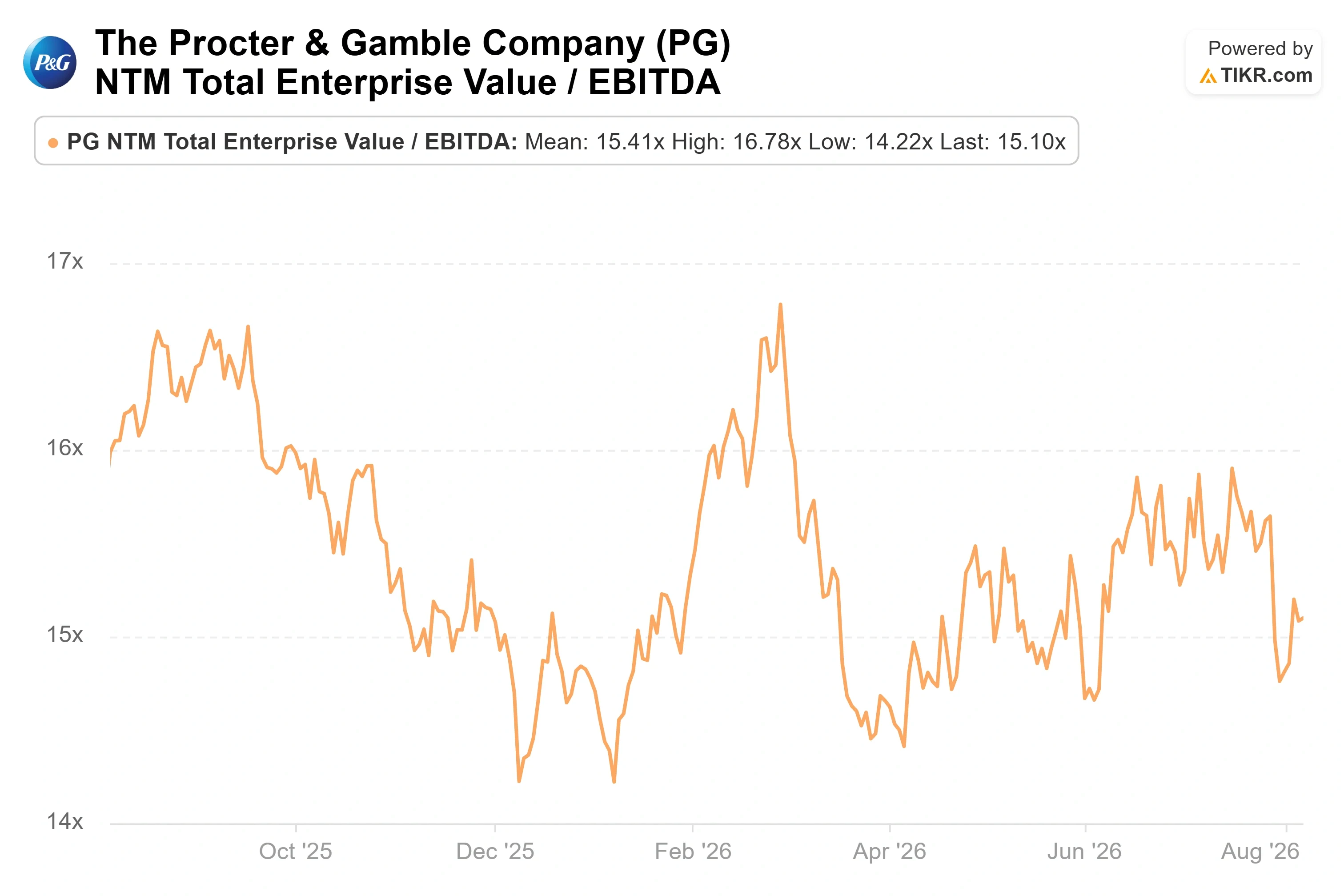
The premium is selective. P&G trades at roughly 15 times forward EV/EBITDA, in line with Colgate-Palmolive near 16 times but well above Kimberly-Clark, near 11 times, and most of the broader household products peer set. Where P&G stands apart is margins: its LTM operating margin near 25% runs several points ahead of both peers, which is what has historically justified paying up for the shares. Whether flat quarterly organic growth justifies that today, or whether the discount to P&G’s own history is the better signal, is the live question.
See how P&G performs against its peers in TIKR (It’s free!) >>>
TIKR Advanced Model Analysis
- Current Price: $146.97
- Target Price (Mid): ~$205
- Potential Total Return: ~39%
- Annualized IRR: ~6% / year
See analysts’ growth forecasts and price targets for P&G stock (It’s free!) >>>
Using the TIKR mid-case, the model values P&G at around $205 per share by mid-2031, a total return of roughly 39%, or about 6% annualized over the next 4.9 years. It leans on two revenue drivers: organic growth of around 2.6% carried by international momentum in China and Latin America, and incremental contribution from acquired and innovation-led categories, of which Thorne is now one. The margin driver is P&G’s productivity program, which delivered $2.8 billion before tax in fiscal 2026 and funds reinvestment while defending an operating margin near 25%.
The upside case is that the U.S. innovation wave, from Tide evo to reactivated Family Care, lifts category growth while Thorne compounds into a billion-dollar brand. The downside is that oil stays elevated, the $1.4 billion cost headwind proves stickier than modeled, and the premium multiple gives way. At around 21 times forward earnings, this is not deep value. It is a quality compounder priced for a recovery that has not yet reached its results.
Conclusion
The clearest test is the first-quarter fiscal 2027 print in late October. Management already told investors EPS will fall 5% or more as costs peak, so the number that matters is not headline EPS but whether North America volume growth holds. If it does, the recovery Jejurikar described is real, and Thorne becomes the first of several growth bets on a base that is finally moving. If volume stalls again, HSBC’s downgrade looks early rather than wrong, and 21 times earnings on flat growth gets hard to defend. P&G’s Investor Day on November 19 should sharpen how much of the “CPG company of the future” is capability and how much is cost.
See what stocks billionaire investors are buying so you can follow the smart money with TIKR.
Should You Invest in P&G?
The only way to really know is to look at the numbers yourself. TIKR gives you free access to the same institutional-quality financial data that professional analysts use to answer exactly that question.
Pull up P&G, and you’ll see years of historical financials, what Wall Street analysts expect for revenue and earnings in the quarters ahead, how valuation multiples have moved over time, and whether price targets are trending up or down.
You can build a free watchlist to track P&G alongside every other stock on your radar. No credit card required. Just the data you need to decide for yourself.
Looking for New Opportunities?
- See what stocks billionaire investors are buying so you can follow the smart money.
- Analyze stocks in as little as 5 minutes with TIKR’s all-in-one, easy-to-use platform.
- The more rocks you overturn… the more opportunities you’ll uncover. Search 100K+ global stocks, global top investor holdings, and more with TIKR.
Disclaimer:
Please note that the articles on TIKR are not intended to serve as investment or financial advice from TIKR or our content team, nor are they recommendations to buy or sell any stocks. We create our content based on TIKR Terminal’s investment data and analysts’ estimates. Our analysis might not include recent company news or important updates. TIKR has no position in any stocks mentioned. Thank you for reading, and happy investing!