Key Takeaways
- Qualcomm (QCOM) stock dropped 13% in the month through October 22, with a September 28 semiconductor selloff accounting for more than half the decline.
- Arm Holdings (ARM) fell 37% over the same period, compared with the Nasdaq 100’s 6% decline, highlighting broader semiconductor weakness.
- Apple (AAPL) remains a major headwind, with Qualcomm expecting Apple-related revenue to decline approximately 50% sequentially in the December quarter.
- Qualcomm looks better suited for holding than aggressively buying, trading near 19x forward earnings against its five-year average of 14x.
What Happened?
Qualcomm (QCOM) stock declined 13% over the past month through October 22, closing near $173 as investors weighed weaker smartphone demand, Apple-related revenue losses, and broader semiconductor volatility.
The biggest setback came on September 28, when Qualcomm shares dropped 7% amid inflation concerns, rising Treasury yields, and technology-sector selling pressure.
Arm Holdings (ARM) fell nearly 9% that session. Over the full month, Arm lost 37%, compared with Qualcomm’s 13% decline and the Nasdaq 100’s 6% drop, highlighting semiconductor stocks’ underperformance.
The selloff followed positive developments, including Qualcomm’s Snapdragon Summit, an Apple patent-license renewal, and an Amazon Web Services partnership. However, those announcements failed to offset concerns about handset demand.
Qualcomm also announced a multi-year patent cross-license agreement with Huawei on October 5, covering AI, 5G, computing, and networking technologies.
On October 13, a Delaware jury found that Arm breached its licensing agreement with Qualcomm, awarding $2 in nominal damages while leaving significant royalty questions unresolved.
Meanwhile, Reuters reported that CEO Cristiano Amon outlined a global “performance-focused reduction” in staffing, with employee notifications beginning in November.
Despite these developments, Qualcomm’s biggest challenge remains smartphones.
Management expects handset-market weakness to pressure Android chip revenue, while Apple-related revenue could decline approximately 50% from the September quarter to the December quarter.
Still, diversification offers encouragement. Non-handset revenue increased 28% last quarter, while automotive revenue reached a record $1.6 billion.
Qualcomm also targets $5 billion in data center revenue by fiscal 2027 and more than $15 billion by fiscal 2029, potentially creating a meaningful growth engine beyond smartphones.
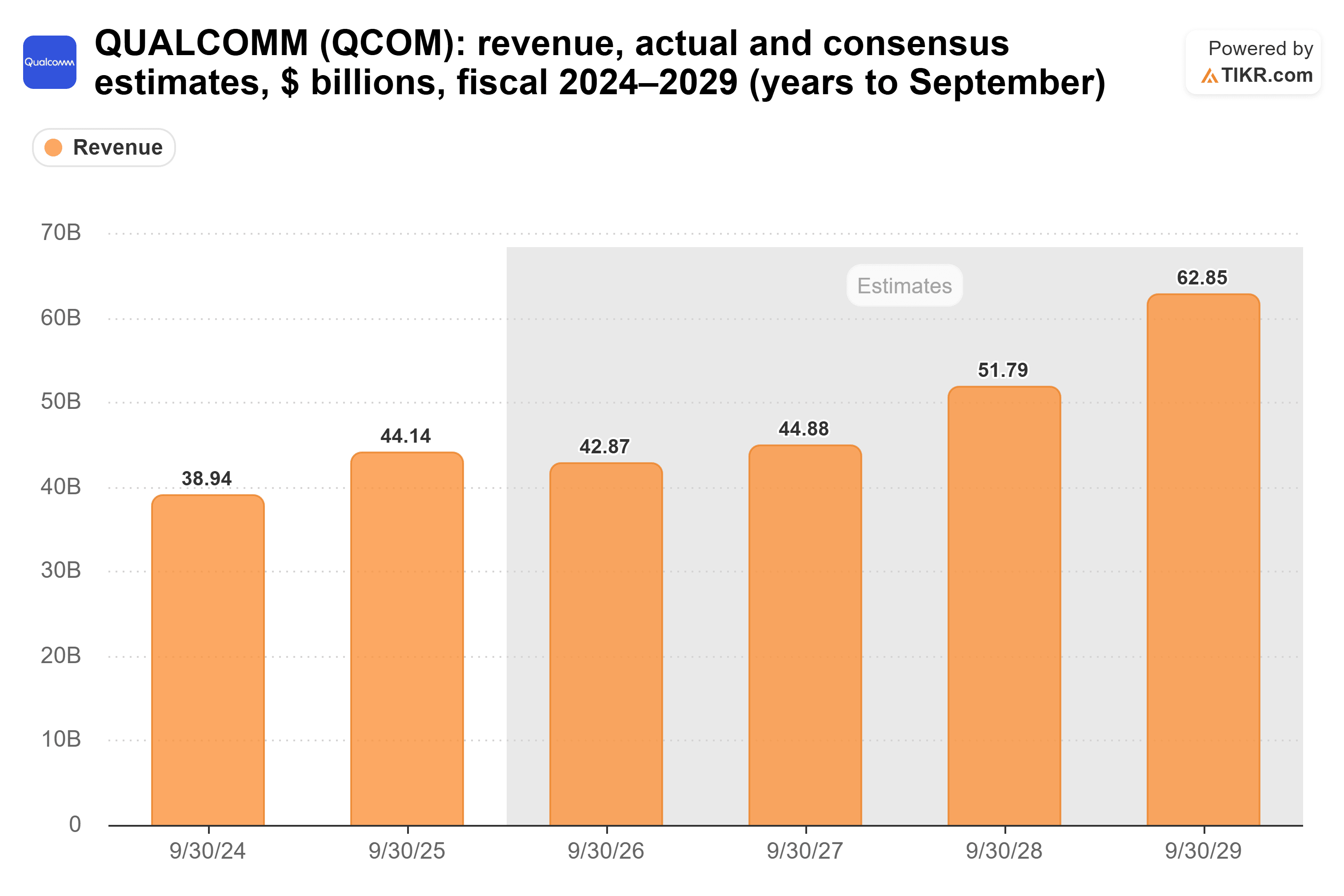
Wall Street expects revenue to decline from $44.1 billion in fiscal 2025 to $42.9 billion in fiscal 2026 before reaching $62.9 billion by fiscal 2029, although only nine analysts provide estimates that far out.
That projected $20 billion increase depends on successful expansion beyond smartphones, particularly in data centers and automotive applications.
Qualcomm reports fiscal fourth-quarter earnings after the market closes on November 4, following revenue guidance of $9.7 billion to $10.5 billion.
The December-quarter outlook will be particularly important as data center revenue begins contributing while Apple-related revenue declines.
Is Qualcomm Stock Undervalued or Overvalued?
Despite the selloff, Qualcomm appears fairly valued rather than significantly undervalued, given its earnings multiple and near-term smartphone challenges.

Shares trade near 19x forward earnings, above Qualcomm’s five-year average of 14x but below its May 2026 peak of 26x, suggesting investors already anticipate significant diversification.
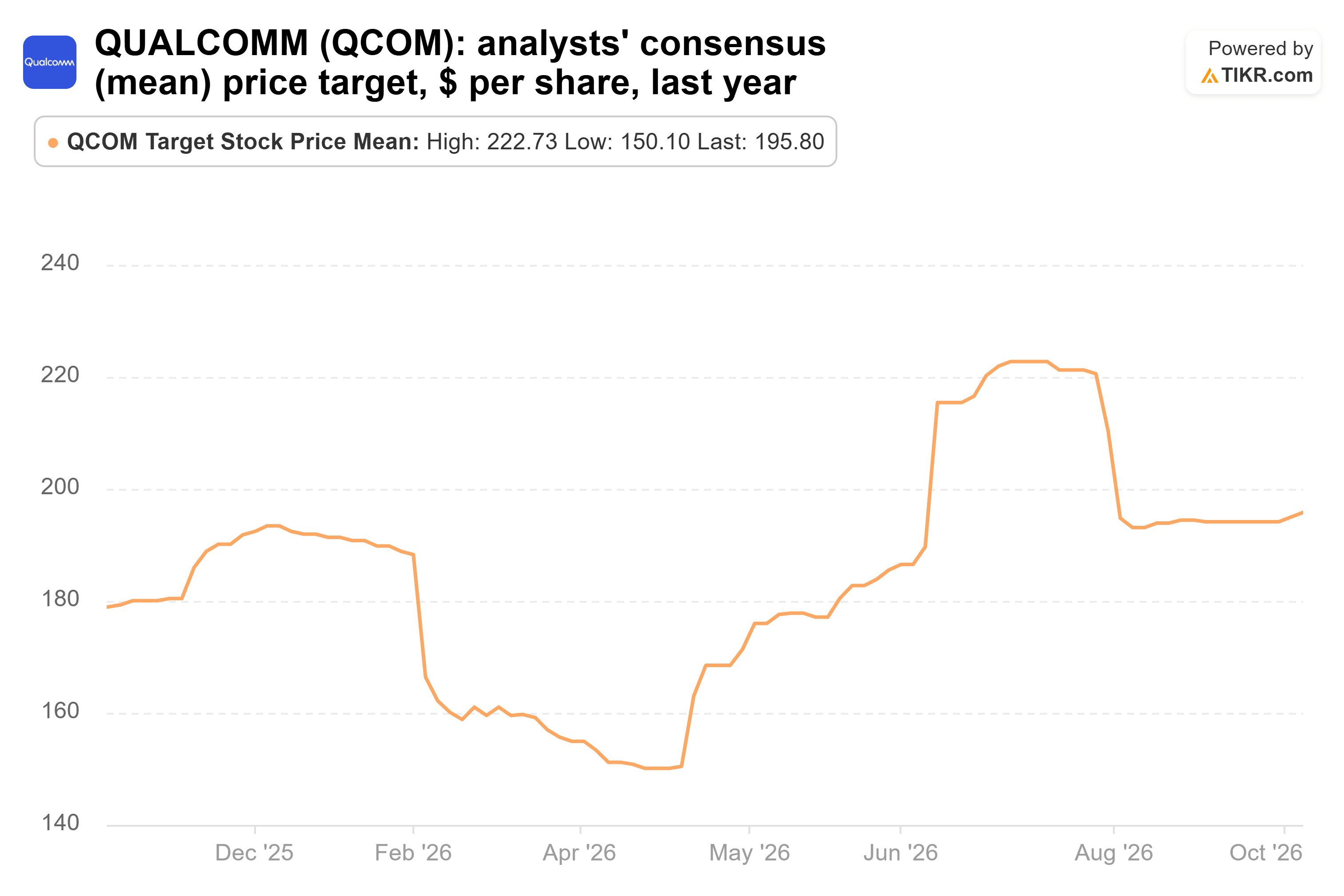
Analysts’ average price target of $196 implies approximately 13% upside from Qualcomm’s October 22 closing price near $173, suggesting moderate recovery potential.
For now, holding Qualcomm looks more reasonable than selling after a sector-wide correction or aggressively buying before earnings, particularly while Apple-related revenue remains under pressure.
Over the next 12 months, stronger data center sales, sustained automotive growth, and improving Android demand could support further upside. However, delays in Qualcomm’s expansion beyond smartphones could leave its above-average valuation vulnerable.
So what is Qualcomm stock actually worth?
TIKR lets you forecast the future price of any stock in less than a minute. Just enter a few assumptions into TIKR’s valuation model and see what Qualcomm could be worth. Start from Wall Street consensus estimates, or adjust the inputs to reflect your own view of the business. It’s free to use.
Disclaimer:
Please note that the articles on TIKR are not intended to serve as investment or financial advice from TIKR or our content team, nor are they recommendations to buy or sell any stocks. We create our content based on TIKR Terminal’s investment data and analysts’ estimates. Our analysis might not include recent company news or important updates. TIKR has no position in any of the stocks mentioned. Thank you for reading, and happy investing!