HSBC Holdings (HSBC) shares fell more than 6% in Hong Kong on Tuesday, October 27, to about HK$133, after the bank’s third-quarter results came in just short of forecasts. Pretax profit rose 32% to $9.6 billion in the third-quarter earnings release, and the bank announced another buyback of up to $1 billion plus a $0.10 dividend.
The 32% flatters the quarter. HSBC booked $1.4 billion of legal provisions in the same period last year, and their absence does most of the work. Excluding notable items, pretax profit rose 10% to $10.0 billion. Revenue of $18.6 billion missed the $18.93 billion consensus CNBC cited, and pretax profit landed just under the $9.69 billion expected.
The Cost Plan Is Ahead of Schedule
HSBC originally promised $1.5 billion of annual savings by the end of 2026. It beat that early and lifted the goal to about $2 billion at its half-year results on August 4. By the end of September, it had actioned about $1.9 billion of annualised savings, spending $1.6 billion on restructuring to get there.
The savings show up in the numbers. Target-basis operating expenses, HSBC’s own cost measure, rose just 1.4% from a year earlier, and the cost-efficiency ratio improved to 47.4% from 56.6%. Return on tangible equity excluding notable items was 18.2%, above the 17% floor HSBC has set through 2028.
So why did the stock fall?
HSBC’s Buyback Has Shrunk
HSBC used to be one of the heaviest buyers of its own stock. Its diluted share count fell from 20.30 billion in 2021 to 17.28 billion over the last twelve months, a 14.9% drop, with roughly 5% cut in each of 2024 and 2025.
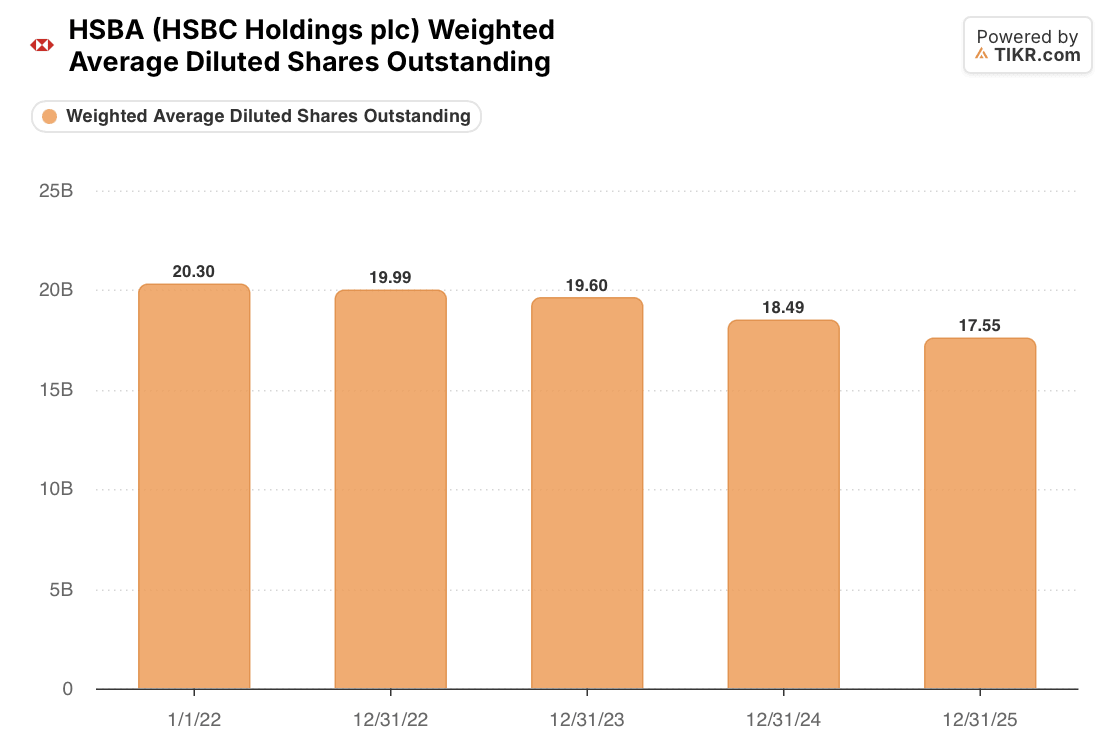
The new program is much smaller. At today’s price, $1 billion buys about 59 million shares, or 0.3% of the count. Repeat that every quarter and HSBC shrinks its share count by about 1.4% a year, barely a quarter of the recent pace.
Capital is the constraint. HSBC’s CET1 ratio slipped to 13.9%, below its own 14% to 14.5% target range, as risk-weighted assets grew and higher bond yields cut the value of bonds it holds for liquidity.
TIKR Tracks 18 Analysts on HSBC. How Many Say “Buy”?
See the full breakdown of Buy, Hold, and Sell ratings on HSBC, along with Wall Street’s revenue and earnings estimates, all in one place. More than 500,000 investors use TIKR to research stocks like this one. See HSBC’s Analyst Ratings
Wealth Went Flat
The other disappointment was wealth, the Asian growth engine HSBC has built its pitch around. Wealth fee and other income came in at $2.69 billion, flat from a year earlier, after growth of 15% and 23% in the first two quarters, Reuters reported. (HSBC pointed to last year’s insurance one-offs and business sales, while investment distribution and private banking still grew.) That’s the number Standard Chartered (STAN) holders will look for too, since it chases the same Hong Kong and Asian wealth clients.
The valuation leaves little room for that. HSBC stock trades at 10.03x NTM earnings, down from about 12x in August but still above its three-year average of 8.61x.
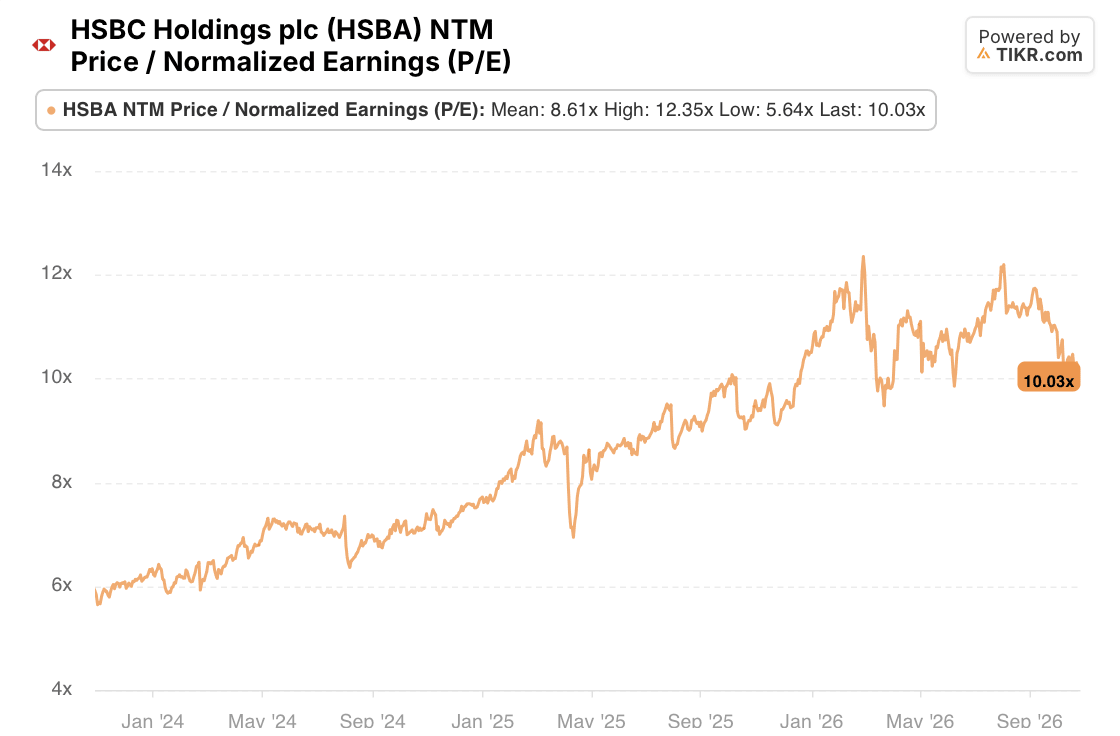
The re-rating priced in growth this quarter didn’t deliver.
The Date HSBC Holders Should Circle
January 1, 2027. HSBC expects the final Basel 3.1 rules to lift its CET1 ratio by about 40 to 50 basis points that day, though the final impact depends on modelling and supervisory permissions. All else equal, that would take CET1 from 13.9% to about 14.3% to 14.4%, inside HSBC’s target range. The benefit is equivalent to about $3.7 billion to $4.6 billion of capital at current risk-weighted assets, but it doesn’t establish how much HSBC can hand back through buybacks.
That’s what decides the stock from here. If HSBC turns that headroom into a bigger buyback at its full-year results on February 23, paying 10x earnings for an 18% return business holds up. If buybacks stay at $1 billion a quarter while wealth stays flat, the multiple has room to drift back toward 8.6x. Most of the planned annualised savings have been actioned, so the February buyback number is the next test for my thesis.
So What Is HSBC Stock Actually Worth?
TIKR lets you forecast the future price of any stock in less than a minute. Just enter a few assumptions into TIKR’s valuation model and see what HSBA stock could be worth. Start from Wall Street consensus estimates, or adjust the inputs to reflect your own view of the business. It’s free to use.
Value HSBC Holdings plc for free→
Disclaimer:
Please note that the articles on TIKR are not intended to serve as investment or financial advice from TIKR or our content team, nor are they recommendations to buy or sell any stocks. We create our content based on TIKR Terminal’s investment data and analysts’ estimates. Our analysis might not include recent company news or important updates. TIKR has no position in any of the stocks mentioned. Thank you for reading, and happy investing!