
Key Stats for Palantir Stock
- Current Price: $134.37
- Target Price (Mid): ~$880
- Street Target: ~$183
- Potential Total Return: ~560%
- Annualized IRR: ~52% / year
- Earnings Reaction: (6.93%) (May 4, 2026)
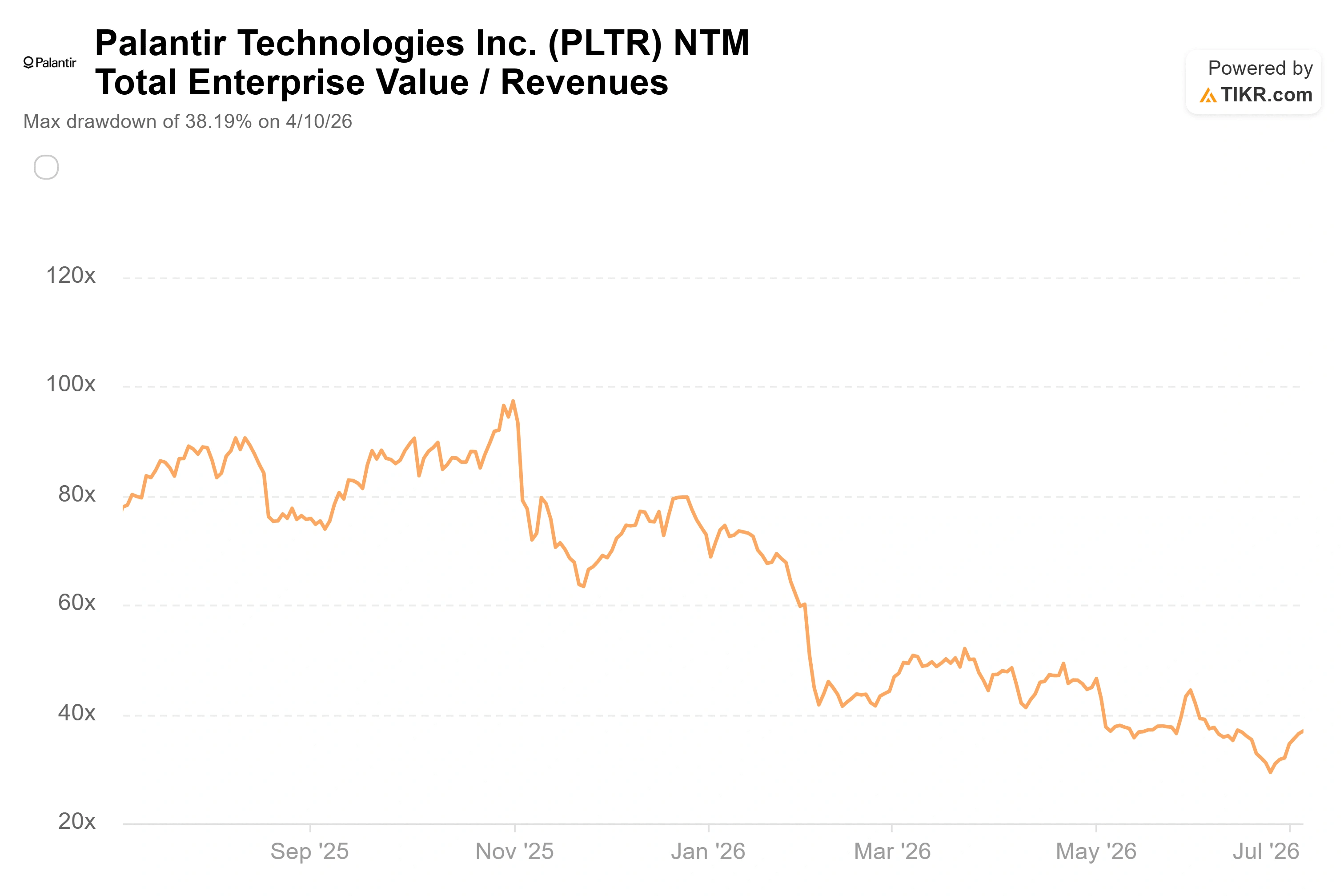
- Max Drawdown: (38.19%) (April 10, 2026)
Now Live: Discover how much upside your favorite stocks could have using TIKR’s new Valuation Model (It’s free) >>>
What Happened?
Palantir Technologies (PLTR) spent the first half of 2026 as the market’s favorite argument. The stock is down about 27% year to date, it sits roughly 35% below the November 2025 high of $207.52, and yet it still trades at around 85 times next-twelve-months earnings. Bulls and bears have been fighting over the same number for months, and neither side has landed a clean punch.
Then the CEO changed the subject.
On July 1, Alex Karp went on CNBC and said “something has gone completely wrong” with how OpenAI and Anthropic sell AI, describing what reporters characterized as a wealth tax on American business for token usage that returns little value. Palantir stock climbed about 8% that day. The remark grabbed the headlines, but the argument underneath it is the one investors should actually care about, because it reframes the entire bear case. The market has spent 2026 asking whether frontier AI labs will make Palantir irrelevant. Karp is arguing the opposite: that the labs’ own pricing model is handing Palantir its next decade.
The Sovereignty Pitch Is a Product, Not a Soundbite
The timing was not an accident. Two days before the CNBC appearance, on June 29, Palantir and Nvidia announced a Sovereign AI Operating System, a full-stack reference architecture that runs Nvidia’s open Nemotron models on Blackwell Ultra GPUs inside air-gapped environments, layered on Palantir’s AIP (Artificial Intelligence Platform, the software that puts AI models to work on a company’s own operations). Karp tied the two together in his July 1 CNBC interview, where he argued enterprises want to own their compute, models, and data rather than rent them. The point of the design is ownership. Customers train models on their own data and keep the resulting model weights on their own hardware, rather than renting access to a hosted model through an API.
That is the concrete answer to a question the whole market has been circling. If an enterprise can call a frontier model directly, why pay Palantir? Karp’s response, stripped of the theatrics, is that calling a hosted API means renting your intelligence and leaking your edge. As he put it on CNBC, technical customers want “control over their compute, their models, their data stack.” The sovereignty framing is a sales pitch, and investors should treat it as one. It is also a real architectural choice that competitors relying on hosted models cannot easily copy.
What Matters More Than the Headline
The most useful explanation of Palantir’s position did not come from the CNBC clip. It came from Chief Technology Officer Shyam Sankar on the Q1 2026 earnings call, and it is a part of the story search results tend to miss.
Sankar’s framing is that cheaper AI does not shrink Palantir’s market; it explodes it. “GPT-4 equivalent performance that cost $20 per million tokens in early 2023 is now approximately 1,000x cheaper 3 years later,” he said, and because of that, “use case demand for tokens is exploding.” He reached for a 19th-century analogy to explain it. “When the Victorians built more efficient steam engines, everyone assumed coal consumption would fall. Instead, it’s skyrocketed.” His conclusion: “Tokens are the new coal, AIP is the train.”
That matters because it flips the scariest bear argument on its head. The fear is that a collapsing model costs commoditize Palantir. Sankar’s answer is that collapsing costs generate an avalanche of AI tasks, and every one of those tasks needs somewhere trustworthy to run. That somewhere, in his telling, is the Ontology, Palantir’s structured model of a company’s real-world assets and relationships that he calls a “no slop zone.” His line captures the whole thesis in one sentence: “More tokens means more slop.” The more commodity AI a company consumes, the more it needs a governed layer to keep that AI from doing damage. Why it matters: This is the qualitative moat the $175 analyst upgrade only gestured at, laid out by the person who built the product.
The Numbers Behind the Rhetoric
The rhetoric would be empty without the financials, and this is where Palantir has separated itself. In the first quarter of 2026, revenue grew 85% year over year to $1.633 billion, the company’s highest growth rate as a public company and its 11th straight quarter of acceleration. U.S. revenue crossed 100% growth for the first time, rising 104% to $1.282 billion, while U.S. commercial revenue jumped 133% to $595 million.
Profitability moved with it. Adjusted free cash flow reached $925 million, a 57% margin, and TIKR data shows actual net income of $856 million for the quarter. On the back of those results, management raised full-year 2026 revenue guidance to a range of $7.650 billion to $7.662 billion, about 71% growth, the largest guidance raise in company history. CFO David Glazer told investors it was the company’s “strongest ever Q1 sequential growth rate.” The market’s reaction was still negative: PLTR fell 6.93% the day after the May 4 report, a reminder that at this valuation, even a record quarter can disappoint.

See historical and forward estimates for Palantir stock (It’s free!) >>>
Valuation Is Still the Hard Part
None of this makes the stock cheap on any conventional screen. Per TIKR data, Palantir trades at around 37 times NTM revenue and around 61 times NTM EV/EBITDA, meaning enterprise value against forward earnings before interest, taxes, depreciation, and amortization. Set that against its own software peers on the TIKR Competitors page and the gap is stark: Microsoft trades at 7.97x NTM EV/Revenue and 12.78x NTM EV/EBITDA, ServiceNow at 6.43x and 17.31x, and Oracle at 6.15x and 10.86x. The peer group median sits near 3.51x revenue and 11.29x EBITDA. Palantir’s premium is not a rounding error, it is a different category.
The bull answer is growth. D.A. Davidson’s Gil Luria, who upgraded PLTR to Buy on July 2 with a $175 target, argues the stock’s price/earnings-to-growth ratio of roughly 0.5 makes the headline multiple misleading, and that Palantir grows “twice as fast as any” of the AI software peers it now trades alongside. He also made the sovereignty point in market terms: recent U.S. government restrictions on Anthropic’s models were, in his words, a live stress test, and Palantir customers who had a model swapped out beneath them barely noticed. The counterweight is duration risk. With trailing free cash flow yield still under 1%, any deceleration from that 71% guided growth would compress the multiple fast, and it would happen before revenue actually slowed. That is the single fault line under the whole thesis.
See how Palantir performs against its peers in TIKR (It’s free!) >>>
TIKR Advanced Model Analysis
- Current Price: $134.37
- Target Price (Mid): ~$880
- Potential Total Return: ~560%
- Annualized IRR: ~52% / year

See analysts’ growth forecasts and price targets for Palantir stock (It’s free!) >>>
This uses the TIKR model’s mid case, and it is worth being blunt about how demanding it is. The model targets around $880 over roughly the next four and a half years, an annualized IRR of about 52%, far above the Street mean near $183. The two revenue drivers are U.S. commercial AIP adoption, where mid-case revenue growth runs near 53% CAGR (compound annual growth rate, the smoothed yearly rate), and U.S. government expansion anchored by programs like Maven and the new Nvidia sovereign architecture. The margin driver is operating leverage on a largely fixed cost base, with the mid case carrying net income margins toward 48%.
The primary risk is multiple compression across a multi-year forecast: the entire return depends on the market continuing to pay a premium multiple, so any erosion of the Ontology’s uniqueness re-rates the stock well before growth decelerates.
Upside: if AIP adoption compounds and sovereign AI becomes the default government architecture, the model’s high case runs dramatically higher.
Downside: if growth moderates toward the low-20% range as competition builds, the low case implies far more modest returns from today’s price.
Conclusion
The number that settles this debate arrives on August 10, 2026, when Palantir reports Q2. Management guided U.S. commercial revenue above $3.224 billion for the full year, at least 120% growth, and Q1 delivered $595 million of that. To stay on track, the next three quarters need to average roughly $877 million each. Watch the single Q2 U.S. commercial figure: clear $750 million, and the sovereignty thesis gets its proof point, with the “labs will eat Palantir” narrative losing its last piece of evidence. Come in below $650 million, and the bears finally have the deceleration they have been predicting all year. Everything Karp said on CNBC is a claim until that line prints.
See what stocks billionaire investors are buying so you can follow the smart money with TIKR.
Should You Invest in Palantir?
The only way to really know is to look at the numbers yourself. TIKR gives you free access to the same institutional-quality financial data that professional analysts use to answer exactly that question.
Pull up Palantir, and you’ll see years of historical financials, what Wall Street analysts expect for revenue and earnings in the quarters ahead, how valuation multiples have moved over time, and whether price targets are trending up or down.
You can build a free watchlist to track Palantir alongside every other stock on your radar. No credit card required. Just the data you need to decide for yourself.
Analyze Palantir on TIKR Free →
Looking for New Opportunities?
- See what stocks billionaire investors are buying so you can follow the smart money.
- Analyze stocks in as little as 5 minutes with TIKR’s all-in-one, easy-to-use platform.
- The more rocks you overturn… the more opportunities you’ll uncover. Search 100K+ global stocks, global top investor holdings, and more with TIKR.
Disclaimer:
Please note that the articles on TIKR are not intended to serve as investment or financial advice from TIKR or our content team, nor are they recommendations to buy or sell any stocks. We create our content based on TIKR Terminal’s investment data and analysts’ estimates. Our analysis might not include recent company news or important updates. TIKR has no position in any stocks mentioned. Thank you for reading, and happy investing!