Key Takeaways
- ByteDance, Alibaba and Tencent have reportedly ordered more than $35 billion of NVIDIA’s export-compliant chips, and export-control expert Chris McGuire says Chinese companies can also legally rent US-made AI compute from data centers abroad, or even in the US.
- NVIDIA probably won’t go after that rental demand, because it can’t make enough chips as it is and its guidance already assumes no China data center revenue.
- The risk is that no one has measured how much Chinese demand already reaches NVIDIA through rentals, and the House has passed a bill that would put renting chips under export controls.
- Analysts expect NVIDIA’s revenue to nearly double to $412 billion this fiscal year with no China data center sales in the guidance, and NVIDIA’s Nov. 17 report is the next thing to watch.
Chinese tech giants want NVIDIA (NVDA) chips so badly that they’ll take the watered-down ones.
Alibaba (BABA), ByteDance and Tencent have ordered more than 3 million of NVIDIA’s RTX PRO 5500 cards, a less powerful chip that complies with US export rules, with a sticker price of more than $35 billion, Reuters reported.
But export-control expert Chris McGuire says they don’t have to settle. As he put it on a recent episode of the MTS podcast:
“Alibaba could just set up a data center in the United States and then rent the compute back to China. It’s completely legal.”
He said the same is true for anyone who sets up a company in Singapore, buys “unlimited chips” for a data center in Malaysia and rents a gigawatt of compute to Chinese companies.
That’s billions of dollars of Chinese demand NVIDIA could go after. I just don’t think it will.
TIKR tracks 62 analysts on Nvidia. How many say “Buy”?
See the full breakdown of Buy, Hold, and Sell ratings on Nvidia, along with Wall Street’s revenue and earnings estimates, all in one place. More than 500,000 investors use TIKR to research stocks like this one. See Nvidia’s Analyst Ratings
China still runs on NVIDIA
On paper, China barely matters to NVIDIA anymore. Revenue from customers based in China and Hong Kong fell to $19.7 billion in fiscal 2026 (the year ended January 2026), from $25.0 billion a year earlier. Shipments to China were less than 1% of data center revenue last quarter. NVIDIA’s $108 billion revenue guide for the October quarter assumes no China data center compute revenue at all.
But McGuire’s point is that Chinese AI still runs on American hardware: “Chinese AI companies are just extremely dependent on US chips.” He figures the US has about a 25-to-1 compute lead over China if China used only its own chips. When China exploits the gaps in export controls, that lead shrinks to roughly 2-to-1.
That’s a lot of US chips doing China’s work.
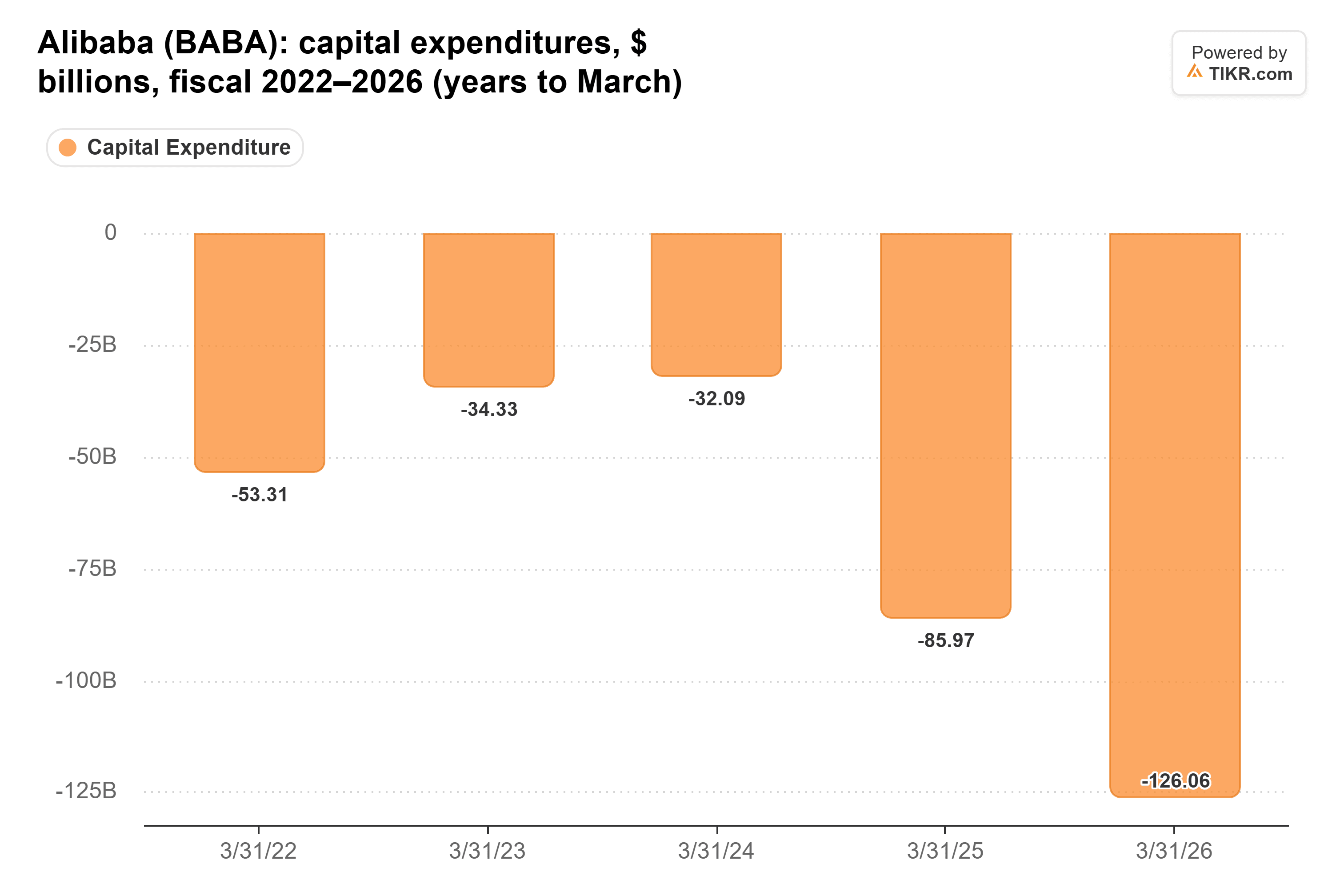
And Alibaba, his example, has the money to build the data centers. Its capital spending nearly quadrupled in the two years through the year ended March 2026…
NVIDIA doesn’t need the loophole
Here’s the thing: NVIDIA can’t make enough chips as it is.
Management guides for roughly 70% revenue growth in fiscal 2028 (the year ending January 2028) and says supply is what limits that figure. NVIDIA has also reportedly told Chinese customers it can’t guarantee their RTX PRO 5500 orders. It can make no more than 3 million of the cards in 2027, and Chinese customers have ordered more than 6 million.
Wall Street expects plenty of growth anyway. Analysts see revenue nearly doubling to $412 billion this fiscal year, then reaching $692 billion in fiscal 2028 and $903 billion the year after…

Nothing McGuire said should move those estimates, since the guidance they’re built on already leaves out China data center sales.
Plus: going after rental demand would mean picking a fight in Washington. In January the House voted 369-22 to pass the Remote Access Security Act, which would put renting out chips under export-control law. As of August, it hadn’t passed the Senate. And the first item on McGuire’s own policy agenda is “closing loopholes in controls.”
The catch is that nobody has measured how much Chinese demand already reaches NVIDIA through data centers in Malaysia, Singapore or the US, where it would count as non-China revenue. If Washington closes the loophole, some of that revenue could go away.
China is a bonus
My take: NVIDIA has sold every chip it can make, and its guidance already leaves China out, so it has little to gain from defending a loophole. Any Chinese demand that comes in through rentals is a bonus. With the stock at a forward P/E below its one-, three- and five-year averages (24x, 30x and 36x), I don’t think the market is paying for it.
Of course, NVIDIA reports on Nov. 17, and anything it says about China, or about who’s renting its chips, could change that.
So what is NVIDIA stock actually worth?
TIKR lets you forecast the future price of any stock in less than a minute. Just enter a few assumptions into TIKR’s valuation model and see what NVIDIA could be worth. Start from Wall Street consensus estimates, or adjust the inputs to reflect your own view of the business. It’s free to use.
Disclaimer:
Please note that the articles on TIKR are not intended to serve as investment or financial advice from TIKR or our content team, nor are they recommendations to buy or sell any stocks. We create our content based on TIKR Terminal’s investment data and analysts’ estimates. Our analysis might not include recent company news or important updates. TIKR has no position in any of the stocks mentioned. Thank you for reading, and happy investing!