Key Takeaways
- Elon Musk now expects $500 billion to $1 trillion of annual recurring revenue by the end of 2027, and hitting that would take returns on compute the AI industry has never come close to.
- Short seller Jim Chanos says the goal implies $1 to $2 of revenue per dollar of capex, against about $0.30 for the industry, and puts SpaceX’s Q3 AI revenue at $19.5 million per MW.
- Over the next few quarters, watch SpaceX’s AI capex and its revenue per MW: Q3’s AI capex was $16 billion, against the roughly $500 billion Chanos says the plan needs.
SpaceX (SPCX) could have had a nice, boring run after reporting blockbuster earnings last week. Heck, the earnings were good enough to lift NVIDIA (NVDA) stock as well!
But Elon Musk had to raise the stakes. He said SpaceX expects its annual recurring revenue to land between $500 billion and $1 trillion by the end of 2027, and he posted on X: “As crazy as this sounds, $1T in SpaceX revenue in 2028 is no longer impossible.”
SpaceX brought in $14.6 billion of revenue in the third quarter.
Short seller Jim Chanos did the math on X. He figures the goal implies about $500 billion of capex for 10 GW of new capacity, and: “This is a 1-2x revenue/investment ratio as the entire industry is now at 0.3x. Their 3Q AI capex was only $16B. They had better get going…”
So SpaceX would have to earn three to nearly seven times as much revenue on each dollar of capex as the rest of the industry does today.
No pressure.
TIKR tracks 38 analysts on SpaceX. How many say “Buy”?
See the full breakdown of Buy, Hold, and Sell ratings on SpaceX, along with Wall Street’s revenue and earnings estimates, all in one place. More than 500,000 investors use TIKR to research stocks like this one. See SpaceX’s Analyst Ratings
The returns aren’t there yet
AI now brings in about half of SpaceX’s revenue. The superintelligence segment (formerly AI) brought in $7.56 billion in Q3, up 830% from a year ago, on 1.7 GW of installed compute.
Multiply that by four and you get the $30 billion of AI ARR Chanos uses. In a follow-up post, he says that leaves SpaceX “not even remotely close” to a 1-2x ratio today, even with the Google and Anthropic deals.
He also puts Q3’s annualized AI revenue at $19.5 million per MW, “a far cry from the $40-50M figures that were thrown around during the quarter.” By his reading, that’s much closer to where the rest of the industry is.
Wall Street isn’t modeling anything near Musk’s number. Analysts expect revenue to climb from $45.9 billion this year to $132 billion in 2027 and $249 billion in 2028…

That’s already explosive growth. Musk’s $1 trillion for 2028 is still four times what the Street expects, and nothing in Q3’s per-MW figure would push those estimates up that much.
$500 billion is a lot of data centers
SpaceX’s capital spending has been climbing fast, from $11.2 billion in 2024 to $20.9 billion in 2025…
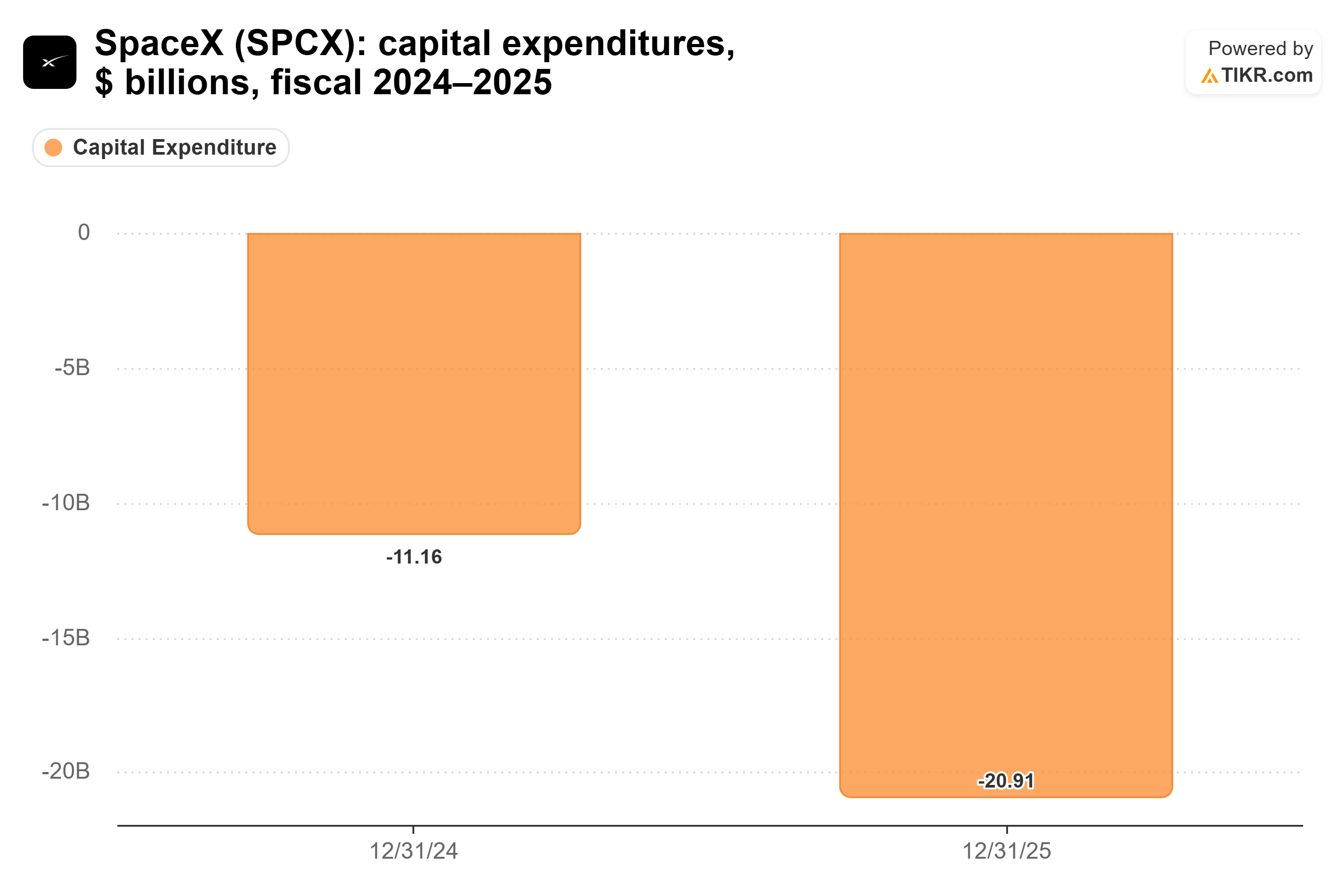
…and Q3’s $19.6 billion alone nearly matched all of 2025.
Even so, $500 billion is more than 20x what SpaceX spent last year. There are five quarters left until the end of 2027, so spending it all by then would mean about $100 billion a quarter, more than six times Q3’s $16 billion of AI capex. (That’s only if the full build is done by then.)
SpaceX ended the quarter with $90 billion of cash and marketable securities. That’s a solid cushion, but it covers less than a fifth of the bill.
The new deals have to do the heavy lifting
Chanos was skeptical before the report, too, when he called SpaceX “the largest global neocloud”. And Q3’s revenue per MW could rise as capacity for the Google and Anthropic deals comes online.
Even at the $40 million to $50 million per MW that was floated during the quarter, though, 10 GW of new capacity works out to $400 billion to $500 billion a year. That only reaches the bottom of Musk’s range, and it takes a $500 billion build plus more than twice Q3’s revenue per MW.
The rally is betting on a leap
Chanos has the better of the math here. The 9% jump prices in returns on compute that no one in the industry has delivered, and Q3 doesn’t show SpaceX getting there yet.
My take: a lot of the upside in SpaceX stock now rests on a goal its own numbers don’t support, so a disappointment from here could hurt. If SpaceX really does spend anything like $500 billion, the suppliers selling it compute, NVIDIA among them, could be the more dependable winners.
Of course, this is one quarter of AI results. The next few reports will show whether AI capex is heading toward $100 billion a quarter and whether revenue per MW is climbing toward the figures bulls were talking about.
So what is SpaceX stock actually worth?
TIKR lets you forecast the future price of any stock in less than a minute. Just enter a few assumptions into TIKR’s valuation model and see what SpaceX could be worth. Start from Wall Street consensus estimates, or adjust the inputs to reflect your own view of the business. It’s free to use.
Disclaimer:
Please note that the articles on TIKR are not intended to serve as investment or financial advice from TIKR or our content team, nor are they recommendations to buy or sell any stocks. We create our content based on TIKR Terminal’s investment data and analysts’ estimates. Our analysis might not include recent company news or important updates. TIKR has no position in any of the stocks mentioned. Thank you for reading, and happy investing!