Key Takeaways
- Jefferies raised its Spotify price target to $620 from $600 and called the platform highly defensible against AI, while the stock is down 8.5% in 2026.
- Margins are the best test of that call, because a business losing ground to AI shouldn’t be able to keep raising prices and keep more of every euro.
- Spotify guided to a 32.9% gross margin and €670 million of operating income for the third quarter, after 33.4% and €655 million in the second.
- At about 35x forward earnings, the stock gets cheaper quickly if margins keep climbing, though a soft subscriber count or Q4 outlook could still overshadow a strong margin print.
Spotify (SPOT) stock is down 8.5% in 2026 (through Tuesday’s close), as investors worry about what AI could do to a subscription music business.
Jefferies thinks the market has it wrong, and Spotify gets its chance to show which side is right when it reports third-quarter results before the open on Thursday, Oct. 22.
What Jefferies is betting on
On Tuesday, Jefferies kept its Buy rating and raised its price target to $620 from $600, about 18% above Tuesday’s close. Analyst James Heaney called Spotify’s platform “highly defensible against AI disintermediation fears.”
His reasons: expectations are muted, he expects operating expense growth to peak this quarter, and he sees advertising improving as programmatic sales become a bigger part of the business. (Ads could use the help: ad-supported revenue grew just 1% in the second quarter.) He also expects price increases in the US and UK within the next six to 12 months.
Then there’s the AI angle. Jefferies sees a possible launch announcement later this year for an AI-powered remixing product tied to Spotify’s partnership with Warner Music Group. But its base case includes no AI revenue at all, so none of that $620 depends on AI paying off.
TIKR tracks 40 analysts on Spotify. How many say “Buy”?
See the full breakdown of Buy, Hold, and Sell ratings on Spotify, along with Wall Street’s revenue and earnings estimates, all in one place. More than 500,000 investors use TIKR to research stocks like this one. See Spotify’s Analyst Ratings
Pricing power shows up in margins
If AI were really pulling listeners away from Spotify, pricing is where you’d see it first. People who have somewhere better to go don’t keep paying more.
Spotify’s subscribers keep paying more. In the second quarter, Premium revenue grew 15% to €4.33 billion, from 9% more subscribers and 7% higher revenue per user.
Those price increases have widened the gross margin, from 25.0% in 2022 to 32.0% in 2025…

…and it reached 33.4% in the second quarter of 2026, up 193 basis points from a year earlier.
The gains are making it to the bottom line, too. Operating margin went from -5.6% in 2022 to 12.8% in 2025:
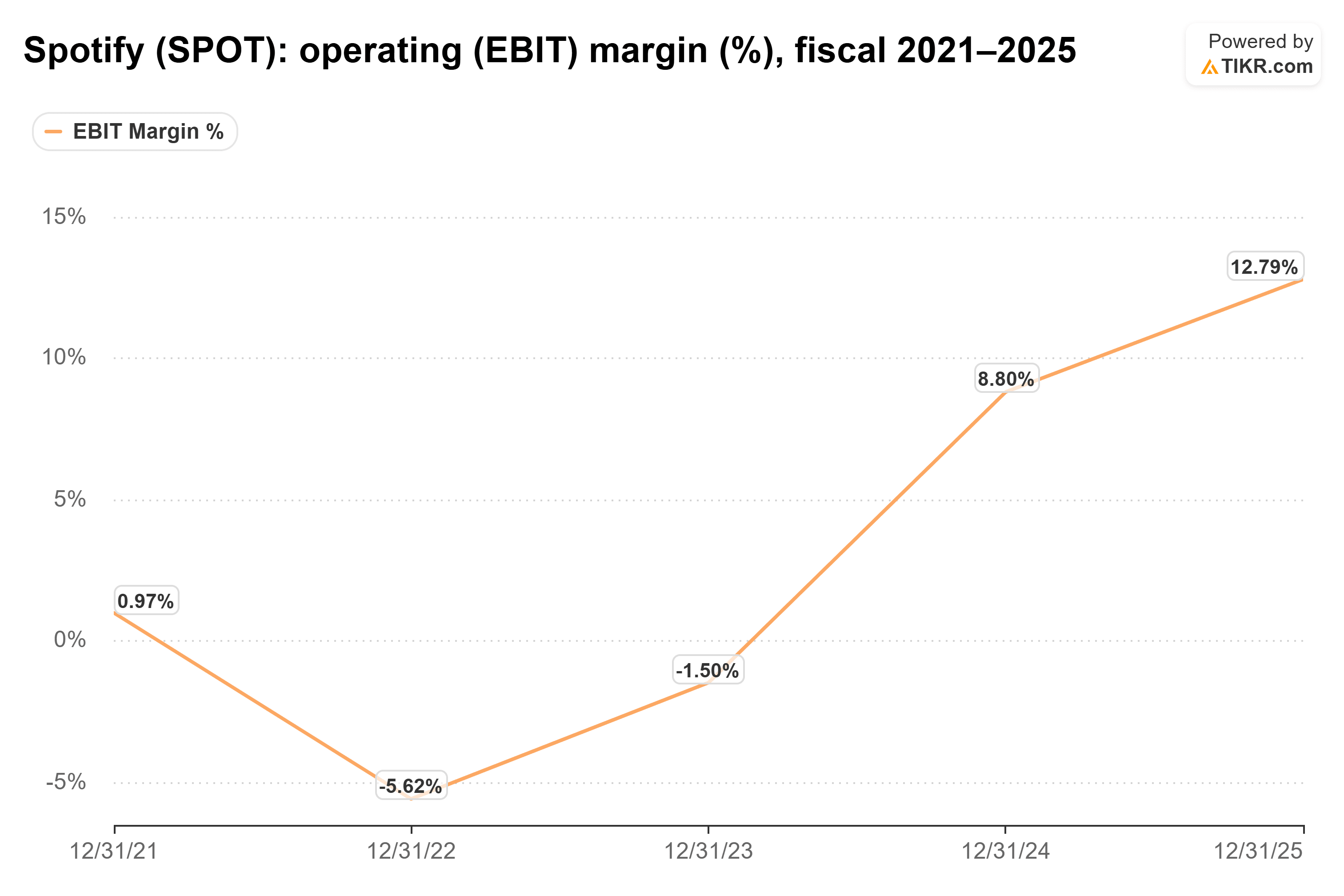
It was 13.7% in the second quarter, on €655 million of operating income. Over the twelve months through June, free cash flow came to €3.3 billion, up from €2.9 billion for 2025.
The bar for Thursday
Spotify guided to a 32.9% gross margin for the third quarter, along with €670 million of operating income on about €5.0 billion of revenue, which works out to roughly a 13.4% operating margin.
That’s a step down from the second quarter. Jefferies puts it down to seasonal factors and a regulatory charge that has historically taken 30 to 40 basis points off the margin, and it expects investors to look for about 33.1%. The fourth-quarter outlook matters as much: Jefferies cut its own Q4 gross margin forecast to about 33.7% from 34.3%, since 2026 has been an investment year.
Spotify doesn’t always trade on its margins, though. In August, the gross margin beat guidance and the stock still fell 3.4% after an earnings miss. So a subscriber count short of the 305 million guide, or a cautious Q4 outlook, could outweigh a good margin print.
A valuation gap, if the margins hold
Spotify trades at about 35x forward earnings. Analysts expect 2026 earnings per share to grow about 16%, a bit faster than revenue. Each extra point of margin pushes earnings growth further ahead of revenue growth, and that brings the multiple down quickly.
Management has put money behind the stock, too: Spotify added $1.5 billion to its buyback heading into the report.
My take: Spotify’s margins have done everything a defensible platform’s margins should, and at 35x forward earnings the stock is priced as if that’s about to stop. If Thursday’s margin holds at or above guidance and the Q4 outlook keeps it climbing, the AI fear is a valuation gap, and Jefferies’ $620 looks reasonable.
Of course, the US and UK price increases Jefferies expects haven’t been announced yet, and they’re what keeps this margin story going into 2027.
So what is Spotify stock actually worth?
TIKR lets you forecast the future price of any stock in less than a minute. Just enter a few assumptions into TIKR’s valuation model and see what Spotify could be worth. Start from Wall Street consensus estimates, or adjust the inputs to reflect your own view of the business. It’s free to use.
Disclaimer:
Please note that the articles on TIKR are not intended to serve as investment or financial advice from TIKR or our content team, nor are they recommendations to buy or sell any stocks. We create our content based on TIKR Terminal’s investment data and analysts’ estimates. Our analysis might not include recent company news or important updates. TIKR has no position in any of the stocks mentioned. Thank you for reading, and happy investing!