Key Stats for Nike Stock
- This Week Performance: 4%
- 52-Week Range: $52 to $82
- Current Price: $65
What Happened to Nike Stock?
Nike (NKE) shares closed at $65.40 this Friday before the U.S. Supreme Court struck down President Trump’s global tariffs, ruling his use of the 1977 IEEPA exceeded his authority, a decision expected to deliver immediate relief to retail and consumer discretionary stocks broadly.
The ruling directly removed one of the most pressing cost pressures facing Nike, which sources significant manufacturing from overseas markets hit hardest by the tariff regime.
Meanwhile, RBC Capital Markets flagged Nike as a favored sporting goods pick on February 18 following U.S. marketing trips, even as the firm noted the softest investor sentiment across the broader consumer sector since 2014-2016.
Still, the broader sentiment picture for Nike remains complicated, with Viking Global dissolving its entire Nike stake as of December 31, signaling at least one major institutional player exited the position entirely heading into 2026.
Meanwhile,on the operational front, Nike accelerated its turnaround under CEO Elliott Hill, laying off 775 distribution employees in January and restructuring Converse on February 12 into cross-functional sport squads, compressing significant strategic change into a tight six-week window.
Nike also reinforced shareholder confidence on February 13 by declaring a quarterly dividend of $0.41 per share, payable April 1, signaling financial stability even as the company absorbs restructuring costs across its distribution and brand operations.
Wall Street’s Take on NKE Stock
The Supreme Court’s tariff ruling removes a structural cost overhang that had weighed on Nike’s global sourcing model, clearing a path for the turnaround under CEO Elliott Hill to gain traction without the added drag of import-related margin pressure.
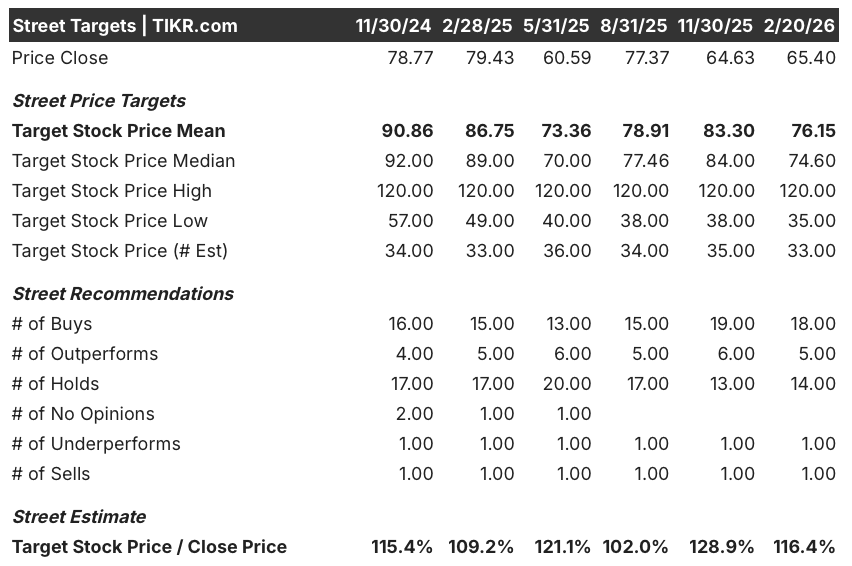
Wall Street currently holds 18 buy ratings and 14 holds on Nike as of February 20, with the mean price target sitting at $76.15 against a closing price of $65.40, implying roughly 16.4% upside from current levels.
The target range stretches from a bear-case low of $35 to a bull-case high of $120, reflecting the wide disagreement on how quickly Hill’s turnaround strategy converts restructuring costs into sustained revenue growth and market share recovery.
What Does the Valuation Model Say?
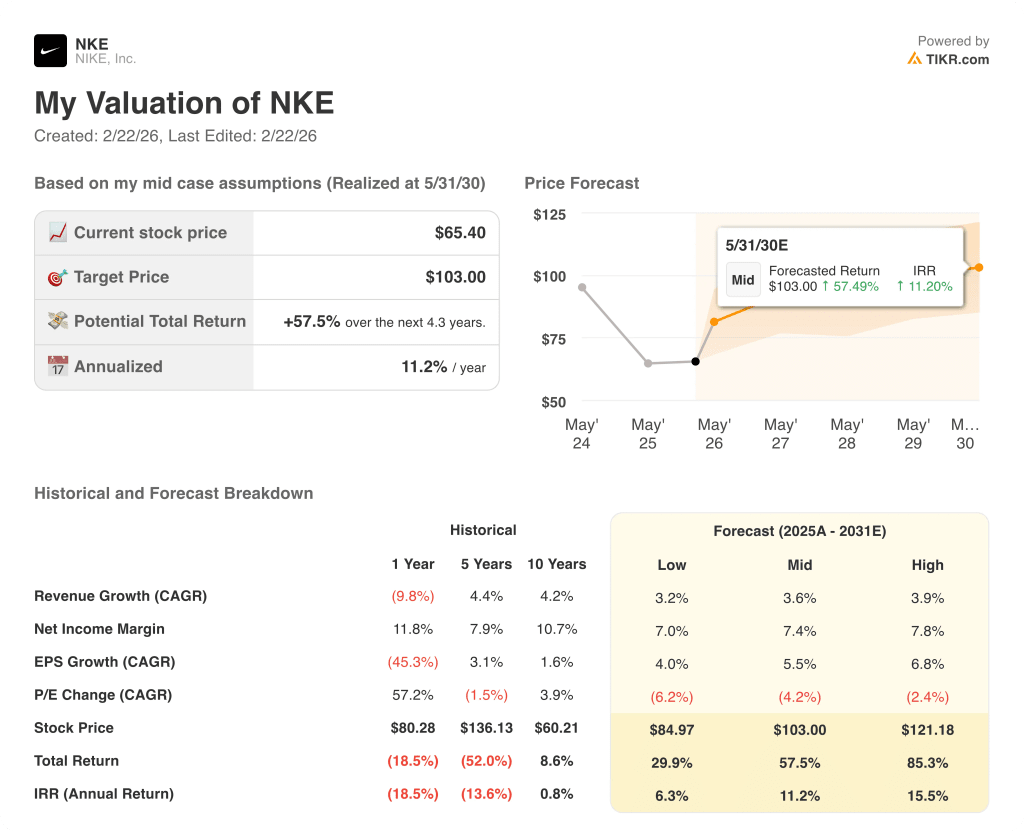
Even after stripping out the tariff noise, a mid-case valuation model prices Nike at $103 per share by May 2030, projecting a total return of 57.5% and an annualized IRR of 11.2% over the next 4.3 years.
The key risk is execution: Nike’s one-year revenue growth sits at negative 9.8% and EPS growth collapsed 45.3% over the same period, meaning the bull case depends entirely on Hill delivering a credible inflection before analyst patience runs thin.
At $65.40, Nike looks undervalued relative to both analyst consensus and the mid-case model, but the stock remains a show-me story where the turnaround must produce visible results before the market awards it a meaningfully higher multiple.
Value Any Stock in Under 60 Seconds (It’s Free)
With TIKR’s new Valuation Model tool, you can estimate a stock’s potential share price in under a minute.
All it takes is three simple inputs:
- Revenue Growth
- Operating Margins
- Exit P/E Multiple
From there, TIKR calculates the potential share price and total returns under Bull, Base, and Bear scenarios so you can quickly see whether a stock looks undervalued or overvalued.
If you’re not sure what to enter, TIKR automatically fills in each input using analysts’ consensus estimates, giving you a quick, reliable starting point.