
0
days
0
hours
0
min.
0
sec.

💥Build Your Research Hub Your Way.New users are invited to save 25% for a limited time

0
days
0
hours
0
min.
0
sec.
Shop the Plan →

Navitas Semiconductor Is Up 80% in a Year. Its AI Pivot Has Wall Street Split.

David Beren6 minute read
Reviewed by: David Hanson
Last updated Aug 8, 2026

AndreyPopov from Getty Images, Alexander Kuzmin from Getty Images via Canva

Key Stats for Navitas Semiconductor Stock

  • 52-Week Range: $5.44 – $34.17
  • Current Price: $13.89
  • Street Mean Target: $14.08
  • TIKR Model Target (Mid): $17.61
  • Q2 2026 Revenue: $10.53M (+22% sequential)
  • Q2 2026 Gross Margin: 39.5%
  • Forward 2-Year Revenue CAGR: 27%
  • Market Cap: $3.6B

Now Live: Discover how much upside your favorite stocks could have using TIKR’s new Valuation Model (It’s free)>>>

From Mobile Castoff to AI Infrastructure Play

Two years ago, Navitas Semiconductor (NVTS) was a company in real trouble. Its core business, making gallium nitride power chips for smartphone chargers, was getting crushed by Chinese competition, and revenue was sliding fast.

Management made a decision that looked painful in the short term: walk away from mobile almost entirely, and redirect everything toward high-power GaN and silicon carbide applications for AI data centers and electric vehicles.

GaN and SiC are power semiconductors that convert electricity more efficiently than traditional silicon, which makes them increasingly valuable in environments where power density and thermal management actually matter, like a 100,000-server AI data center or a high-voltage EV drivetrain. Revenue fell nearly 45% in fiscal 2025 as the mobile business wound down. Then Q2 2026 happened.
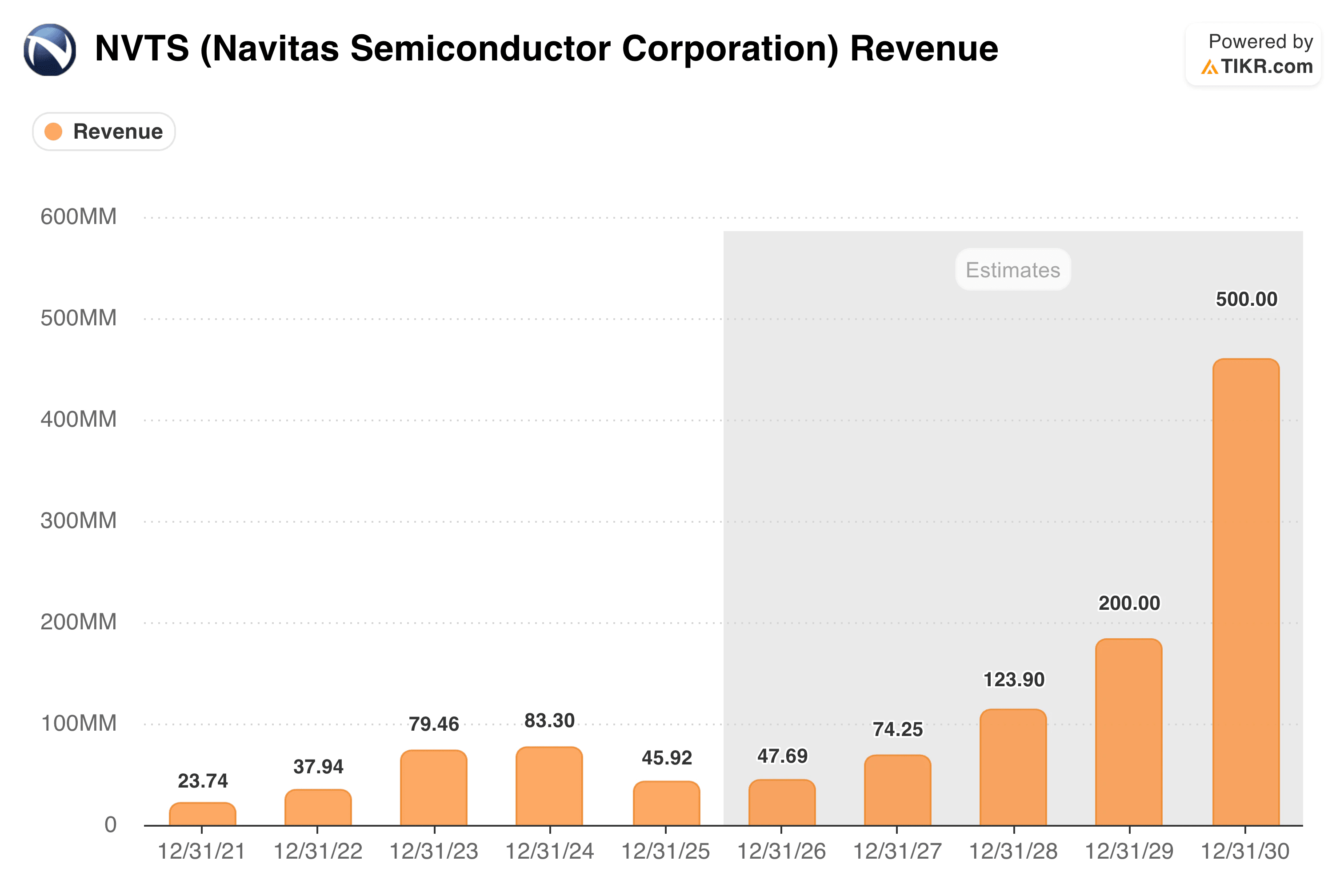
Navitas Semiconductor Revenue Estimates. (TIKR)

Revenue came in at $10.53 million, ahead of the $9.97 million Wall Street estimate, and grew 22% sequentially from Q1.

Management guided Q3 to approximately $12.5 million, another step in what is shaping up to be a sustained acceleration. AI infrastructure is expected to represent more than one-third of total sales by year-end, and the company said its backlog now extends into 2027.

That last point matters more than the headline revenue number: backlog visibility at this stage of the ramp suggests design wins with real customers, not just roadmap speculation.

See historical and forward estimates for Navitas stock (It’s free!) >>>

The Margin Story Has a Twist

Here is where things get genuinely interesting. The quarterly margin trajectory is moving in the right direction, with Q2 gross margin coming in at 39.5% and management guiding Q3 to approximately 39.7%.

Those improvements are real, and they reflect the higher-quality revenue mix as mobile fades out and AI and EV applications grow as a share of the business.

Navitas Semiconductor Gross Margins. (TIKR)

The annual chart, though, tells a more complicated story. Gross margin peaked at 45% back in fiscal 2021, collapsed to around 31% in 2022, recovered to 39% in 2023, and has since drifted back down to 31% through fiscal 2025.

The quarterly momentum heading into the second half of 2026 is encouraging, but the annual trend is a useful reminder that margin stability has not come easily to this business.

Operating losses are still severe: the LTM EBIT margin sits at negative 252%, a reflection of heavy R&D investment and significant stock-based compensation. Getting to operating profitability, under even optimistic assumptions, is still years out.

See how Navitas performs against its peers in TIKR (It’s free!) >>>

What the Numbers Need to Prove

The entire bull case here is a bet on what the revenue ramp looks like starting in 2027. Consensus projects growth from $46 million in fiscal 2025 to around $74 million this year, $124 million by 2028, and approaching $500 million by 2030.

Those are extraordinary growth rates for a company this size, and they imply Navitas capturing a meaningful share of what management believes is a $3.5 billion serviceable addressable market by 2030 across AI infrastructure, EVs, and industrial power applications.

The technology argument for why Navitas can compete is credible: high-voltage GaN offers real performance advantages over silicon in exactly the kind of high-power, high-efficiency applications that are proliferating right now.

Navitas Semiconductor Valuation Model. (TIKR)

The TIKR valuation model prices in a mid-case scenario of around $18 per share, implying roughly 27% total return from current levels over the next four-plus years, or about 5.5% annualized. The low case gets to around $39 by 2034 at roughly 13% per year; the high case reaches around $95 at roughly 26% annually.

The wide spread between those scenarios reflects the genuine uncertainty about timing: the revenue inflection story is real, but the gap between when it starts and how fast it scales makes a huge difference to returns at a valuation like this one.

Should You Buy Navitas Semiconductor Stock?

Navitas is a legitimate technology company making a real product that solves a real problem, and the Q2 results are the clearest evidence yet that the pivot toward high-power applications is beginning to pay off. What is harder to get comfortable with is the price.

At nearly 50 times forward revenues on a business generating around $10 million per quarter, the stock is pricing in a version of Navitas that does not exist yet, and the mid-case model says you are earning roughly 5.5% per year to wait for it.

A Wolfspeed patent lawsuit hanging over the company adds uncertainty that is not fully reflected in the current valuation. The bull case is real, but it requires a lot to go right, and the return profile for assuming it does is thinner than the risk warrants for most investors.

See analysts’ growth forecasts and price targets for Navitas stock (It’s free!) >>>

Looking for New Opportunities?

Disclaimer:

Please note that the articles on TIKR are not intended to serve as investment or financial advice from TIKR or our content team, nor are they recommendations to buy or sell any stocks. We create our content based on TIKR Terminal’s investment data and analysts’ estimates. Our analysis might not include recent company news or important updates. TIKR has no position in any of the stocks mentioned. Thank you for reading, and happy investing!

Related Posts

Join thousands of investors worldwide who use TIKR to supercharge their investment analysis.

Sign Up for FREENo credit card required