
Key Stats for Microsoft Stock
- 52-Week Range: $349.20 – $553.72
- Street Mean Target: ~$569
- Market Cap: ~$3.59T
- NTM P/E: 24.5x
- LTM EBIT Margin: 46.8%
- FY2026 Revenue: $331.8B (up 18% YoY)
- Azure Annual Revenue: Crossed $100B milestone in FY2026
Now Live: Discover how much upside your favorite stocks could have using TIKR’s new Valuation Model (It’s free) >>>
A Year of Pain, Then One Report That Changed Everything
Microsoft (MSFT) spent the better part of 2026 as one of the most frustrating large-cap technology stocks on the market. Revenue grew 17-18% year over year in every quarter. EPS beat consensus in each one. And yet investors kept selling.
By Q4 fiscal 2026, MSFT shares had fallen roughly 19% from their January high, while the S&P 500 was up around 7%. The gap between the underlying business and the stock price was as wide as it had been in years.
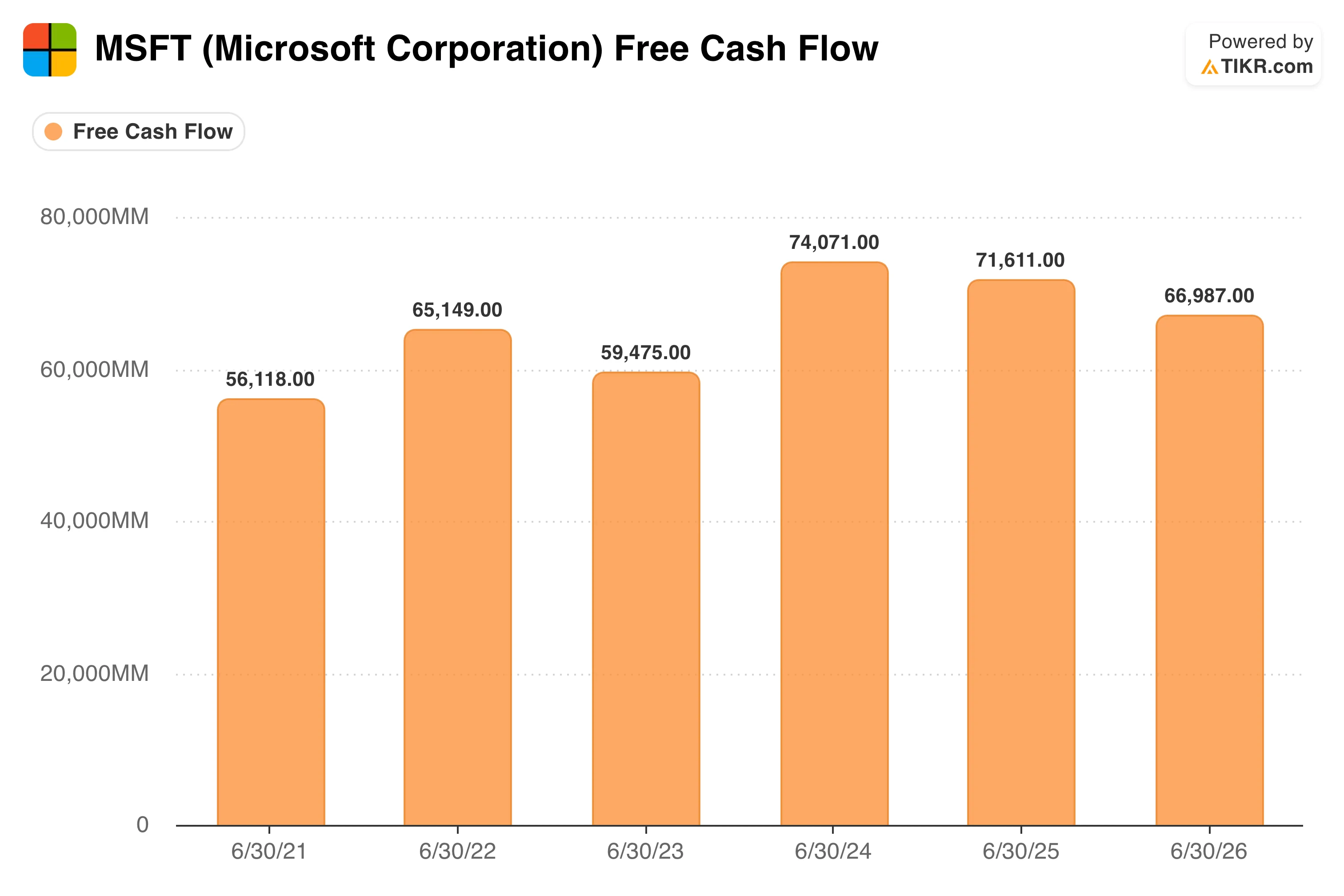
The frustration centered on one number: free cash flow. Microsoft has been spending at a scale that would have seemed implausible three years ago. Capital expenditures for calendar 2026 came in at around $190 billion as the company built out data centers and GPU infrastructure to meet what management has described as demand outpacing supply. The FCF chart shows the consequence clearly.
Free cash flow peaked at $74.1 billion in FY2024, then fell to $71.6 billion in FY2025, and dropped further to $67.0 billion in FY2026 as the CapEx surge overwhelmed even Microsoft’s exceptional operating cash generation.
CFO Amy Hood acknowledged the pressure directly on the Q4 call, saying she expects the company to be FCF positive in FY2027.
Then July 29 arrived. Azure grew 43% in Q4, well ahead of the 40% analysts had modeled, and crossed $100 billion in annualized revenue for the first time.
Commercial remaining performance obligations surged 84% to $678 billion, providing concrete evidence that AI infrastructure spending was generating locked-in, long-term demand. Microsoft 365 Copilot crossed 30 million paid seats, up from 20 million just three months earlier.
Revenue came in at $90 billion for the quarter, an 18% gain that beat estimates by more than $2 billion. CEO Satya Nadella declared Microsoft’s AI business had crossed a $37 billion annual run rate, up 123% year over year. The stock jumped roughly 17% the following day.
See historical and forward estimates for Microsoft stock (It’s free!) >>>
Where the Revenue Goes From Here
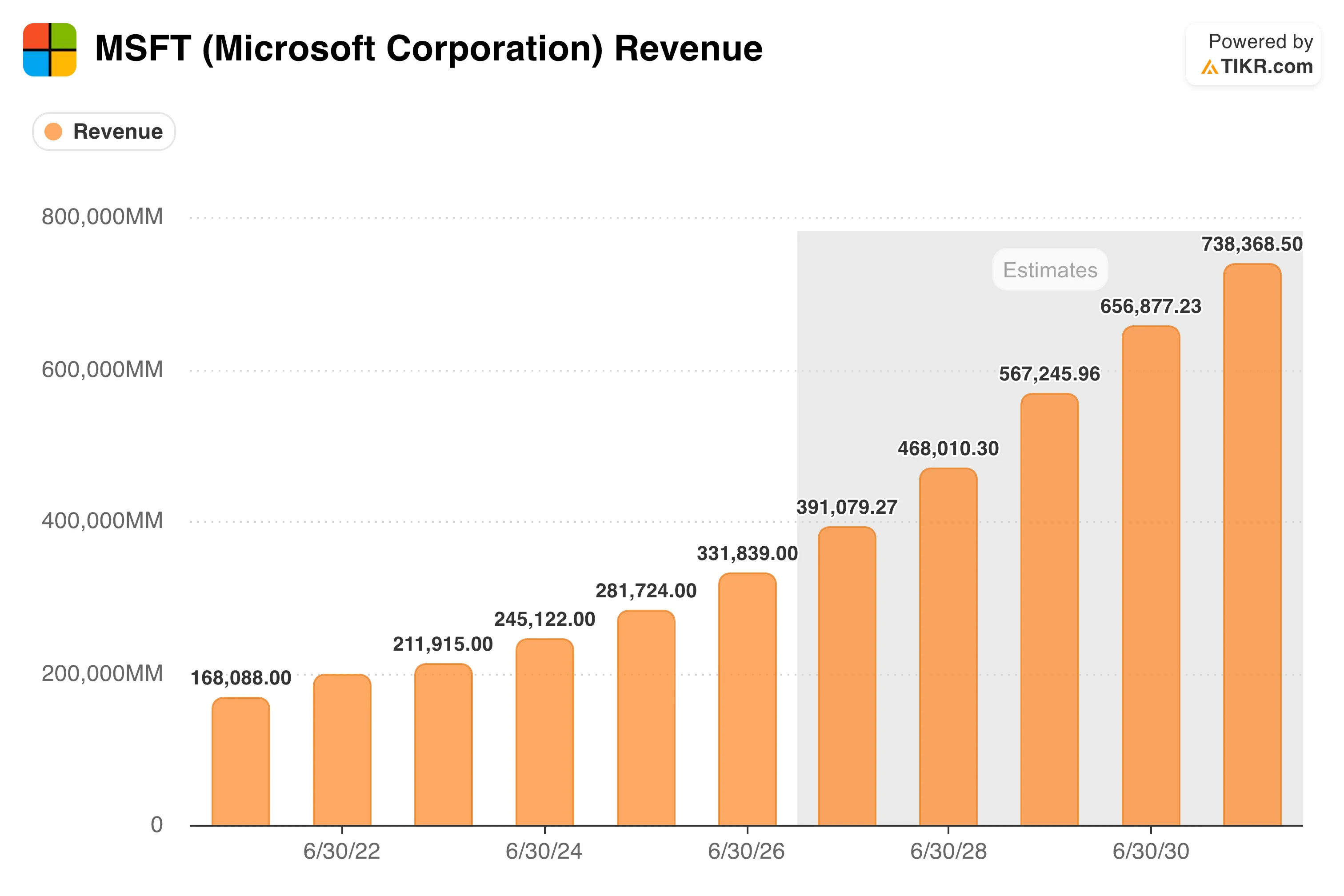
The revenue trajectory the TIKR chart reveals is worth sitting with. Microsoft went from $168 billion in FY2021 to $245 billion in FY2023 and $332 billion in FY2026. The slope is steep, and consensus estimates suggest it steepens further.
Analysts project FY2027 revenue around $391 billion, growing toward $468 billion in FY2028 and $567 billion by FY2029. The implied compound growth rate sits in the mid-to-high teens, extraordinary for a company already generating more than $300 billion annually.
Azure is the fastest-growing, accelerating toward 45% growth in the current quarter per management’s own guidance. Microsoft 365 Commercial cloud grew 19% in the March quarter, with per-user revenue rising as enterprises upgrade to Copilot-enabled tiers.
Security, a segment that most investors underweight, is now an $18 billion annual business growing at double-digit rates.
The commercial backlog of $678 billion pre-funds revenue for years, and the OpenAI relationship gives the cloud business a structural demand anchor that competitors cannot easily replicate.
See how Microsoft performs against its peers in TIKR (It’s free!) >>>
What the Valuation Model Says About MSFT Stock
After months of multiple compression, Microsoft trades at roughly 24.5 times forward earnings, a level not seen in years. The NTM P/E sat in the mid-30s for much of 2024. What changed is not the business quality but the market’s patience with the CapEx cycle.
TIKR’s valuation model targets around $1,112 per share based on mid-case assumptions, implying roughly a 130% total return from current levels over approximately five years.
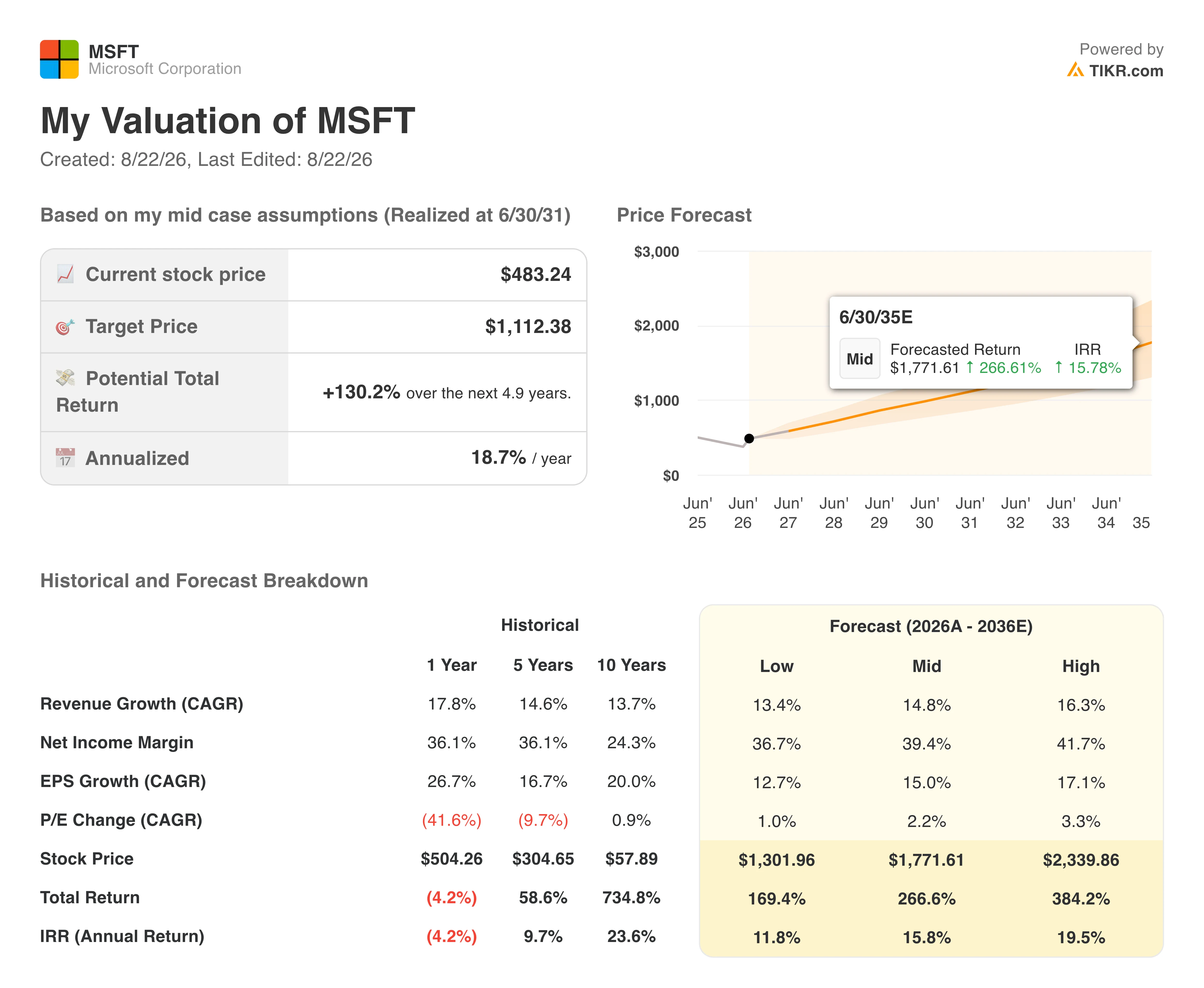
The annualized return works out to around 19% per year. The model assumes roughly 15% revenue growth and net income margins expanding toward 39%, both consistent with where Microsoft has been trending as AI revenue scales faster than infrastructure costs. A more extended mid-case to 2035 puts the price near $1,772 at roughly a 16% annualized IRR.
Should You Buy Microsoft Stock?
Microsoft’s fundamental case is among the strongest in large-cap technology. Azure is reaccelerating with a $678 billion backlog behind it, Copilot monetization is moving faster than most models anticipated, and the company is generating $67 billion in free cash flow even while spending $190 billion on CapEx.
The multiple has compressed to a level that implies far less confidence in the AI buildout than the Q4 results seem to justify.
The risks are genuine and worth naming. Free cash flow has declined for three straight years as CapEx has surged, and FY2027 CapEx is expected to grow further still, toward $255-260 billion. Any slowdown in Azure growth, whether from competition with Google Cloud or Amazon Web Services, or constrained GPU availability, could renew selling pressure quickly.
The OpenAI relationship carries concentration risk, with roughly 45% of the $678 billion backlog tied to OpenAI consumption. And after the 17% surge post-earnings, the stock has already partially priced in the good news. Investors buying today are getting a better setup than they would have had six months ago, but they are not buying at the bottom.
See analysts’ growth forecasts and price targets for Microsoft stock (It’s free!) >>>
Looking for New Opportunities?
- See which stocks billionaire investors are buying to follow the smart money.
- Analyze stocks in as little as 5 minutes with TIKR’s all-in-one, easy-to-use platform.
- The more rocks you overturn… the more opportunities you’ll uncover. Search 100K+ global stocks, global top investor holdings, and more with TIKR.
Disclaimer:
Please note that the articles on TIKR are not intended to serve as investment or financial advice from TIKR or our content team, nor are they recommendations to buy or sell any stocks. We create our content based on TIKR Terminal’s investment data and analysts’ estimates. Our analysis might not include recent company news or important updates. TIKR has no position in any of the stocks mentioned. Thank you for reading, and happy investing!