
Key Stats for Robinhood Stock
- Current Price: $95.10
- Target Price (Mid): ~$235
- Street Target: ~$120
- Potential Total Return: ~145%
- Annualized IRR: ~23% / year
Now Live: Discover how much upside your favorite stocks could have using TIKR’s new Valuation Model (It’s free) >>>
What Happened?
Robinhood Markets (HOOD) rose 4.63% on August 19, but not for a reason specific to Robinhood. The stock climbed alongside Strategy, Coinbase, and Circle as the U.S. Treasury doubled its long-dated bond buybacks and Bitcoin pushed back above $68,000. Of that crypto-sensitive group, Robinhood gained the least, because crypto is a smaller share of its business than the others.
Strip out the macro rally, and a company-specific question is still sitting unanswered underneath it: Robinhood sells tokenized U.S. stocks to customers in more than 120 countries, and it cannot legally sell one to an American.
The Product Robinhood Runs Everywhere But Here
Stock tokens are blockchain versions of real shares, fully backed by the underlying securities and tradable 24/7, including weekends and holidays. Robinhood launched them for European customers last year and has since expanded across more than 120 markets, built on Robinhood Chain, the company’s own Ethereum layer-2 network that went live in July 2026.
On the Q2 call, CEO Vlad Tenev framed the opportunity plainly. “Tokenization makes it possible to expand exposure to high-quality assets like U.S. stocks to every single person with an Internet connection,” he told investors. That reframes Robinhood’s addressable market from American retail traders to anyone worldwide with a smartphone, a population it is only starting to reach, with over 1 million accounts already outside the U.S.
Robinhood Chain crossed 100 million transactions faster than any chain before it, drove over $12 billion in decentralized exchange volume shortly after launch, and pulled in more than $200 million of deposits into Robinhood Earn, its stablecoin lending product paying a 7% yield. Industry-wide, on-chain tokenized equity volume reached roughly $9 billion in 2026, up more than 800% year to date, according to crypto research coverage.

See historical and forward estimates for Robinhood stock (It’s free!) >>>
Why Washington Decides the Rest
The SEC had been preparing an “innovation exemption” giving crypto-native firms a conditional path to issue and trade tokenized securities without full registration. A meeting scheduled for August 14 to advance it was canceled. According to reporting from CoinDesk, White House officials worried a unilateral SEC move could complicate congressional negotiations over the Digital Asset Market Clarity Act, whose tokenized-securities provision faces a reported procedural vote in mid-September.
On August 18, Tenev pressed Washington directly, arguing the U.S. risks watching the rest of the world build the future of ownership around American assets while Americans are locked out. The next day, he was among the executives at a White House crypto summit alongside the CEOs of Coinbase, Ripple, and Nasdaq. This is a campaign for a rule, not a signed rule, and that distinction is the risk: the exemption is delayed rather than dead, the legislative calendar is uncertain, and it could slip again.
Competitors are not waiting. Coinbase launched fully backed tokenized U.S. stocks on-chain in June, and Nasdaq won SEC approval in March 2026 for a pilot trading tokenized equities alongside conventional shares.
What the Core Business Funds While It Waits
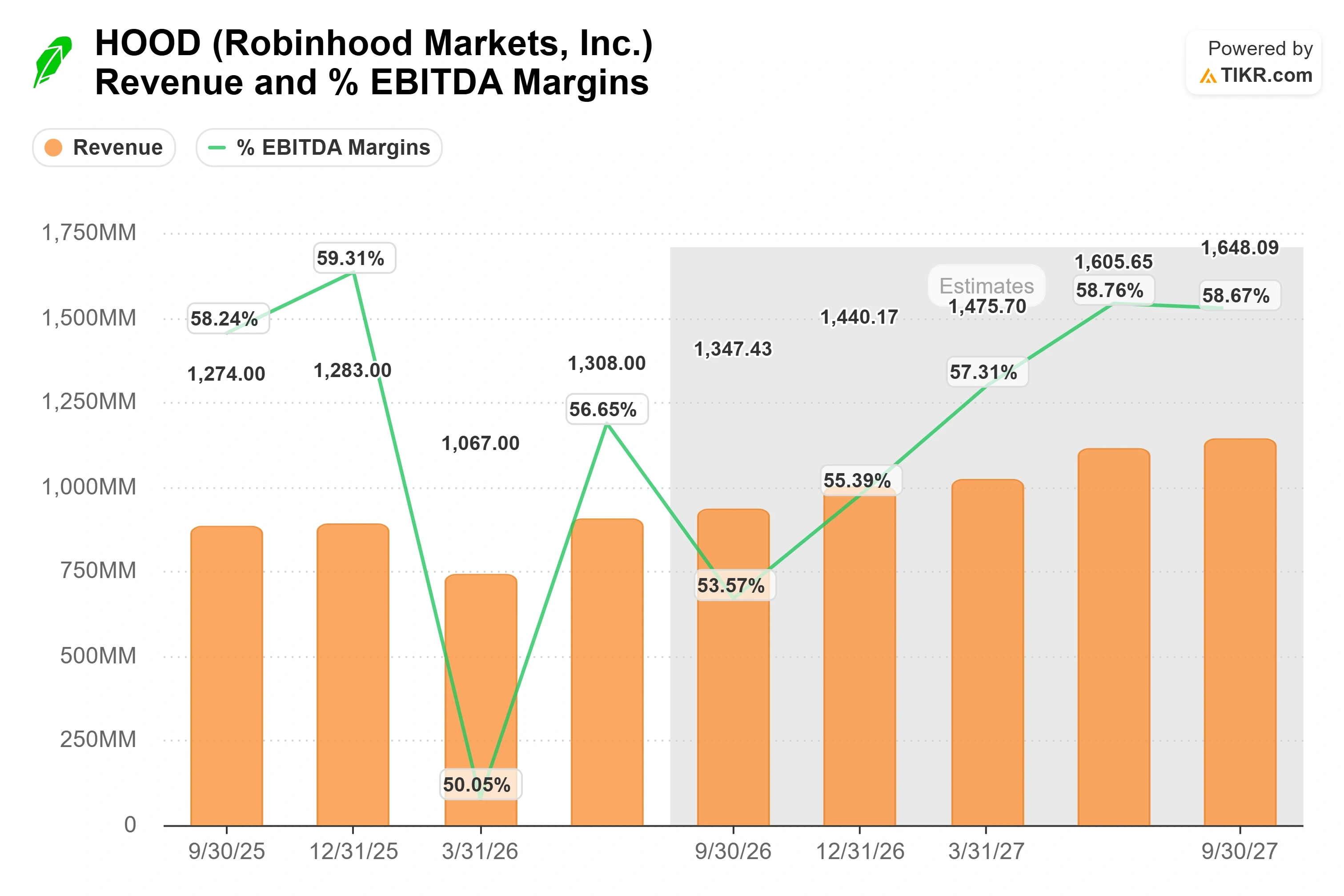
The tokenization option is cheap to own because the underlying business is compounding fast. Robinhood posted record Q2 2026 revenue of $1.308 billion, up 32% year over year, with adjusted EBITDA of $741 million at a 56.65% margin and GAAP EPS of $0.62. Net deposits hit a record $22 billion, the company added nearly 1 million funded customers (its best quarter since the IPO), and Gold subscribers reached 4.8 million. Trump Accounts launched in July, with 7 million children signed up and nearly $1.5 billion in contributions already flowing in. Robinhood even lowered its 2026 cost outlook while absorbing two acquired businesses, so growth and discipline are moving together at scale.
Robinhood trades at around 34 times forward earnings, versus roughly 30 times for Interactive Brokers and a far richer 152 times for Coinbase, per TIKR’s Competitors data. That premium is defensible only if the growth optionality (international, tokenization, Trump Accounts, prediction markets) converts.
See how Robinhood performs against its peers in TIKR (It’s free!) >>>
TIKR Advanced Model Analysis
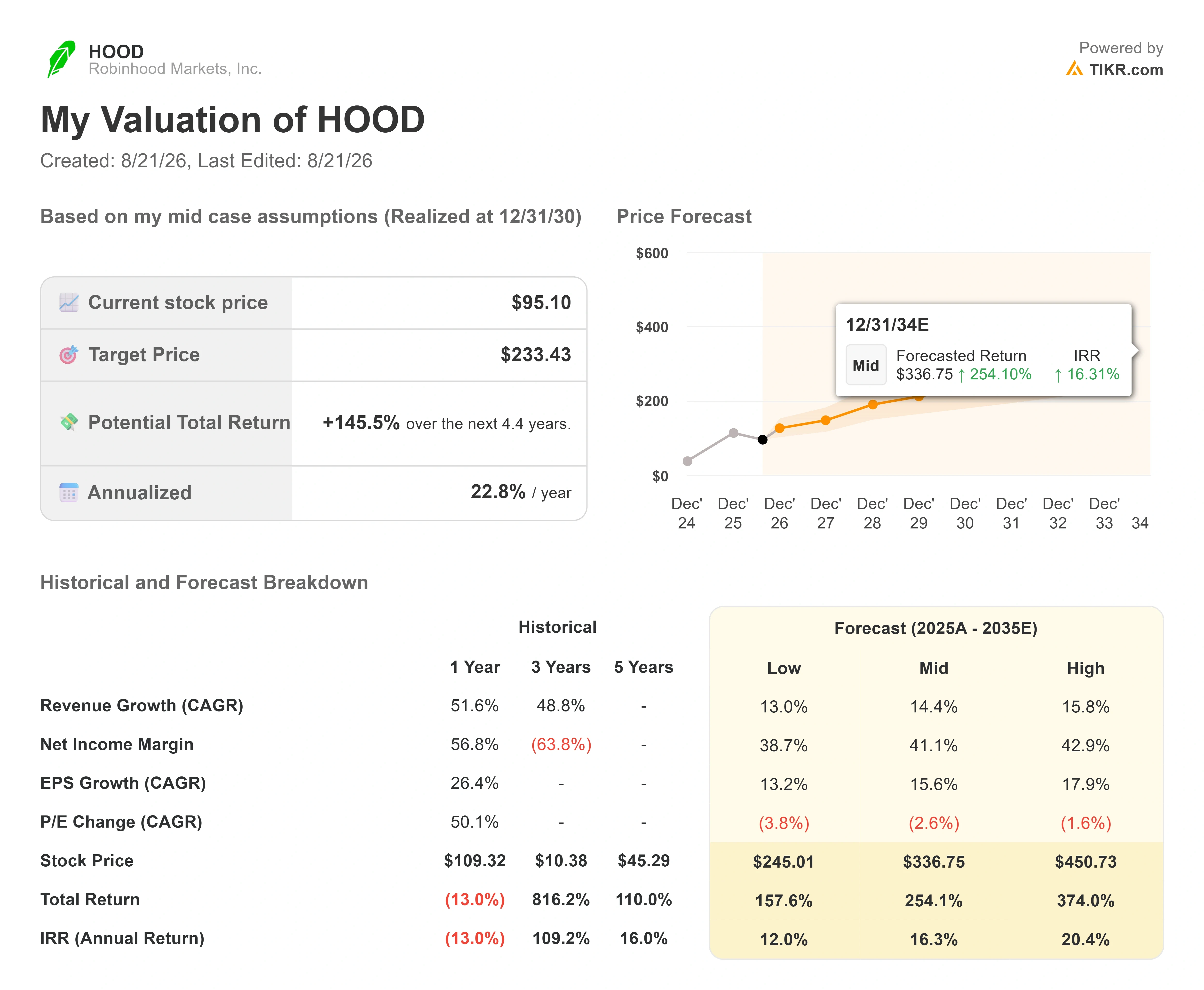
- Current Price: $95.10
- Target Price (Mid): ~$235
- Potential Total Return: ~145% over roughly 4.4 years
- Annualized IRR: ~23% / year
See analysts’ growth forecasts and price targets for Robinhood stock (It’s free!) >>>
Two revenue drivers carry that number: continued net-deposit compounding toward management’s 20%-plus target, and international expansion, where tokenization and the new Singapore license open markets the U.S. brokerage cannot reach. The margin driver is sustained operating leverage, with adjusted EBITDA margins already near 57% and management self-funding new ventures rather than expanding the cost base. The primary risk is Robinhood’s sensitivity to crypto and trading cycles, the same sensitivity that drove this week’s move: a prolonged slowdown in volumes would pressure both revenue and the free cash flow supporting the multiple.
The upside case is that tokenization and international ownership convert into a genuinely global platform, justifying a premium multiple for years. The downside is that regulation stalls, crypto activity fades, and the stock re-rates back toward a conventional brokerage valuation.
Conclusion
Watch mid-September. The reported procedural vote on the CLARITY Act’s tokenized-securities provision is the nearest hard date that will tell investors whether the U.S. path is opening or closing. A vote that advances the framework validates the tokenization thesis and hands Robinhood a domestic runway. A stall confirms the opportunity stays offshore for now, and the stock’s tokenization premium gets harder to defend. This week’s rally came from Bitcoin and the Treasury, not from anything Robinhood decided.
See what stocks billionaire investors are buying so you can follow the smart money with TIKR.
Should You Invest in Robinhood?
The only way to really know is to look at the numbers yourself. TIKR gives you free access to the same institutional-quality financial data that professional analysts use to answer exactly that question.
Pull up Robinhood, and you’ll see years of historical financials, what Wall Street analysts expect for revenue and earnings in the quarters ahead, how valuation multiples have moved over time, and whether price targets are trending up or down.
You can build a free watchlist to track Robinhood alongside every other stock on your radar. No credit card required. Just the data you need to decide for yourself.
Analyze Robinhood on TIKR Free →
Looking for New Opportunities?
- See what stocks billionaire investors are buying so you can follow the smart money.
- Analyze stocks in as little as 5 minutes with TIKR’s all-in-one, easy-to-use platform.
- The more rocks you overturn… the more opportunities you’ll uncover. Search 100K+ global stocks, global top investor holdings, and more with TIKR.
Disclaimer:
Please note that the articles on TIKR are not intended to serve as investment or financial advice from TIKR or our content team, nor are they recommendations to buy or sell any stocks. We create our content based on TIKR Terminal’s investment data and analysts’ estimates. Our analysis might not include recent company news or important updates. TIKR has no position in any stocks mentioned. Thank you for reading, and happy investing!