
Key Stats for Dell Stock
- Current Price: $434.78
- Target Price (Mid): ~$633
- Street Target: ~$509
- Potential Total Return: ~46%
- Annualized IRR: ~9% / year
Now Live: Discover how much upside your favorite stocks could have using TIKR’s new Valuation Model (It’s free) >>>
What Happened?
Dell Technologies (DELL) heads into its September 1 earnings report with the desk and the tape openly disagreeing. In the space of four days, Wells Fargo lifted its target to $545, and Evercore ISI took its own to $550. Buyers did the opposite: the stock fell 6.64% on August 20 to $434.78 and now sits about 15% below the intraday record of $514 it touched on August 13.
Both moves trace to one thing the print will settle: the memory super-cycle. Dell has nearly quadrupled in 2026, and the demand debate is over. What is not settled is what a wave of component inflation does to the profit on all that AI revenue, and whether Dell’s pricing engine is fast enough to stay ahead of it.
How memory inflation lifts targets and pressures margin at once
Component costs are climbing at a pace the group has not seen in years. According to TrendForce’s memory pricing survey, conventional DRAM contract prices rose roughly 90% to 95% quarter over quarter in the first calendar quarter of 2026 and another 58% to 63% in the second, while NAND flash prices climbed 70% to 75% in the second quarter. TrendForce expects the shortage to persist, with meaningful new capacity unlikely before late 2027, because memory makers keep diverting output to high-bandwidth chips for AI accelerators. This is an industry-wide input cost, not a one-quarter spike, and it lands squarely on Dell.
Higher memory prices lift the dollar value of every server Dell ships, padding revenue, and the banks raising targets are partly marking that up. The risk sits one line lower: Dell has to reprice fast enough that rising input costs do not eat the gross margin. Management says it is repricing daily. September 1 is the first clean read on whether daily repricing actually held the line in a full quarter of peak inflation.

See historical and forward estimates for Dell stock (It’s free!) >>>
Why Customers Pay Dell’s price: 6.5-hour rack deployment
The reason Dell can pass costs through at all is that customers are not buying loose components. They are buying working racks, fast, and that is where Dell’s edge is hardest to copy. At the Bank of America Global Technology Conference on June 2, Arthur Lewis, who leads Dell’s Infrastructure Solutions Group, said Dell can now “turn rack into production at a customer site in under 6.5 hours and maintain uptimes of 99.9%, which is kind of unheard of in the industry.” A buyer who needs an AI cluster live this quarter, not next, pays for that speed and argues less about unit price.
There is a second engine under the traditional server line that the memory story tends to bury. As AI shifts from models that answer to agents that act, more work runs on ordinary CPUs, because, as Lewis put it, an agentic task with “50 calls to the model” can throw “250, 300 calls to the tools,” and those tool calls are serial work a CPU handles better than a GPU. That helped traditional servers and networking grow 92% last quarter. The oldest part of the portfolio is getting a fresh tailwind from the newest workload, and it carries better margins than AI servers do.
Where Dell Trades Against Its Peers
Dell trades at around 23 times next-twelve-month earnings, against a peer-group mean near 19 times across technology hardware and storage names. Hewlett Packard Enterprise sits near 14 times and Lenovo closer to 11, while NetApp, the nearest storage comparable, trades around 21 times. The premium is real, and it rests on Dell growing faster than any of them while defending margin through the cost spike. That is exactly the claim September 1 tests, which is why the stock sold off into the print rather than rallying with the target hikes.
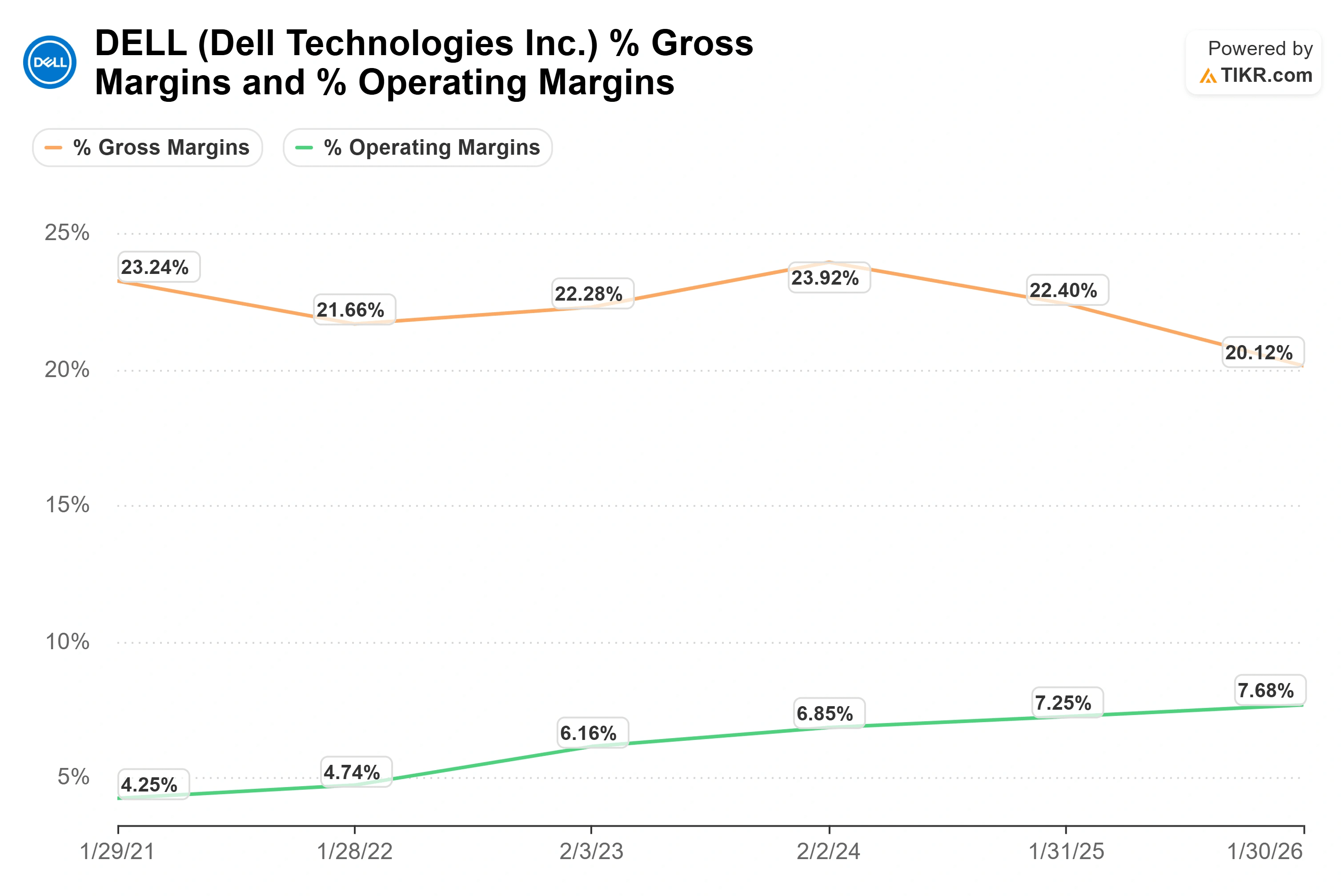
See how Dell performs against its peers in TIKR (It’s free!) >>>
TIKR Advanced Model Analysis
- Current Price: $434.78
- Target Price (Mid): ~$633
- Potential Total Return: ~46%
- Annualized IRR: ~9% / year

See analysts’ growth forecasts and price targets for Dell stock (It’s free!) >>>
TIKR’s mid-case values Dell near $633 by January 2031, roughly 46% above the current price over about 4.4 years, or close to 9% a year. Two drivers carry the revenue line: AI-optimized server growth toward the raised $60 billion full-year target against a record $51.3 billion backlog, and traditional server and networking demand pulled along by agentic workloads that run on CPUs. The margin driver is scale plus mix, higher-value storage, and traditional compute offsetting thinner AI-server economics. The primary risk is the memory super-cycle itself: if input inflation outruns Dell’s repricing, margin compresses while volume stays high, and the multiple contracts with it.
- Upside: margin holds while AI and traditional compute both scale, and the model has room toward its high case.
- Downside: memory costs outrun pricing, margin slips, and a stock trading at a premium gets repriced quickly.
Conclusion
The single line to check on September 1 is gross margin rate, because that is where memory inflation shows up first. Last quarter, it fell to 18.1% as the AI mix climbed, yet ISG’s operating margin still rose to 10.5% because scale and storage offset the hit. CFO David Kennedy told analysts that, excluding AI mix, the gross margin outlook was better than it had been 90 days earlier, and guided to margin rate expansion through the year. Good looks like that promise holding: gross margin steady-to-better ex-AI, with ISG operating income tracking management’s guided 55%-plus full-year growth. Bad looks like gross margin sliding faster than storage and scale can catch, which would confirm the selloff. Watch one tell alongside it: whether Dell raises the $60 billion AI server target a third straight time or holds it, since a hold would say the constraint is now supply, not demand. The report lands after the close on Tuesday, September 1.
See what stocks billionaire investors are buying so you can follow the smart money with TIKR.
Should You Invest in Dell?
The only way to really know is to look at the numbers yourself. TIKR gives you free access to the same institutional-quality financial data that professional analysts use to answer exactly that question.
Pull up Dell, and you’ll see years of historical financials, what Wall Street analysts expect for revenue and earnings in the quarters ahead, how valuation multiples have moved over time, and whether price targets are trending up or down.
You can build a free watchlist to track Dell alongside every other stock on your radar. No credit card required. Just the data you need to decide for yourself.
Looking for New Opportunities?
- See what stocks billionaire investors are buying so you can follow the smart money.
- Analyze stocks in as little as 5 minutes with TIKR’s all-in-one, easy-to-use platform.
- The more rocks you overturn… the more opportunities you’ll uncover. Search 100K+ global stocks, global top investor holdings, and more with TIKR.
Disclaimer:
Please note that the articles on TIKR are not intended to serve as investment or financial advice from TIKR or our content team, nor are they recommendations to buy or sell any stocks. We create our content based on TIKR Terminal’s investment data and analysts’ estimates. Our analysis might not include recent company news or important updates. TIKR has no position in any stocks mentioned. Thank you for reading, and happy investing!