
Key Stats for Atlassian Stock
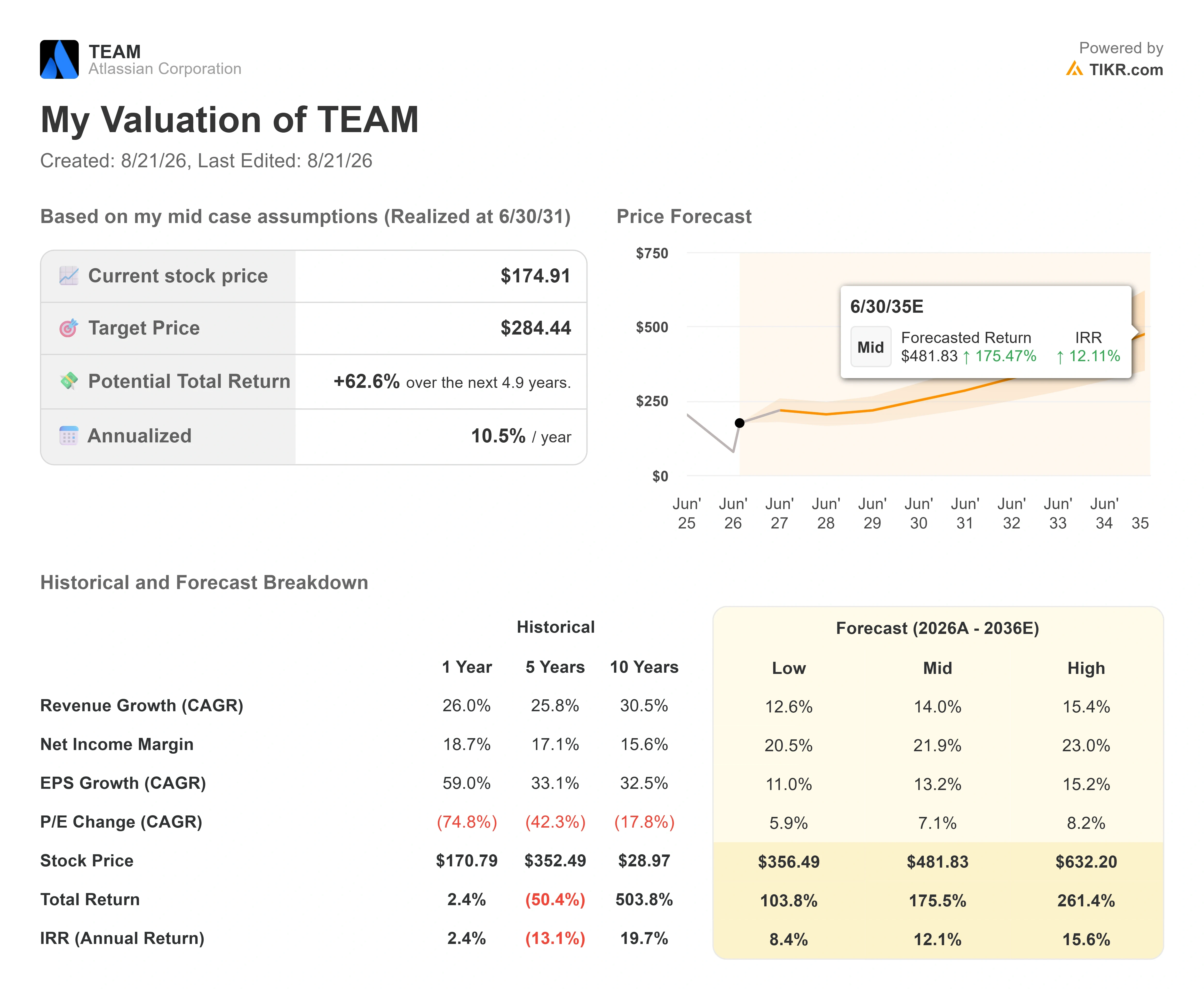
- Current Price: $174.91
- Target Price (Mid): ~$284
- Street Target: ~$189
- Potential Total Return: ~63%
- Annualized IRR: ~11% / year
Now Live: Discover how much upside your favorite stocks could have using TIKR’s new Valuation Model (It’s free) >>>
What Happened?
Atlassian (TEAM) closed at $174.91 on August 20, up roughly 70% since the start of August and more than triple its 52-week low of $56.01. The run began with the company’s fiscal fourth-quarter report on August 6, which beat on every important line and drove a 35% earnings reaction. Momentum and a wave of analyst target hikes have carried it higher since.
Cloud growth is accelerating, the founder just pledged a quarter of a billion dollars of his own money, and the business clearly works. But the stock now sits near its 52-week high of $184, and the same report that drove the rally also told investors that revenue growth is about to be roughly halved. Buying here means paying for a re-acceleration that has not happened yet.
The Quarter That Snapped the Bear Thesis
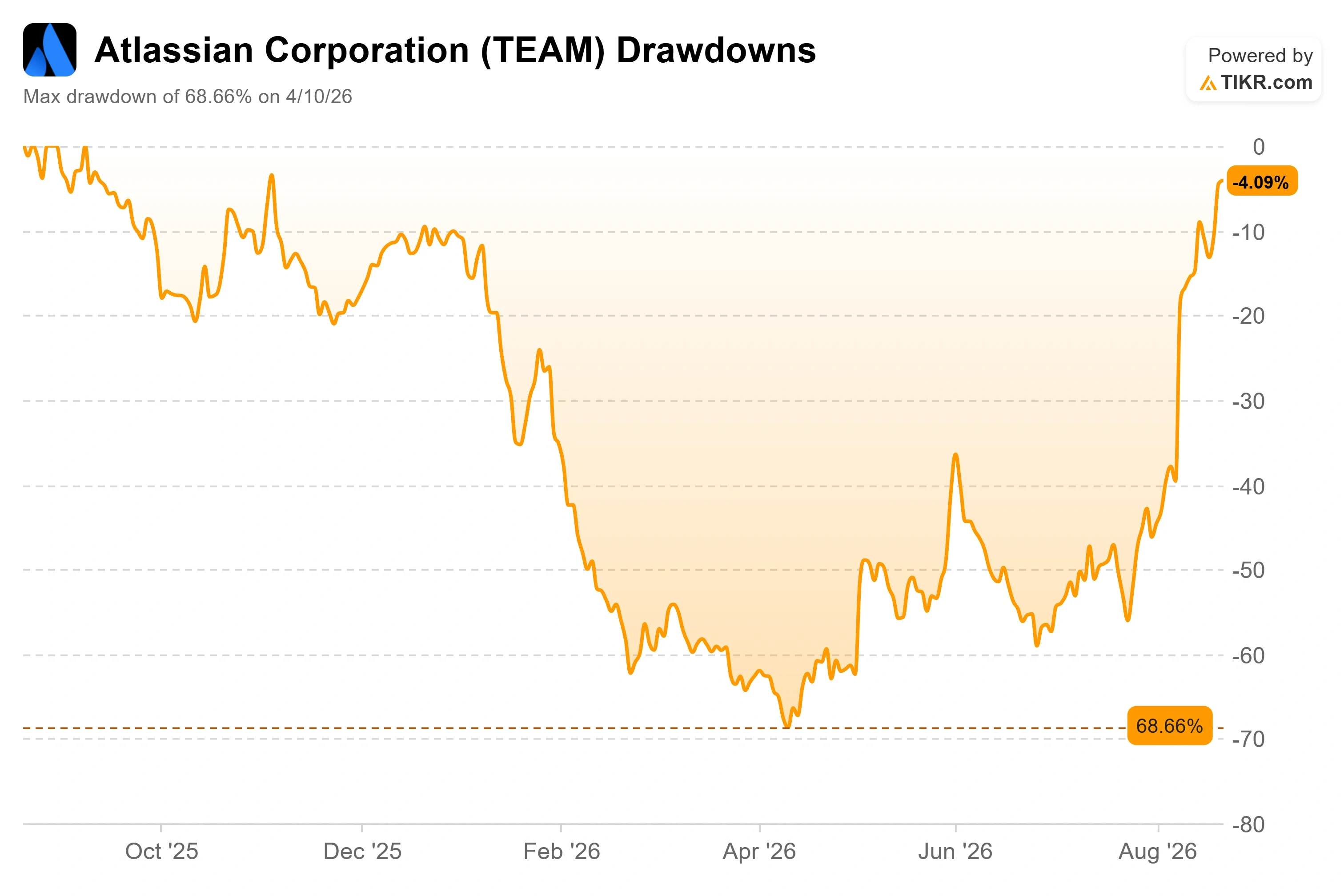
For most of 2026, Atlassian carried one fear: that AI agents would gut demand for seat-based software like Jira and Confluence. The stock fell 68.66% from its 2024 peak to an April 10 trough on that thesis. Q4 said the opposite.
Revenue reached $1,766.47 million, up 27.6% year over year and about 6% ahead of the $1.66 billion the Street modeled. Cloud revenue grew 31% to $1,213 million, an acceleration at the moment the market had priced in a slowdown. Adjusted earnings were $1.87 per share against a $1.50 estimate, and subscription ARR grew 23% to $6.6 billion. Atlassian also swung to a GAAP profit, with a 12% GAAP operating margin versus a 2% loss a year earlier. The clearest AI proof point came straight from management: customers using Rovo, Atlassian’s AI layer, grow their ARR at roughly twice the rate of those who do not.
The same day, CEO Mike Cannon-Brookes disclosed his intention to buy up to $250 million of Class A stock through a Rule 10b5-1 plan. This is an announced intention subject to a cooling-off period, not a completed purchase, but a founder committing that much as the stock gapped up is a genuine conviction signal.
See historical and forward estimates for Atlassian stock (It’s free!) >>>
What $175 Actually Asks You to Believe
At today’s price, the stock trades near 32 times NTM earnings and 5.9 times forward EV/revenue. That is not obviously stretched against software peers: Atlassian’s own revenue multiple ran above 8x as recently as mid-2025, and at 5.9x it now sits below ServiceNow at 7.7x while growing faster. Its 32x forward earnings lands closer to Microsoft’s 24x than to Palo Alto Networks’ 89x. The premium the market once assigned to Atlassian has already compressed.
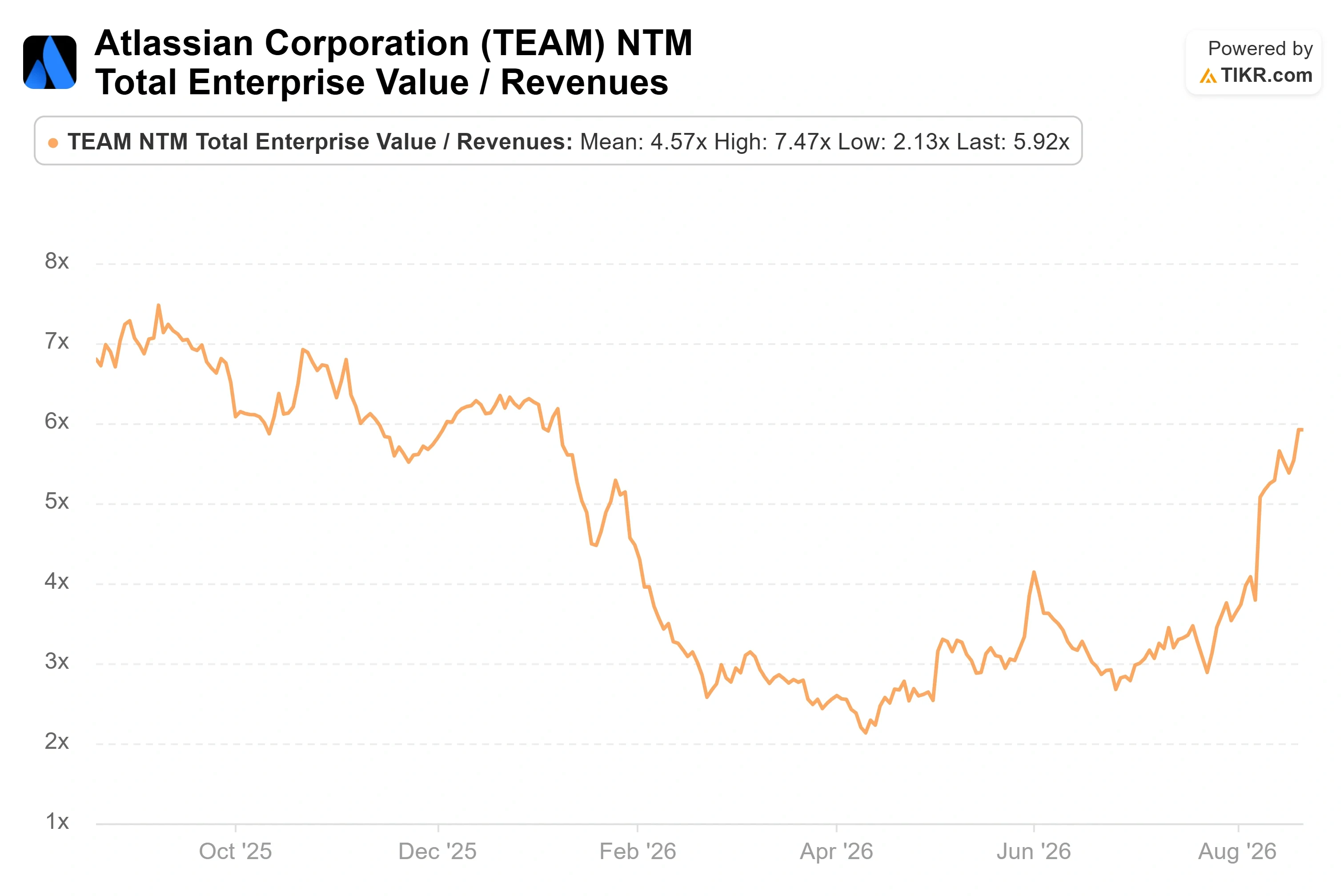
For fiscal 2027, management guided to roughly 13% total revenue growth, down from 26% in fiscal 2026, and subscription ARR growth stepping down from 23% to about 18%. Some of that is the deliberate wind-down of the Data Center product, which becomes a revenue headwind of about 17% for the year. The deceleration is still real, and it arrives right after a rally that priced in strength.
At the KeyBanc Technology Leadership Forum on August 11, Head of Investor Relations Martin Lam steered analysts away from the headline non-GAAP margin, which reached 36% in Q4, toward GAAP. He explained that fiscal 2026’s non-GAAP margin carried about 4 points of one-time benefit from accelerated revenue recognition tied to the Data Center end-of-life, plus a 3-point fiscal 2027 headwind from shifting employee pay toward cash. “GAAP is frankly where we’re focused now as a company,” Lam said, guiding to a 4.5% GAAP operating margin for fiscal 2027. That candor is a reminder that the reported 36% flatters the underlying run rate, and that buyers at $175 are paying for a profitability ramp that management is pacing deliberately.
The business just proved its most important bear thesis wrong, and the same quarter said growth is moderating. The re-rating from a distressed, deeply discounted stock back toward a market multiple has already happened. What has not happened is the fiscal 2028 re-acceleration that the most bullish analysts, including one at Jefferies with a $200 target, are underwriting. Cannon-Brookes’ $250 million plan says the story runs longer than one quarter, but it does not remove the risk that a buyer today is early to a payoff that lands in 2028 rather than 2027.
See how Atlassian performs against its peers in TIKR (It’s free!) >>>
TIKR Advanced Model Analysis
- Current Price: $174.91
- Target Price (Mid): ~$284
- Potential Total Return: ~63%
- Annualized IRR: ~11% / year
See analysts’ growth forecasts and price targets for Atlassian stock (It’s free!) >>>
TIKR’s mid-case scenario points to roughly $284 by mid-2031, an annualized return near 11% from today’s price. Two revenue drivers carry it: cloud compounding in the mid-teens as Data Center customers migrate and enterprises expand seats across Jira and Confluence, and cross-sell into the Teamwork and Service Collections, lifting revenue per customer as Rovo monetization scales. The margin driver is operating leverage, with net income margin modeled toward the low 20s on headcount and infrastructure discipline. The primary risk is that fiscal 2027’s deceleration proves structural rather than transitional, leaving a stock at 32 times forward earnings little room for error.
The upside: AI becomes a durable expansion engine, with Rovo adopters growing ARR at twice the base rate and migration extending seat growth for years. The downside: growth keeps fading past fiscal 2027, and the multiple compresses back toward the peer median.
Conclusion
The next real test is the fiscal Q1 2027 report on October 29, when management guides to $1,705 to $1,715 million in revenue and about 28.5% cloud growth. Watch cloud specifically. Holding near 28% or better keeps the migration-plus-AI expansion story intact and frames the annual deceleration as guidance conservatism. A slip into the low 20s alongside the ARR step-down tells the market the moderation is permanent, and a stock this far off its lows will feel it.
See what stocks billionaire investors are buying so you can follow the smart money with TIKR.
Should You Invest in Atlassian?
The only way to really know is to look at the numbers yourself. TIKR gives you free access to the same institutional-quality financial data that professional analysts use to answer exactly that question.
Pull up Atlassian, and you’ll see years of historical financials, what Wall Street analysts expect for revenue and earnings in the quarters ahead, how valuation multiples have moved over time, and whether price targets are trending up or down.
You can build a free watchlist to track Atlassian alongside every other stock on your radar. No credit card required. Just the data you need to decide for yourself.
Analyze Atlassian on TIKR Free →
Looking for New Opportunities?
- See what stocks billionaire investors are buying so you can follow the smart money.
- Analyze stocks in as little as 5 minutes with TIKR’s all-in-one, easy-to-use platform.
- The more rocks you overturn… the more opportunities you’ll uncover. Search 100K+ global stocks, global top investor holdings, and more with TIKR.
Disclaimer:
Please note that the articles on TIKR are not intended to serve as investment or financial advice from TIKR or our content team, nor are they recommendations to buy or sell any stocks. We create our content based on TIKR Terminal’s investment data and analysts’ estimates. Our analysis might not include recent company news or important updates. TIKR has no position in any stocks mentioned. Thank you for reading, and happy investing!