Key Stats for Salesforce Stock
- 52-Week Range: $146.32 – $269.11
- Street Mean Target: ~$243
- Market Cap: ~$168B
- NTM P/E: 14.7x
- LTM Free Cash Flow: $14.4B
- Agentforce ARR: $1.2B (up 169% YoY as of Q4 FY26)
- Next Earnings: August 26, 2026
Now Live: Discover how much upside your favorite stocks could have using TIKR’s new Valuation Model (It’s free) >>>
Five Beats, One Question
Salesforce (CRM) has done something unusual in 2026. The company has beaten earnings expectations five consecutive times, grown revenue at double-digit rates, seen Agentforce cross $1 billion in annualized revenue, and announced one of the largest buyback programs in enterprise software history.
The stock is still down roughly 22% from its 52-week high. To understand why, you need to understand the one question the market is genuinely wrestling with: Is artificial intelligence a tailwind for Salesforce or a threat?
IBM sent a chill through enterprise software in July when it warned that customers were reallocating IT budgets toward AI infrastructure at the expense of traditional application software seats. Salesforce, alongside ServiceNow and Workday, was named directly.
The fear is that companies will cut CRM licenses to fund GPU spend, and that AI agents will eventually replace the human workflows Salesforce was built to support.
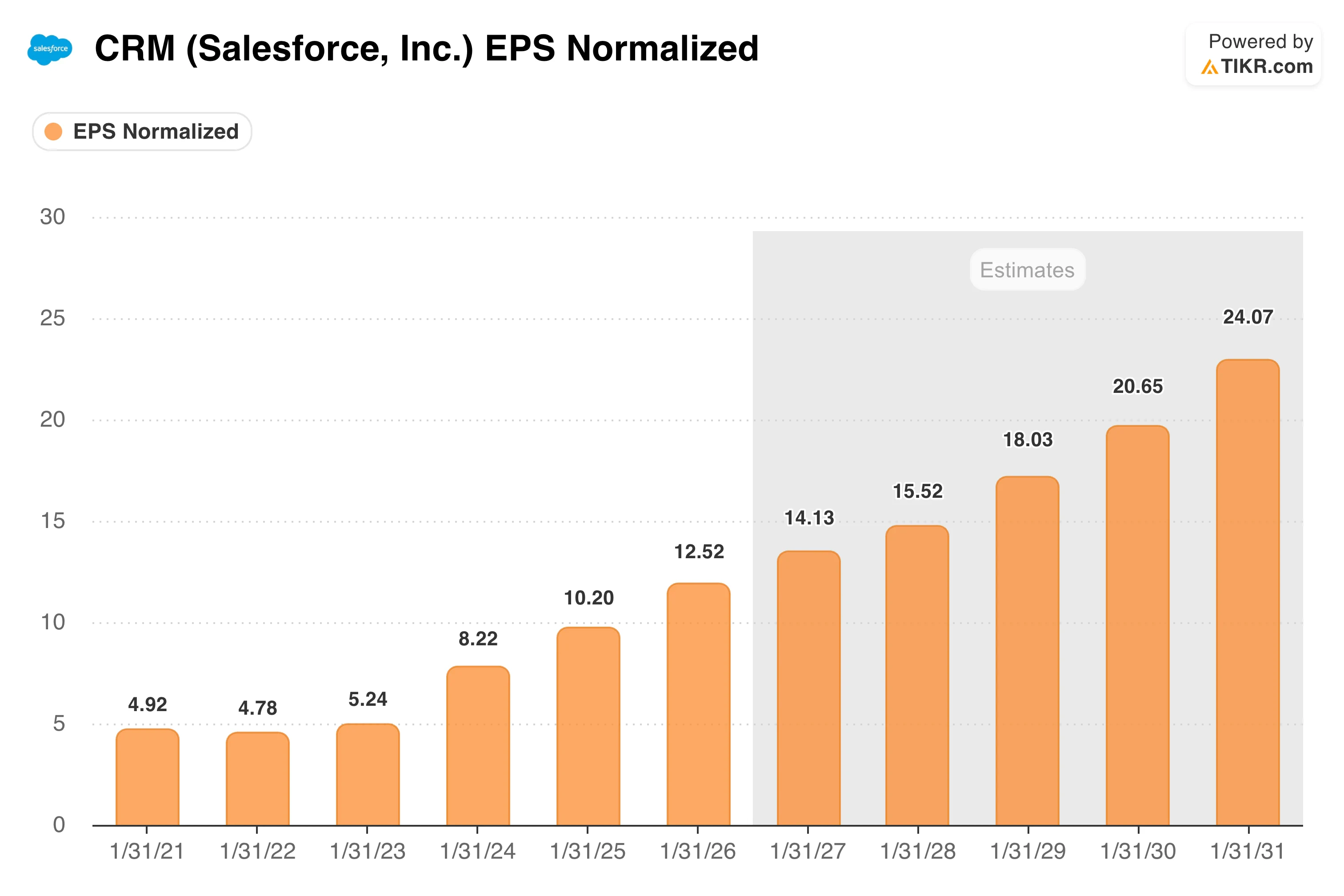
The bull case runs in the opposite direction, and the EPS chart makes it visible. Normalized earnings per share sat in the $4.78 to $5.24 range for three years before margin discipline kicked in.
Since then, EPS has climbed from $8.22 to $10.20 to $12.52, with consensus estimates projecting continued compounding toward $14 in FY2027 and above $24 by FY2031.
CEO Marc Benioff argues that Agentforce doesn’t replace Salesforce’s value; it multiplies it because agents need the customer data, workflows, and integrations Salesforce already owns. Q1 FY27 delivered adjusted EPS of $3.88 against a $3.13 consensus, with revenue of $11.13 billion up 13% year over year.
See historical and forward estimates for Salesforce stock (It’s free!) >>>
The Cash Engine Behind the Buyback
One of the most underappreciated parts of the Salesforce story is the free cash flow machine sitting underneath the Agentforce headlines. While software companies frequently trade on narrative, Salesforce is generating hard cash at a scale that gives management real options.
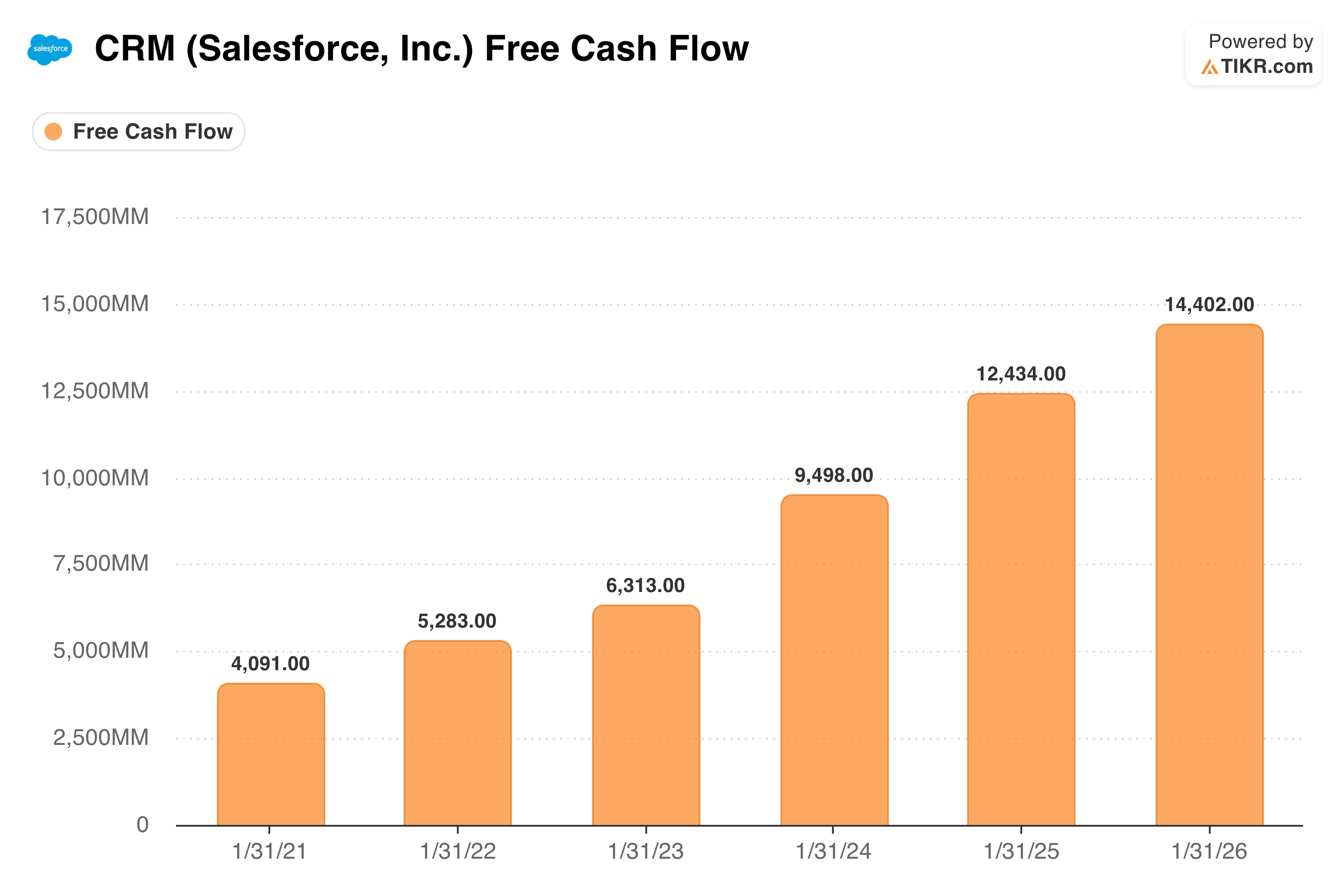
Free cash flow has grown in a nearly unbroken line for five years, from $4.1 billion in FY2021 through $6.3 billion in FY2023, $9.5 billion in FY2024, and reaching $14.4 billion in FY2026.
Operating cash flow hit $15 billion for the fiscal year, funding both ongoing Agentforce investment and a $25 billion accelerated share repurchase that retired over 100 million shares in a single quarter.
Reducing the share count to 14.7 times forward earnings is a meaningful capital allocation decision, and it lifts EPS mechanically even before Agentforce contributes incremental revenue.
Salesforce took on roughly $30 billion in net debt to fund the repurchase, which is worth watching, though current FCF generation comfortably covers that load.
See how Salesforce performs against its peers in TIKR (It’s free!) >>>
What the Valuation Model Says About CRM Stock
At around 15 times forward earnings, Salesforce trades at a significant discount to most large-cap software peers. ServiceNow trades closer to 30 times, and the broader software sector average sits well above 20.
The market is applying a smaller multiple to a business it perceives as facing AI disruption risk, even as the underlying earnings keep compounding.
TIKR’s valuation model targets around $398 per share based on mid-case assumptions, implying roughly a 94% total return from current levels over approximately four and a half years.
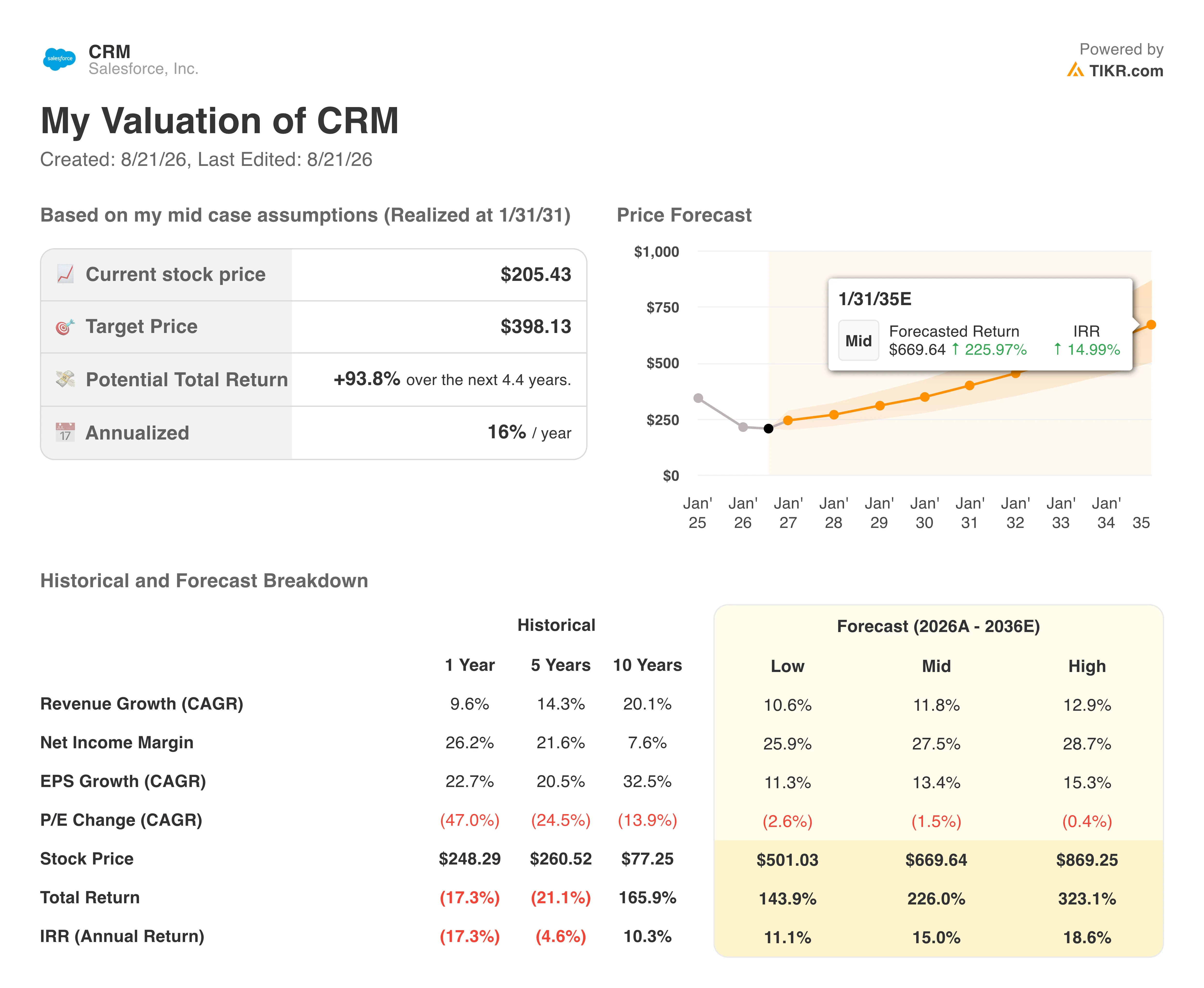
The annualized return works out to around 16% per year.
The model assumes roughly 12% revenue growth and net income margins expanding toward 28%, consistent with Salesforce’s own long-term targets. Crucially, the model assumes modest P/E compression, meaning these returns are driven by earnings growth rather than multiple expansion.
A more extended mid-case to 2035 puts the price near $670 at around a 15% annualized IRR. Salesforce reports Q2 FY27 earnings on August 26, and Agentforce ARR alongside cRPO guidance will be the two numbers the market watches most closely.
Should You Buy Salesforce Stock?
Salesforce is in an unusual position for a company of its size: cheap on earnings, generating substantial free cash flow, and sitting at the center of one of the more consequential debates in enterprise software.
The NTM P/E near 15 times is a level the stock has rarely traded at over the past decade. If Agentforce continues scaling and the AI disruption fears prove overblown, the re-rating opportunity is real.
The risks deserve honest attention, as the company carries significant net debt following the buyback. Revenue growth of around 10% is solid but not spectacular for a software business at this valuation, and Agentforce ARR, while growing fast, remains a fraction of total revenue.
Investors buying today are also walking into earnings in five days, creating near-term volatility risk in either direction. For patient investors with a multi-year horizon, the setup looks considerably more interesting than the stock’s 2026 performance suggests.
See analysts’ growth forecasts and price targets for AMD stock (It’s free!) >>>
Looking for New Opportunities?
- See which stocks billionaire investors are buying to follow the smart money.
- Analyze stocks in as little as 5 minutes with TIKR’s all-in-one, easy-to-use platform.
- The more rocks you overturn… the more opportunities you’ll uncover. Search 100K+ global stocks, global top investor holdings, and more with TIKR.
Disclaimer:
Please note that the articles on TIKR are not intended to serve as investment or financial advice from TIKR or our content team, nor are they recommendations to buy or sell any stocks. We create our content based on TIKR Terminal’s investment data and analysts’ estimates. Our analysis might not include recent company news or important updates. TIKR has no position in any of the stocks mentioned. Thank you for reading, and happy investing!