


Key Stats for Johnson & Johnson Stock
- Current Price: $229.32
- Target Price (Mid): ~$325
- Street Consensus Target: ~$253
- Potential Total Return (Mid): ~42%
- Annualized IRR: ~8% / year
- Most Recent Earnings Reaction: (0.60%) on 4/14/26
- Max Drawdown: (10.96%) on 5/8/26
Now Live: Discover how much upside your favorite stocks could have using TIKR’s new Valuation Model (It’s free) >>>
What Happened?
Johnson & Johnson (JNJ) has a pharmaceutical story every analyst is covering, and a MedTech story most are not. On May 19, at the RBC Capital Markets Global Healthcare Conference, Michael Bodner, Company Group Chair for Electrophysiology and Neurovascular at J&J MedTech, described a product roadmap that does not appear in any earnings release: a complete EP ecosystem build, a first-ever public product name disclosure, and clinical outcome data that reframes how durable J&J’s competitive position actually is.
A $16 Billion Market That Is Still Underpenetrated
The global electrophysiology market stood at roughly $8 billion four years ago. Bodner told the RBC audience it now stands at $16 billion and is growing procedurally at 12% to 13% per year. Atrial fibrillation, or AFib, a condition where the heart beats with an irregular rhythm, drives at least 60% of that volume and is growing at more than 15% annually in procedure terms.
Bodner put the unmet need in plain terms: only a single-digit percentage of patients who could benefit from catheter ablation, a minimally invasive procedure that corrects abnormal heart rhythm by eliminating problem tissue, are currently receiving it. One in four people over the age of 40 will develop AFib. That gap between who needs treatment and who is getting it is the underlying growth engine, independent of competitive dynamics.
A structural tailwind reinforced this in 2026. The Centers for Medicare and Medicaid Services added AFib ablation to the list of procedures covered in ambulatory surgery centers (ASCs), same-day outpatient facilities that offer a more accessible alternative to hospital-based procedures, effective January 1. That policy change opened a new access channel that was not available a year ago and has not been widely modeled by analysts as a medium-term revenue driver for J&J.

See historical and forward estimates for Johnson & Johnson stock (It’s free!) >>>
What Bodner Said That Is Not in Any Press Release
J&J achieved total electrophysiology unit leadership in the United States late last year, spanning both traditional radiofrequency (RF) ablation and pulsed field ablation (PFA), the newer energy modality that treats AFib with greater precision and a cleaner safety profile. According to Bodner, J&J’s VARIPULSE Plus platform has been building momentum week over week since that inflection.
The more defensible competitive position sits in CARTO, J&J’s electroanatomical mapping system that physicians use to visualize the heart and guide ablation in real time. According to J&J management, more than half of competitor ablation cases in the U.S. run on CARTO hardware, which means J&J captures recurring revenue even where it is not the preferred catheter. CARTO is the platform every J&J catheter integrates with, and that integration advantage is difficult to replicate with a single competing device.
Earlier this year, J&J presented data showing that CARTO’s tissue proximity indicators (TPI), which confirm that energy is being delivered into tissue rather than blood, produced a 61% reduction in 30-day rehospitalization rates. Patients treated with CARTO were 2.5 times less likely to return to the hospital within 30 days due to a recurrence. That is the kind of outcome data that wins physician loyalty across product generations.
At RBC, Bodner also introduced the SONATA Module, an AI-enabled imaging tool that automatically builds high-resolution heart maps using an intracardiac echo (ICE) catheter. SONATA extends mapping to the left ventricle for ventricular tachycardia patients, adds tissue thickness readings that let physicians calibrate ablation depth, and enables procedures with zero fluoroscopy, meaning no radiation exposure.
Most notably, Bodner disclosed for the first time publicly that J&J’s upcoming single-shot PFA basket catheter will be called ISOPULSE. It is designed for straightforward first-procedure AFib patients who need uncomplicated vein isolation. ISOPULSE maps and ablates in a single workflow, slotting below VARIPULSE Pro for moderate complexity and OMNYPULSE for advanced cases, with the dual-energy STSF catheter covering the most complex presentations. The result is a four-catheter PFA lineup spanning the full clinical spectrum, something no single competitor currently offers.
The PERSIGMA trial, a head-to-head study of VARIPULSE against Boston Scientific’s Farawave in persistent AFib patients, is also underway. Running it as a head-to-head rather than a single-arm study for indication expansion is a deliberate signal of confidence, Bodner said, backed by over 70,000 VARIPULSE cases with no recorded coronary spasm events.

One More Catalyst the Market Just Began to Price In
On May 12, J&J launched the Shockwave C2 Aero Coronary IVL Catheter globally, with availability in the United States and Japan and a European rollout planned for the coming months. IVL, or intravascular lithotripsy, uses ultrasonic pressure waves to crack calcium deposits inside coronary arteries. The C2 Aero improves on prior models with a more flexible shaft, better lesion-crossing capability, and a repositioning feature that lets a single catheter treat multiple lesions. According to J&J’s announcement, calcified coronary artery disease affects an estimated 315 million people worldwide.
One day later, Leerink Partners upgraded JNJ to Outperform, raising its price target to $265 from $252 and citing strong new drug momentum. The Shockwave launch and the Leerink upgrade landed in the same week as the stock was recovering from a 10.96% drawdown that bottomed on May 8. Both events began a modest re-rating that the full EP roadmap now extends.
See how Johnson & Johnson performs against its peers in TIKR (It’s free!) >>>
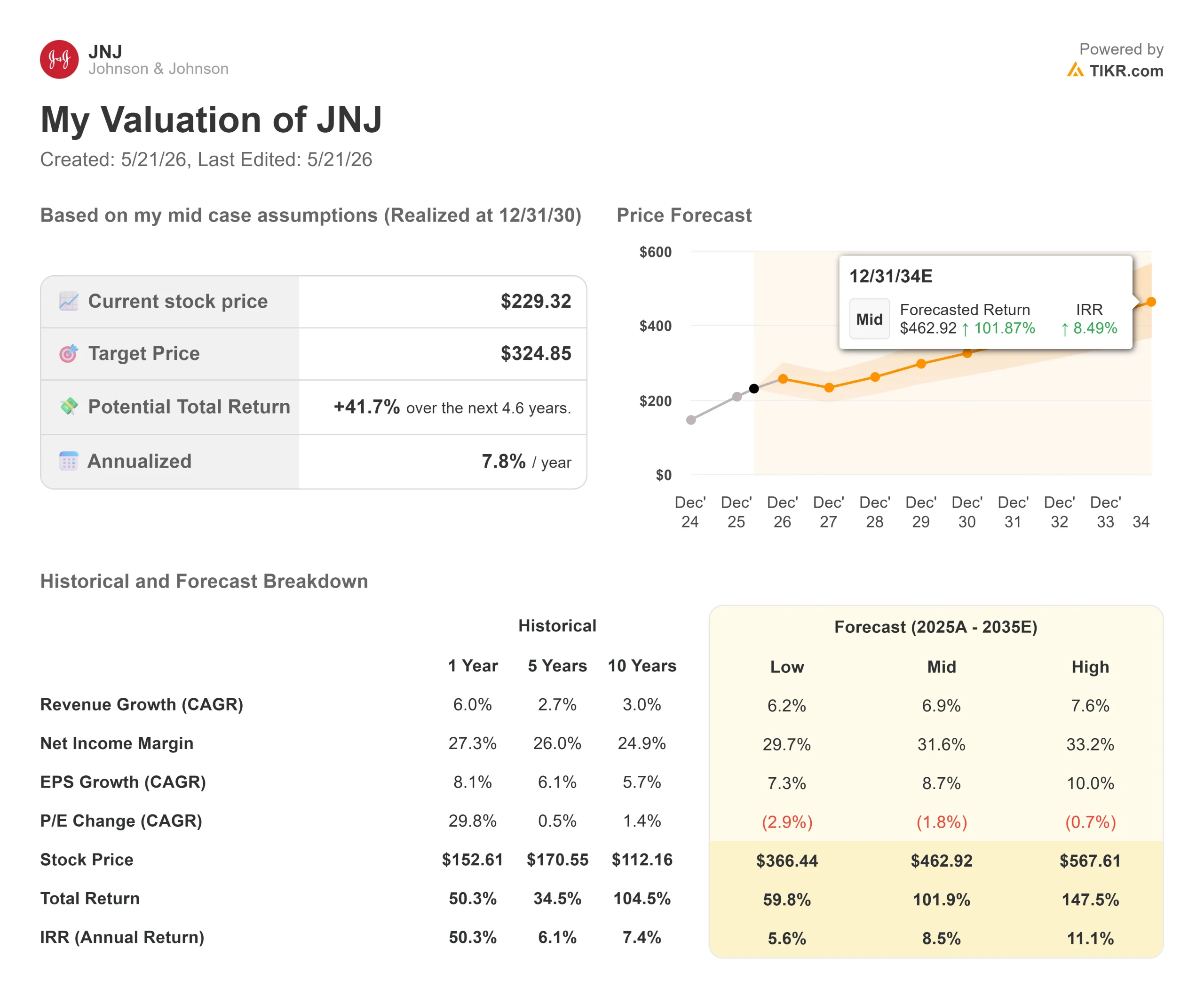
TIKR Advanced Model Analysis
- Current Price: $229.32
- Target Price (Mid): ~$325
- Potential Total Return: ~42%
- Annualized IRR: ~8% / year
See analysts’ growth forecasts and price targets for Johnson & Johnson stock (It’s free!) >>>
The TIKR mid-case model uses a ~7% revenue CAGR through 12/31/30 and net income margins expanding toward around 32%. Two drivers underpin that revenue assumption: the Innovative Medicine segment, where TREMFYA, CAPLYTA, and DARZALEX are absorbing the Stelara biosimilar headwind and expanding into new indications, and the MedTech cardiovascular portfolio, where EP, Abiomed, and Shockwave are each compounding at double-digit rates. The margin driver is operating leverage as acquisition integration costs normalize over the period.
The Street consensus sits at ~$253, implying roughly 10% upside. The TIKR mid case at ~$325 suggests the market has not fully priced in the EP market expansion or the compounding effect of J&J’s multi-catheter PFA build. The Leerink upgrade is a sign that consensus is beginning to move, not that it has arrived.
The primary risk is China, where management flagged potential second-half pressure from volume-based procurement on EP products. That is manageable if U.S. and European momentum holds, but it will create quarterly noise in H2 2026.
Conclusion
Two data points will determine whether the bull case holds. First, Q3 2026 electrophysiology revenue growth: if it holds above 7% to 8% despite the China headwind management has flagged, it confirms U.S. share gains and the new ASC channel is absorbing the drag. Second, the PERSIGMA readout: when head-to-head data against Farawave arrives, it either validates VARIPULSE as the preferred persistent AFib platform or forces the Street to reassess the EP growth trajectory. If both go well, the gap between the ~$253 consensus and TIKR’s ~$325 mid-case target starts to close. Watch Q3 EP revenue and PERSIGMA timing. Those are the two signals that matter.
See what stocks billionaire investors are buying so you can follow the smart money with TIKR.
Should You Invest in Johnson & Johnson?
The only way to really know is to look at the numbers yourself. TIKR gives you free access to the same institutional-quality financial data that professional analysts use to answer exactly that question.
Pull up Johnson & Johnson, and you’ll see years of historical financials, what Wall Street analysts expect for revenue and earnings in the quarters ahead, how valuation multiples have moved over time, and whether price targets are trending up or down.
You can build a free watchlist to track Johnson & Johnson alongside every other stock on your radar. No credit card required. Just the data you need to decide for yourself.
Analyze Johnson & Johnson on TIKR Free →
Looking for New Opportunities?
- See what stocks billionaire investors are buying so you can follow the smart money.
- Analyze stocks in as little as 5 minutes with TIKR’s all-in-one, easy-to-use platform.
- The more rocks you overturn… the more opportunities you’ll uncover. Search 100K+ global stocks, global top investor holdings, and more with TIKR.
Disclaimer:
Please note that the articles on TIKR are not intended to serve as investment or financial advice from TIKR or our content team, nor are they recommendations to buy or sell any stocks. We create our content based on TIKR Terminal’s investment data and analysts’ estimates. Our analysis might not include recent company news or important updates. TIKR has no position in any stocks mentioned. Thank you for reading, and happy investing!


