Key Stats for FedEx Stock
- Current Price: $381.87
- Target Price (Mid): ~$498
- Street Target: ~$402
- Potential Total Return: ~32%
- Annualized IRR: ~7% / year
- Earnings Reaction: +0.77% (March 19, 2026)
Now Live: Discover how much upside your favorite stocks could have using TIKR’s new Valuation Model (It’s free) >>>
What Happened?
Transportation stocks got hit hard on May 4, 2026. Amazon launched Amazon Supply Chain Services, opening its warehouses, freight forwarding, and parcel delivery network to third-party businesses. FedEx (FDX) shares fell 9.5% that day, their worst single-session drop in over a year. UPS fell nearly 10%. The stock has partially recovered, trading around $381 as of May 11.
The bears see an existential repricing: Amazon is no longer just a FedEx customer but a direct competitor across freight, distribution, and last-mile delivery. The bulls argue the selloff was exaggerated because big corporate shippers weigh service quality, geographic reach, and reliability, not just price, when committing to logistics contracts.
The more important question is whether the Amazon threat actually changes the investment case for the business FedEx is about to spin off.
That business, FedEx Freight, becomes an independent publicly traded company on June 1, 2026, under the ticker FDXF on the NYSE. It is a less-than-truckload (LTL) carrier, meaning it hauls freight too large for parcel delivery but not enough to fill an entire truck. Amazon’s logistics push targets parcel and last-mile delivery. The LTL market, where manufacturers, distributors, and retailers move pallets and oversized goods, operates on a different competitive axis entirely. The selloff may have created an entry point before a major structural catalyst.
What FedEx Freight Actually Is
FedEx Freight is the largest pure-play LTL carrier in North America. Per investor relations materials from the April 8, 2026, Investor Day, the network spans more than 365 locations, approximately 26,000 doors, and 30,000 vehicles covering all 50 states, Mexico, and Canada. It was built through three acquisitions: Viking Freight in 1998, American Freightways in 2001, and Watkins Motor Lines in 2006, each integrated into a single unified network.
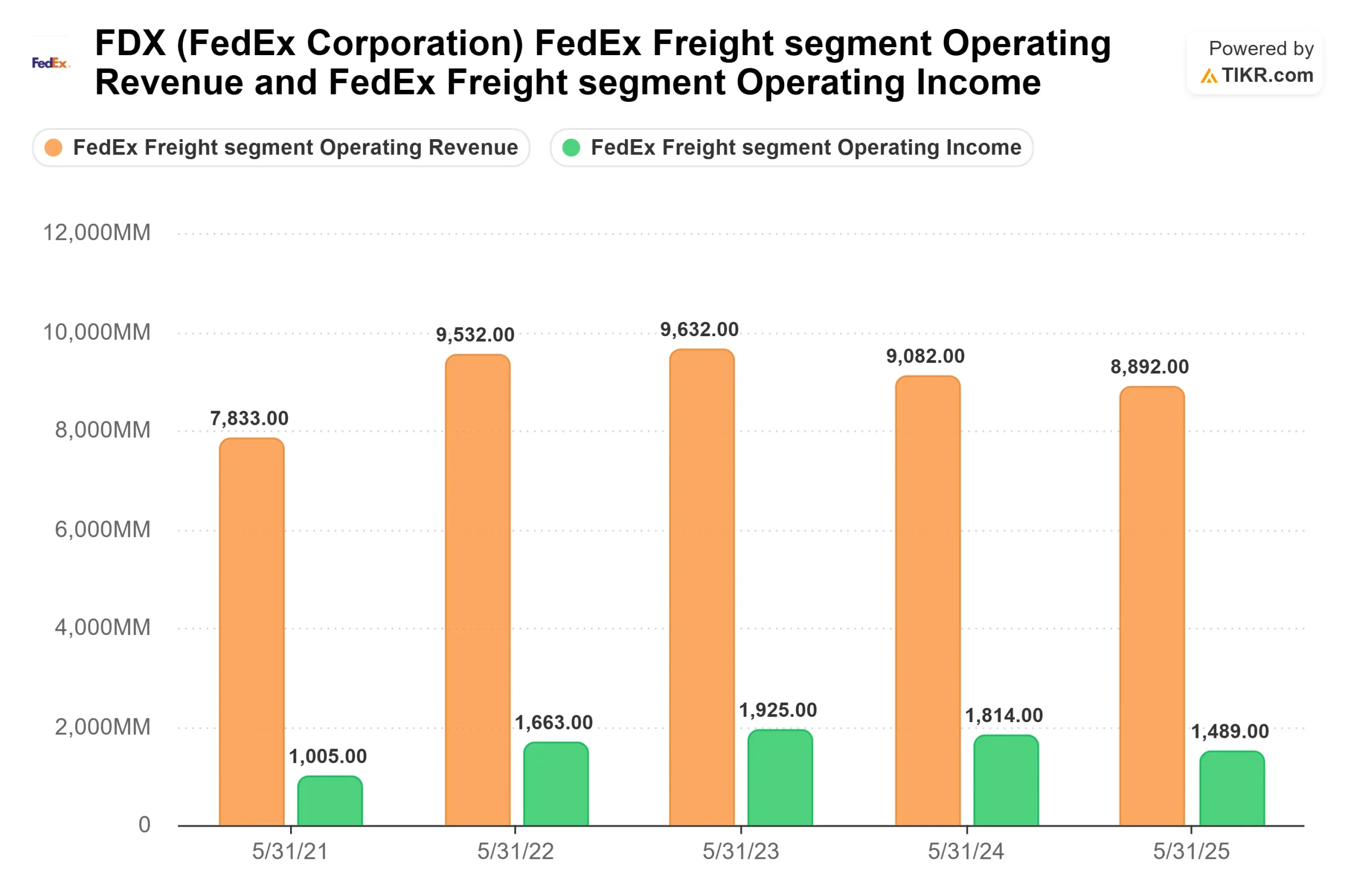
This is not a struggling carve-out. TIKR segment data shows FedEx Freight generated $8.9 billion in operating revenue and $1.49 billion in operating income in the fiscal year ended May 2025. At its fiscal 2022 peak, operating income reached $1.66 billion. Management guided for approximately $8.7 billion in revenue and around $1.1 billion in adjusted operating income for the current fiscal year, implying a margin of around 12%.
See historical and forward estimates for FedEx stock (It’s free!) >>>
What the April 8 Investor Day Revealed
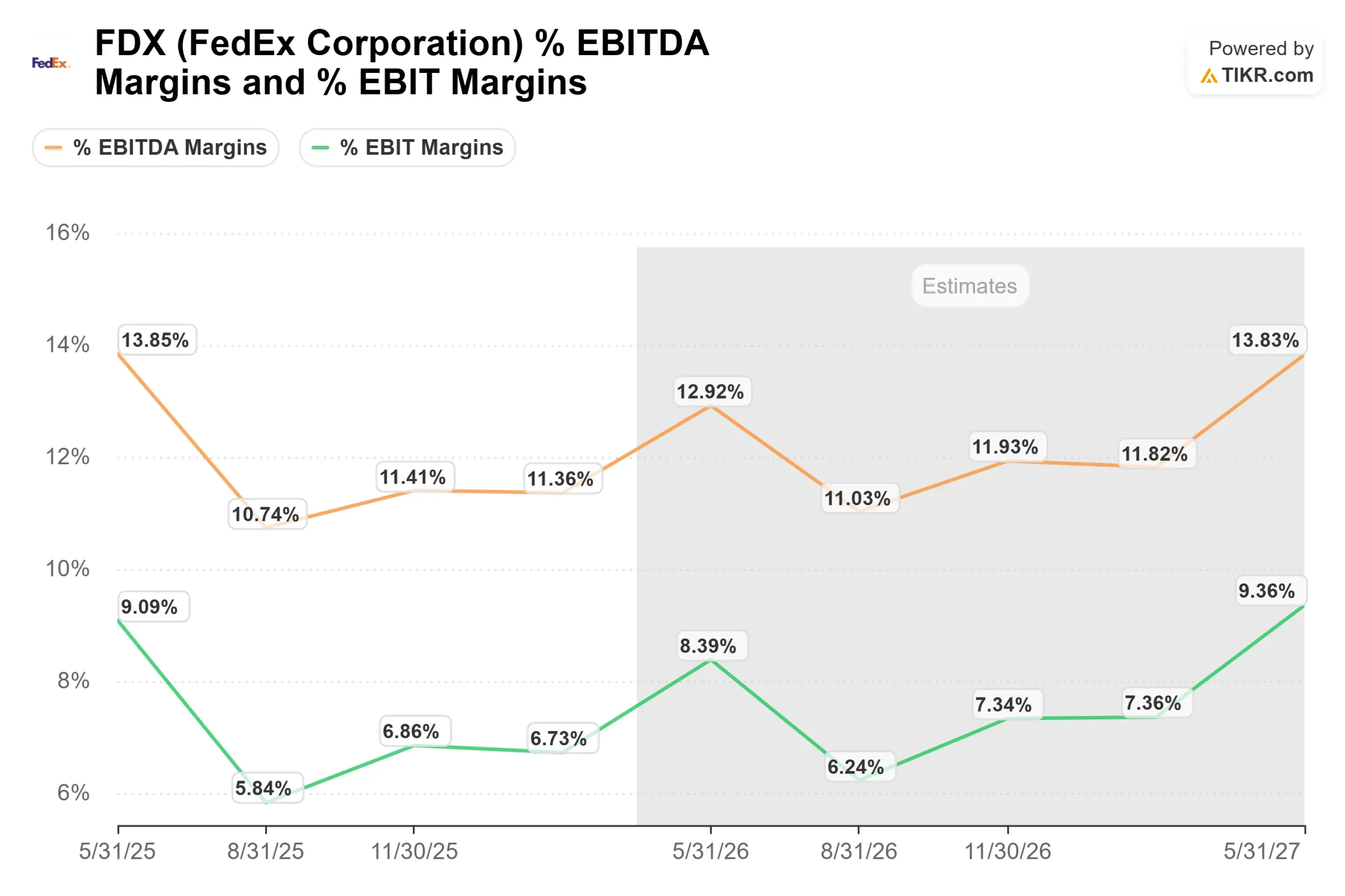
CFO Marshall Witt guided for 4% to 6% revenue compound annual growth rate over the medium term, with adjusted operating income growing at a 10% to 12% CAGR, meaningfully faster than revenue. Margins are expected to expand from around 12% today to around 15%, a roughly 300 basis point improvement. Witt was specific: yield management accounts for more than half of that gain, with volume growth and cost efficiencies contributing the rest.
The emphasis on yield over volume reflects a deliberate philosophy. As CEO, John Smith said at the event: “We’re not hauling freight for practice. We’re here to make money and grow profitably.”
Pricing quality is also improving structurally. FedEx Freight was previously bundled into FedEx’s enterprise-wide contracts, distorting LTL-specific pricing. Smith confirmed unbundling is approximately 99% complete, removing a drag that had been suppressing yield quality.
On the operational side, COO Clint McCoy described three efficiency programs that do not depend on a volume recovery to deliver value. A shift from weight-based to cube-based dimensional planning drove a 12% increase in line-haul cube utilization over the past year. Fleet modernization reduced the average fleet age from 5.6 years to 4.5 years since 2023, improving fuel efficiency by 3%. Advanced network flow modeling, run at least three times per year, eliminates unnecessary miles and controls line-haul costs. The network carries approximately 30% available capacity, meaning FDXF can absorb significant volume growth with minimal additional capital.
The Commercial Opportunity
Chief Commercial Officer Mike Lyons disclosed that FedEx Freight has built a dedicated LTL sales force of 500 sellers across North America, all with LTL-specific experience and geographically deployed near the service centers they support. This is a return to the local sales model that existed before FedEx’s integration centralized everything.
Lyons identified four verticals where FDXF has minimal penetration today: small and medium-sized businesses, healthcare, grocery, data centers, and energy. He cited a combined addressable market of approximately $9 billion across those four verticals (management’s own estimate), of which FDXF currently captures very little. Healthcare alone was sized at around $6 billion.
The existing revenue base provides a durable foundation. FDXF’s top 25 customers represent only 17% of total revenue, and customers with over a decade of tenure account for nearly 90% of revenue. The new verticals are incremental, not defensive.
CTO Mike Rodgers added that the technology footprint has been reduced by more than 20%, eliminating over 300 systems inherited from FedEx’s global infrastructure. A new invoicing platform is expected to cut manual touch points by up to 60%, addressing the friction that has historically pushed smaller customers away.
How FDX Is Priced Against Its Peers
Per TIKR’s Competitors page, FDX trades at 10.77x NTM EV/EBITDA. UPS trades at 8.49x. Expeditors International trades at 16.52x. The Air Freight and Logistics peer median sits at 7.99x NTM EV/EBITDA.
FDX carries a premium to the median today. After June 1, the remaining FedEx entity becomes a leaner express and ground delivery business with a cleaner cost profile, while FDXF trades as a standalone LTL operator. Whether FDXF attracts a re-rating to a higher standalone multiple depends on whether management executes on its margin targets in the early quarters after separation.
See how FedEx performs against its peers in TIKR (It’s free!) >>>
TIKR Advanced Model Analysis
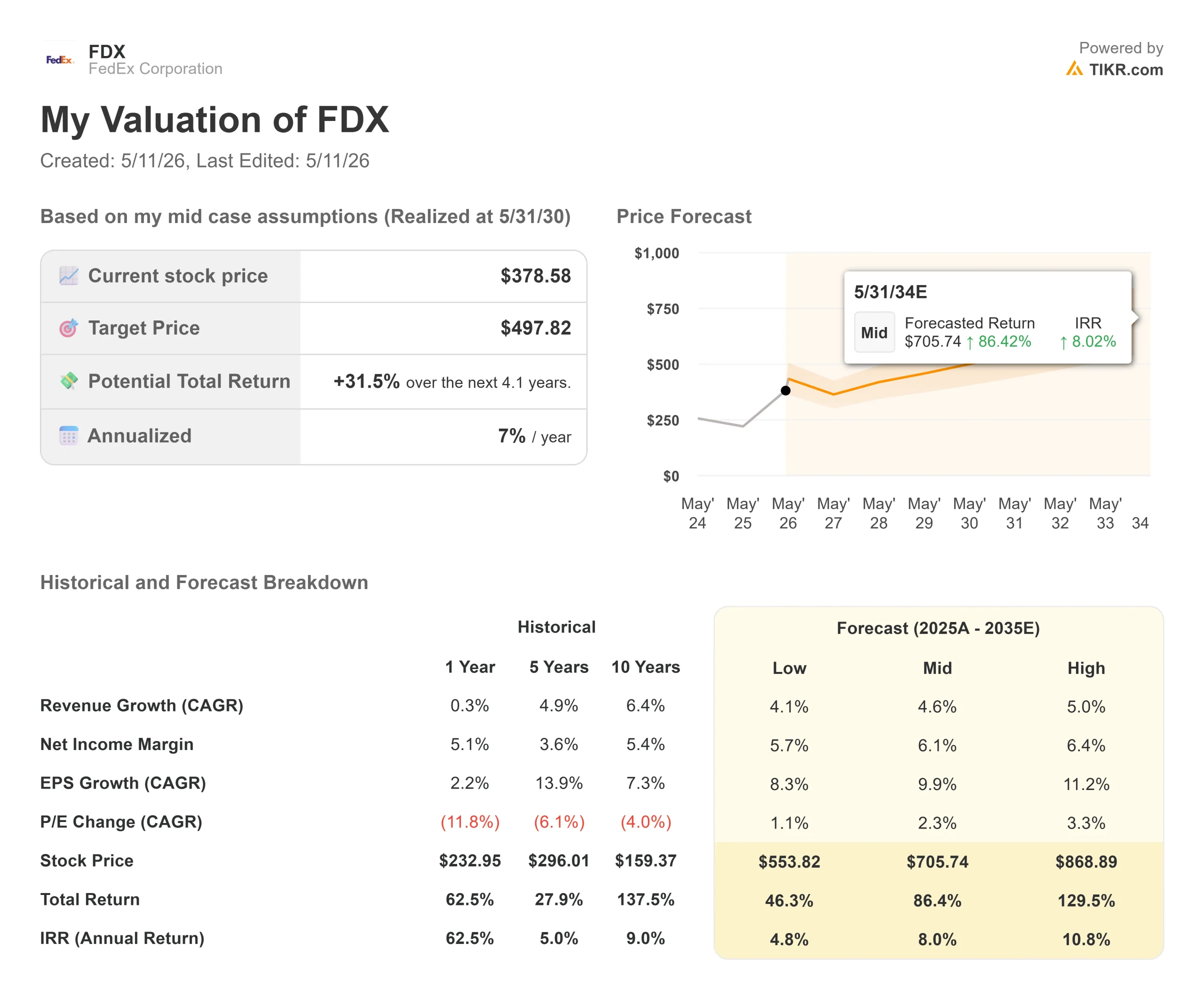
- Current Price: $381.87
- Target Price (Mid): ~$498
- Potential Total Return: ~32%
- Annualized IRR: ~7% / year
See analysts’ growth forecasts and price targets for FedEx stock (It’s free!) >>>
The TIKR mid-case model uses a revenue CAGR of around 5% and a net income margin of around 6% through May 31, 2030, producing a target price of approximately $498 and a 7% annualized IRR. Management has attributed the revenue growth outlook to the dedicated LTL sales force, underpenetrated verticals, and a broader freight cycle recovery. The key margin driver is yield discipline, which Witt confirmed accounts for the majority of the expected 300 basis point improvement. The primary risk is that Amazon Supply Chain Services gains faster-than-expected traction among FedEx’s core B2B parcel clients, compressing express yields and delaying the margin recovery.
Per TIKR, 27 analysts cover FDX, with 16 Buys, 2 Outperforms, 8 Holds, 1 Underperform, and 1 Sell, and a mean price target of approximately $402. That consensus may underestimate the spin-off value unlock because most models still value FDX as a single consolidated entity.
Conclusion
Watch FedEx Freight’s adjusted operating margin at the Q4 FY2026 earnings report on June 23, 2026. If the first standalone quarter shows Freight margin holding above 11% and free cash flow conversion trending toward management’s 90% medium-term target, the re-rating case becomes hard to dismiss. Amazon is a legitimate long-term threat to FedEx’s parcel and express business. Based on the competitive structure of the LTL market, it is a less direct threat to FedEx Freight’s industrial franchise, though that should be monitored as Amazon’s logistics ambitions expand. The May 4 selloff may have created noise around a structural story that was already playing out on its own timetable.
See what stocks billionaire investors are buying so you can follow the smart money with TIKR.
Should You Invest in FedEx?
The only way to really know is to look at the numbers yourself. TIKR gives you free access to the same institutional-quality financial data that professional analysts use to answer exactly that question.
Pull up FedEx, and you’ll see years of historical financials, what Wall Street analysts expect for revenue and earnings in the quarters ahead, how valuation multiples have moved over time, and whether price targets are trending up or down.
You can build a free watchlist to track FedEx alongside every other stock on your radar. No credit card required. Just the data you need to decide for yourself.
Looking for New Opportunities?
- See what stocks billionaire investors are buying so you can follow the smart money.
- Analyze stocks in as little as 5 minutes with TIKR’s all-in-one, easy-to-use platform.
- The more rocks you overturn… the more opportunities you’ll uncover. Search 100K+ global stocks, global top investor holdings, and more with TIKR.
Disclaimer:
Please note that the articles on TIKR are not intended to serve as investment or financial advice from TIKR or our content team, nor are they recommendations to buy or sell any stocks. We create our content based on TIKR Terminal’s investment data and analysts’ estimates. Our analysis might not include recent company news or important updates. TIKR has no position in any stocks mentioned. Thank you for reading, and happy investing!