Key Stats for Disney Stock
- Current Price: $106.16
- Target Price (Mid): ~$152
- Street Target: ~$127
- Potential Total Return: ~43%
- Annualized IRR: ~9% / year
Now Live: Discover how much upside your favorite stocks could have using TIKR’s new Valuation Model (It’s free) >>>
What Happened?
The Walt Disney Company (DIS) raised standalone ad-free Disney+ and Hulu by 13% to $21.49 a month on September 23, its sixth U.S. streaming price increase in as many years, according to Bloomberg. Disney cited investment in technology, features, and personalization. The shares slipped 0.35% to $103.46 that day and closed September 25 at $106.16.
Ad-supported standalone plans rose 50 cents to $12.49 after a $2 increase in October 2025, and the ad-supported Disney+ and Hulu bundle held at $12.99 after rising $2 that month. On September 9, Chief Financial Officer Hugh Johnston told the Goldman Sachs Communacopia + Technology Conference that streaming profit dollars now outrank margin.
Disney Widened the Gap Between Ad-Free and Ad-Supported Streaming
Standalone ad-free Disney+ costs $9 more a month than the ad-supported plan, up from $7. Bundles also rose: ad-free Disney+ and Hulu climbed $2 to $21.99, and bundles with ESPN Select went up.
In the quarter ended June 27, Entertainment SVOD (Disney+ and Hulu subscription streaming) subscription fees rose 15% to $4.715 billion, and Disney attributed 9 points to more subscribers and 3 to higher rates. Advertising rose 3% to $851 million as ad rates fell 4%, per the Q3 shareholder letter in Disney’s investor relations materials. A cheap ad tier favors volume but leans on softer ad pricing.
Johnston called the overall ad environment “healthy,” with live sports strong, but said the added streaming supply has hit pricing: “we saw that a little bit in terms of our pricing. And we expect that a little bit of softness to continue in Q4.” He also described a free, ad-supported FAST channel, which he called “early days,” as a way to add inventory because Disney “pretty well” sells out its ads.
Disney’s streaming focus, he said, is “driving revenue growth and driving absolute OI dollar growth rather than just be focused on margins” (OI is operating income). Disney is “not looking to go backwards in a material way or go below double digits,” he added.
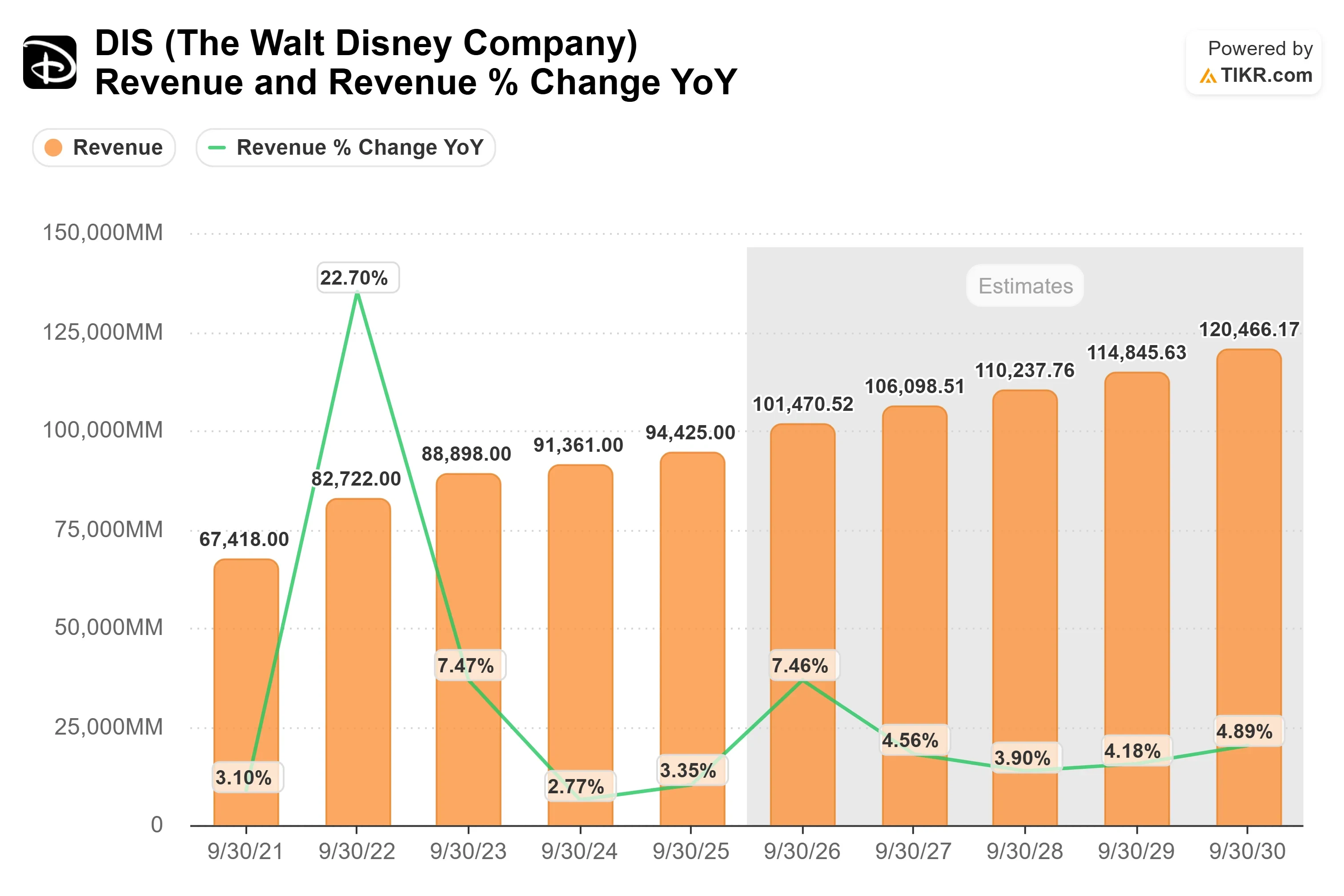
See historical and forward estimates for Disney stock (It’s free!) >>>
Disney Says Cost Savings Will Be Reinvested in Growth
Disney plans to roughly triple local original series on Disney+ over three years. Johnston called international content “a relatively small piece of our overall spend right now,” adding, “I would expect it to go up by a lot on a percentage basis, but it won’t be disruptive to the overall algorithm of the business.”
Disney also names cost cuts as a funding source. A September 18 memo from legal chief Horacio Gutierrez, reported by Deadline, warned staff of a “much smaller organization” and cited “freeing up capital to reinvest in the content, guest experiences, and technology infrastructure.” Johnston described a “virtuous circle of reducing cost, reinvestment in the business, driving growth, creating operating leverage and then reducing cost again.”
Disney+ Premium, which includes 4K, costs $5.50 less than the $26.99 Premium plan from Netflix (NFLX). TIKR data puts Netflix at about 21x NTM P/E versus about 14x for Disney, whose multiple also carries Sports, where segment operating income fell 17% in the June quarter.
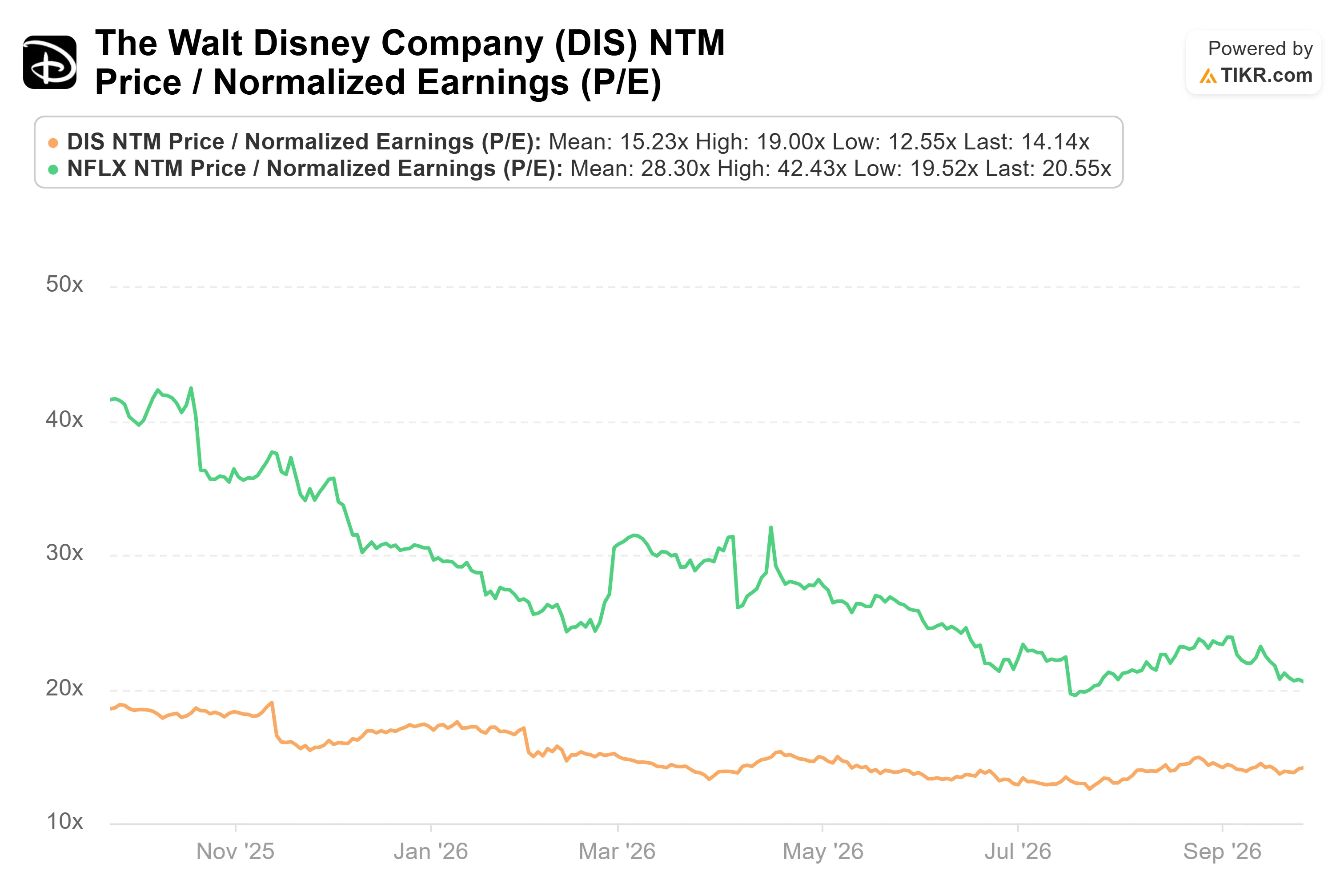
See how Disney performs against its peers in TIKR (It’s free!) >>>
TIKR Advanced Model Analysis
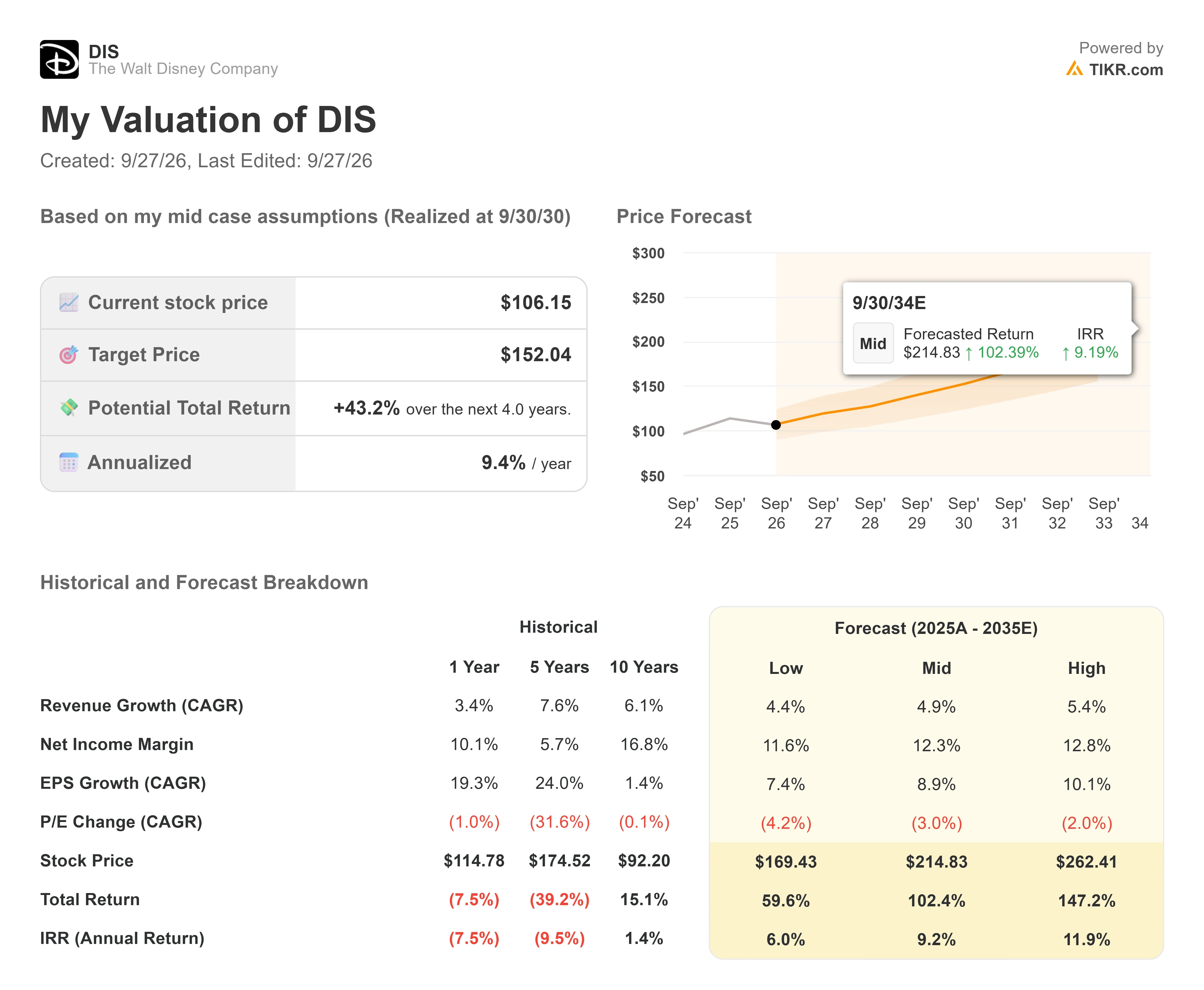
- Current Price: $106.16
- Target Price (Mid): ~$152
- Potential Total Return: ~43%
- Annualized IRR: ~9% / year
See analysts’ growth forecasts and price targets for Disney stock (It’s free!) >>>
Under mid-case assumptions, the TIKR model projects Disney at around $152 by September 30, 2030, about a 43% total return from its $106.15 entry price, or around 9% a year. Across the model’s 2025 to 2035 forecast window, the mid case assumes revenue growth of around 5% a year and a net income margin of around 12%, up from 3.4% and 10.1% over the past year.
Streaming pricing and Experiences capacity are the clearest revenue drivers, on cruises, Johnston said “we can’t fill all the demand that we have right now.” Cost cuts are the margin lever, and the main risk is content spending and soft ad pricing outrunning price gains.
Faster revenue growth than the mid case would lift the return. A lower exit multiple than the model assumes would cut it even if earnings hold.
Conclusion
Existing subscribers see the higher prices on their next monthly bill. With the 53-week fiscal year closing in early October, the fiscal fourth-quarter report expected in mid-November will capture little of the increase while also reflecting live-action Moana’s box office miss.
The fiscal first-quarter report, around early February, is the test. Rising SVOD operating income dollars with margin in double digits would support Johnston’s approach; weaker churn commentary or lower ad rates would signal the increase outran the content.
See what stocks billionaire investors are buying so you can follow the smart money with TIKR.
Should You Invest in Disney?
The only way to really know is to look at the numbers yourself. TIKR gives you free access to the same institutional-quality financial data that professional analysts use to answer exactly that question.
Pull up Disney, and you’ll see years of historical financials, what Wall Street analysts expect for revenue and earnings in the quarters ahead, how valuation multiples have moved over time, and whether price targets are trending up or down.
You can build a free watchlist to track Disney alongside every other stock on your radar. No credit card required. Just the data you need to decide for yourself.
Looking for New Opportunities?
- See what stocks billionaire investors are buying so you can follow the smart money.
- Analyze stocks in as little as 5 minutes with TIKR’s all-in-one, easy-to-use platform.
- The more rocks you overturn… the more opportunities you’ll uncover. Search 100K+ global stocks, global top investor holdings, and more with TIKR.
Disclaimer:
Please note that the articles on TIKR are not intended to serve as investment or financial advice from TIKR or our content team, nor are they recommendations to buy or sell any stocks. We create our content based on TIKR Terminal’s investment data and analysts’ estimates. Our analysis might not include recent company news or important updates. TIKR has no position in any stocks mentioned. Thank you for reading, and happy investing!