
Key Stats for DAL Stock
- Past week performance: -5.9%
- 52-week range: $55.03 to $95.6
- Valuation model target price: $84.87
- Implied upside: 3.0% over 2.4 years
See how rising fuel costs and margin trends could shape Delta’s next 5 years using TIKR’s new Valuation Model (It’s free) >>>
A Margin Story That Fuel Costs Couldn’t Derail
Delta Air Lines (DAL) posted Q2 revenue of $19.8 billion, up 14% year over year, alongside $1.6 billion in net profit. The headline number that mattered most was an 8.8% operating margin, which beat guidance even though fuel expenses jumped nearly $2 billion to $4.4 billion. That combination shows pricing power caught up faster than management had modeled.
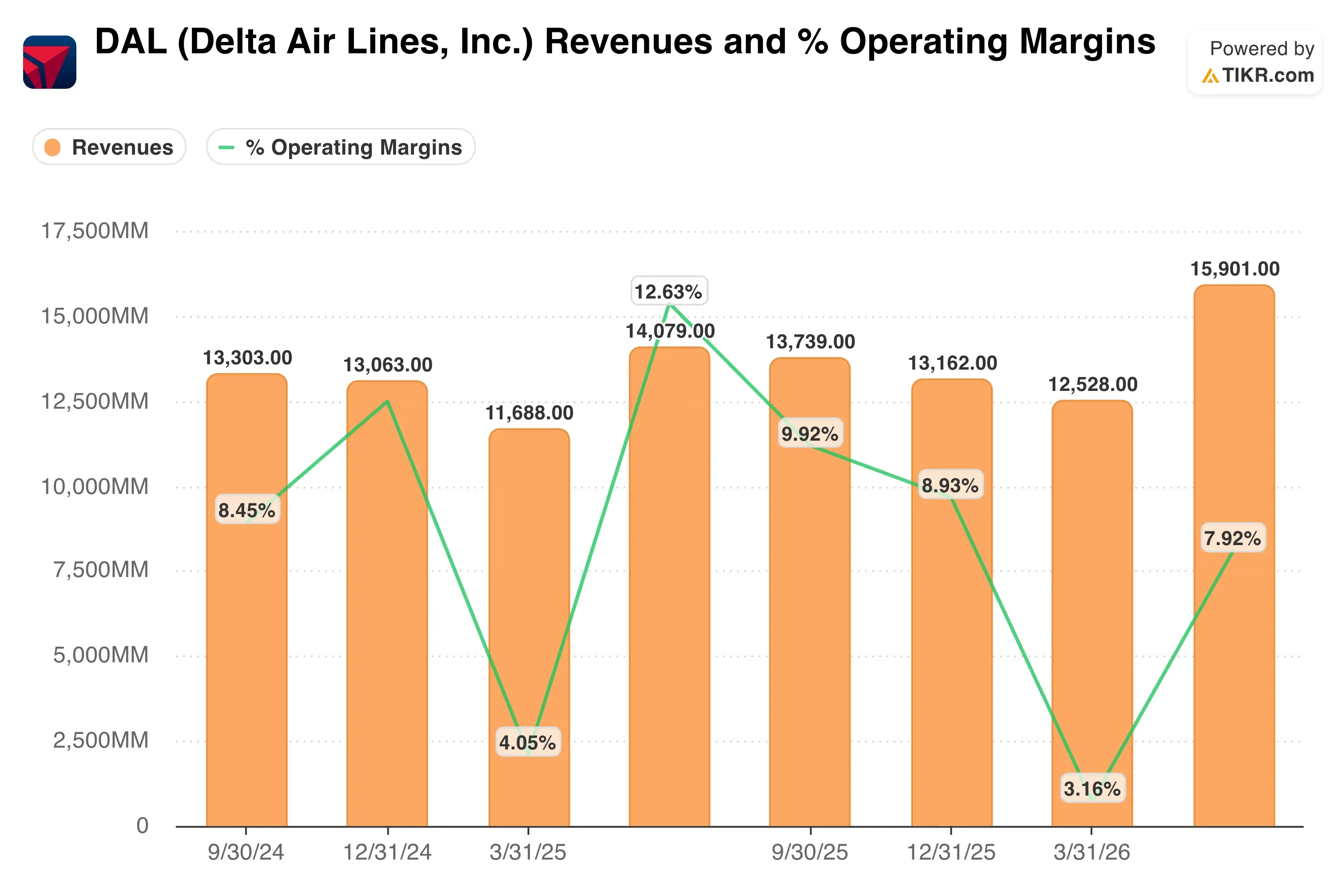
The bigger news this week came from the courtroom. A U.S. appeals court overturned a Trump administration order that sought to force Delta and Aeromexico to unwind their nearly decade-old, antitrust-immunized joint venture. The court found the Department of Transportation acted arbitrarily, so Delta and Aeromexico can keep coordinating scheduling and pricing on U.S.-Mexico routes.
Fuel remains the swing factor for the whole sector. Industry-wide fuel costs are expected to account for 31.4% of operating expenses in 2026, and government data show carrier fuel spending rose roughly 84% compared with the same period last year. Because Delta’s margin held up despite that pressure, the quarter reads as a validation of pricing discipline rather than a fuel-driven fluke.
Engine maintenance bills linger as grounded jets return to service across the industry. If Delta stock keeps trading below its 52-week high, it likely reflects investor caution around oil prices rather than any deterioration in Delta’s underlying demand trends.
See analysts’ growth forecasts and price targets for DAL (It’s free) >>>
A Steady Business, a Modest Return
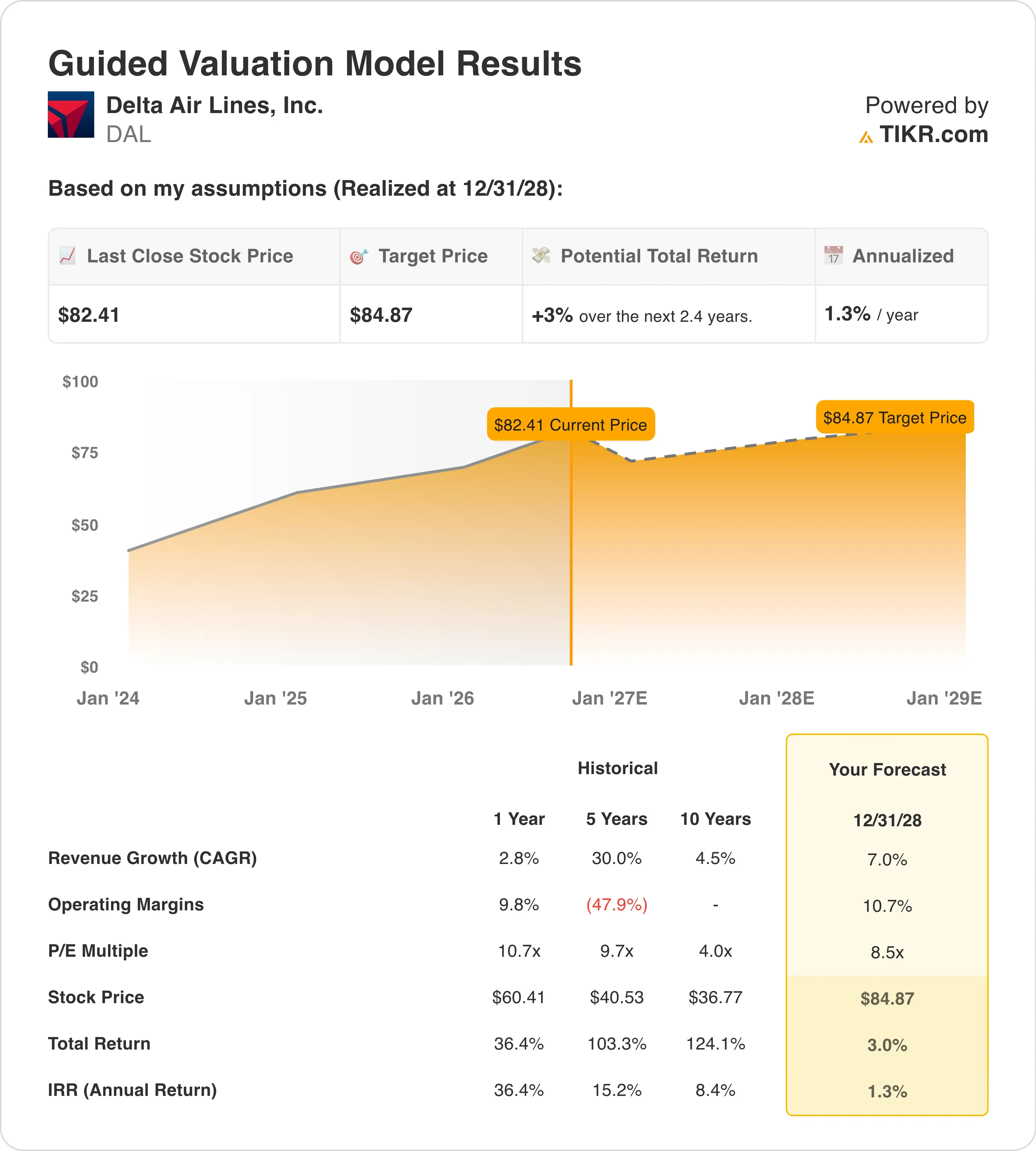
Under valuation model assumptions realized through 12/31/28, the stock is modeled using:
- Revenue Growth (CAGR): 7.0%
- Operating Margins: 10.7%
- Exit P/E Multiple: 8.5x
Based on these inputs, the model estimates a target price of $84.87, implying 3.0% total upside from the current share price and a 1.3% annualized return over the next 2.4 years.
Delta’s valuation tells a story of a mature, cyclical business rather than a growth stock. A 7.0% revenue growth assumption sits below Delta’s forward two-year revenue CAGR of 8.5%, so the model is arguably conservative on the top line. But airlines rarely command premium multiples, and the 8.5x exit P/E reflects that reality.
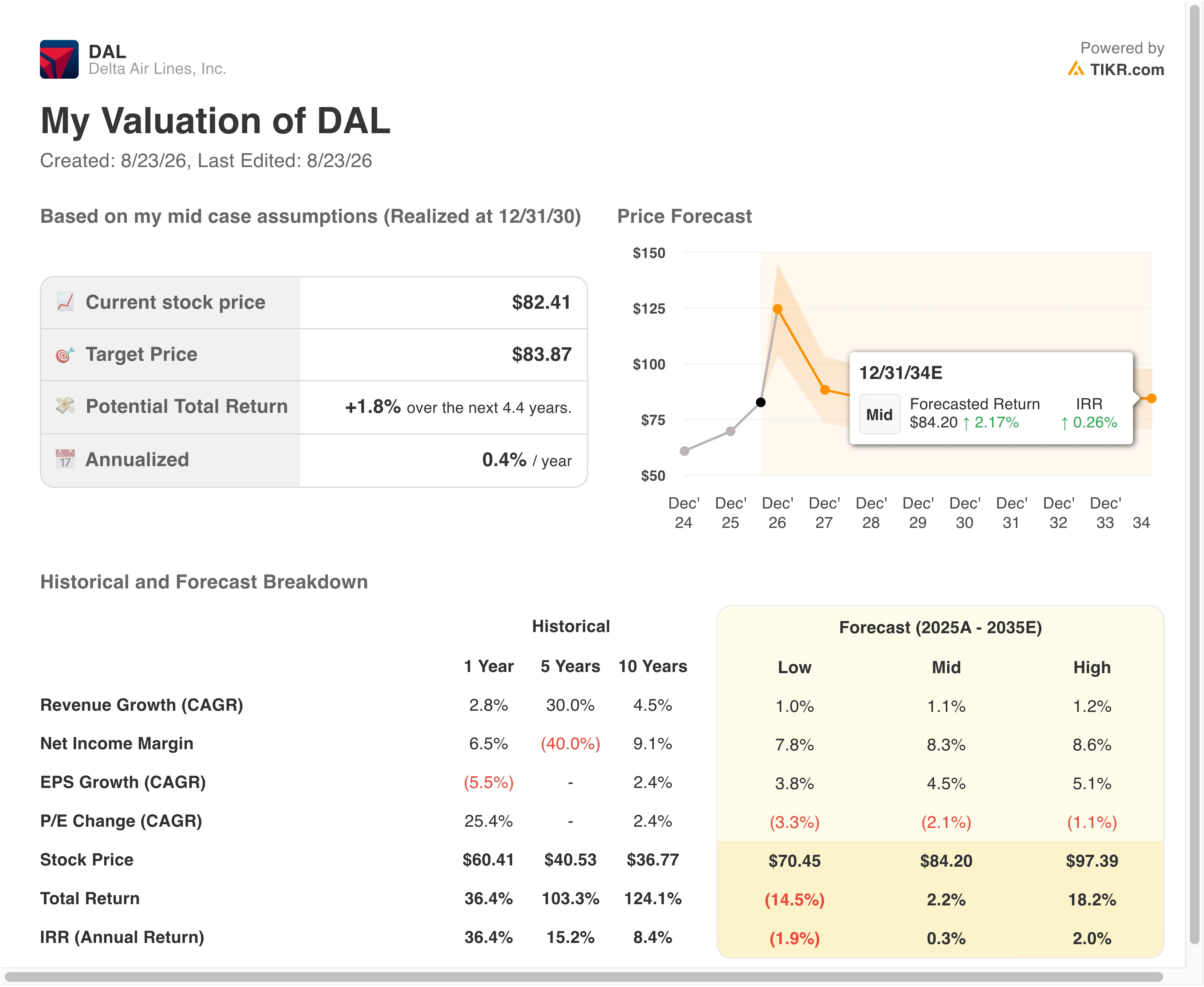
An annualized return near 1.3% falls well under the 5% threshold that typically signals limited upside for growth-oriented investors. That doesn’t mean Delta is a bad business. It means the current share price already reflects most of the near-term margin improvement story, leaving little room for multiple expansion unless fuel costs ease meaningfully.
Compared to its own five-year revenue CAGR of 30.0%, which was skewed by the pandemic recovery, today’s single-digit growth assumption looks far more realistic. Investors buying Delta today are underwriting operational execution and capital returns, not a growth re-rating.
How Delta Stacks Up Against United and Southwest
Delta’s 8.8% operating margin puts it ahead of most legacy peers this quarter, but Southwest Airlines (LUV) posted the standout comparison. Southwest’s adjusted operating margin expanded 3.3 points to 6.7%, still below Delta’s, while revenue jumped 16.4% to $8.43 billion on record unit revenue gains.
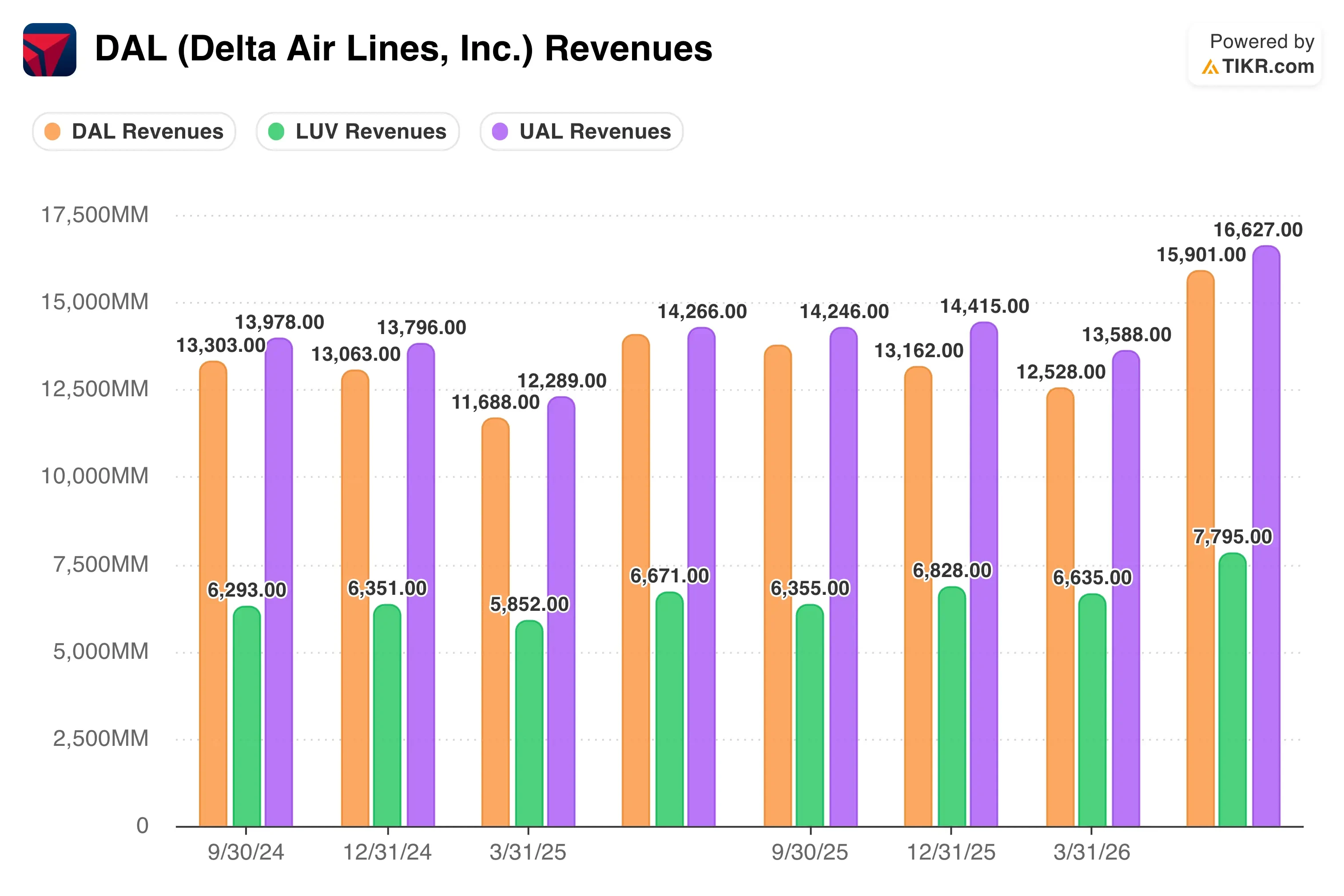
United Airlines (UAL) reported Q2 revenue near $14.0 billion, up roughly 8%, with operating income of about $1.5 billion, translating to a margin near 10.7%, edging out Delta’s 8.8% print. That comparison highlights how tight the profitability gap has become across the big three domestic carriers.
Delta’s moat comes from its premium and loyalty revenue mix, which has historically insulated margins better than peers during fuel spikes. United’s slightly higher margin this quarter suggests that edge is narrowing, so investors should watch whether Delta can widen the gap again once fuel prices stabilize and the Aeromexico venture continues contributing incremental revenue.
What’s Driving DAL Stock Going Forward?
Oil prices remain the single biggest swing factor for Delta’s next few quarters. Strait of Hormuz tensions and broader Middle East uncertainty have already pushed fuel costs higher, and further spikes could pressure the margin gains Delta just delivered.
The Aeromexico ruling gives Delta a durable near-term catalyst. Because the joint venture can continue operating, Delta retains pricing and scheduling coordination on a lucrative U.S.-Mexico corridor that competitors can’t easily replicate. That advantage should support revenue in coming quarters even if broader industry growth slows.
Engine maintenance costs across the industry remain a watch item. As more grounded aircraft return to service, Delta will need to manage those bills carefully to protect the margin gains it just posted. Management has guided for fuel consumption in the remainder of 2026 to stay aligned with capacity changes.
The next earnings report in mid-October will be the clearest test of whether Delta can sustain an operating margin near 8.8% if fuel costs keep climbing. If Delta stock is to move meaningfully off its current levels, sustained margin execution through a volatile fuel environment will likely be the deciding factor.
Should You Invest in Delta Airlines?
The only way to really know is to look at the numbers yourself. TIKR gives you free access to the same institutional-quality financial data that professional analysts use to answer exactly that question.
Pull up DAL, and you’ll see years of historical financials, what Wall Street analysts expect for revenue and earnings in the quarters ahead, how valuation multiples have moved over time, and whether price targets are trending up or down.
You can build a free watchlist to track DAL alongside every other stock on your radar. No credit card required. Just the data you need to decide for yourself.
Analyze DAL stock on TIKR Free→
Disclaimer:
Please note that the articles on TIKR are not intended to serve as investment or financial advice from TIKR or our content team, nor are they recommendations to buy or sell any stocks. We create our content based on TIKR Terminal’s investment data and analysts’ estimates. Our analysis might not include recent company news or important updates. TIKR has no position in any stocks mentioned. Thank you for reading, and happy investing!