Key Takeaways
- Bank of America’s total deposits grew from $1.93 trillion in Q3 2024 to $2.03 trillion in Q2 2026, while quarterly interest expense fell from $23.52 billion to $17.84 billion.
- Moynihan has cited about $800 million of benefit from AI projects at a $400 million cost, but 10 basis points on the deposit base is worth roughly $2 billion a year by our calculation.
- Lower short rates explain part of the funding-cost decline, so the October 14 report is the first look at deposits after the Fed’s September hike and the launch of AI agents like Meta’s Muse.
Bank of America’s quarterly funding bill fell $5.68 billion while deposits kept growing. Track BAC’s deposits and interest expense on TIKR for free →
BAC Stock Faces a Bigger AI Question Than Its Savings
On September 14, a Barclays conference moderator asked Brian Moynihan whether Bank of America (BAC) would pay up for deposits to win share. His answer was short. A 4% CD would just put cash to work at the Fed for less, “and we don’t do things to lose money.”
The same day, he guided investment banking fees lower. The stock has slid from its $65.22 intraday high on August 17 to $54.43 at the September 30 close, about 16.5%.
Most of the debate has centered on that fee guide. A quieter one sits underneath it. Reuters Breakingviews argued this week that AI agents could move customers’ idle cash out of low-yield checking, citing figures that put average checking rates at 0.1% against 3% to 5% at fintech upstarts. Bank of America’s consumer deposits, by contrast, were $957 billion at a 48 basis point cost in Q2.
Moynihan’s AI payoff is real. He has put the benefit of implemented projects at about $800 million against a $400 million cost, and Breakingviews described it as annual. But the scale is lopsided. Ten basis points on the $2.03 trillion deposit base is about $2.0 billion a year. That is an illustration that assumes the whole base reprices, but it shows the AI savings are measured in hundreds of millions while deposit costs are measured in billions.
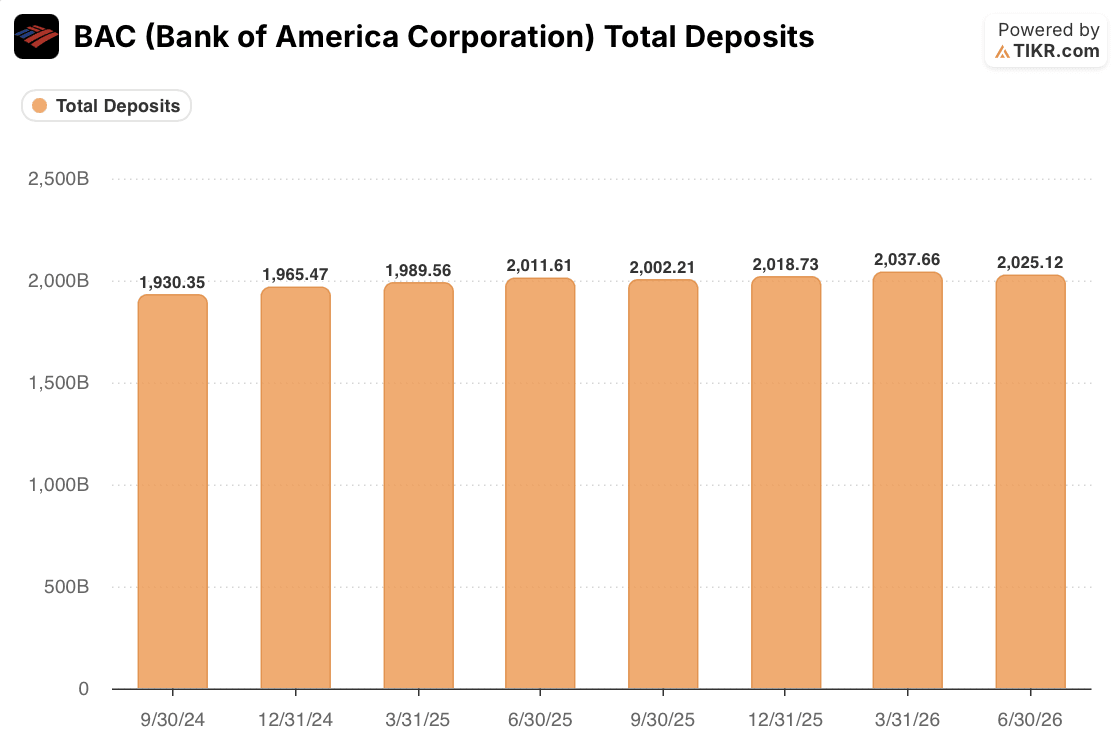
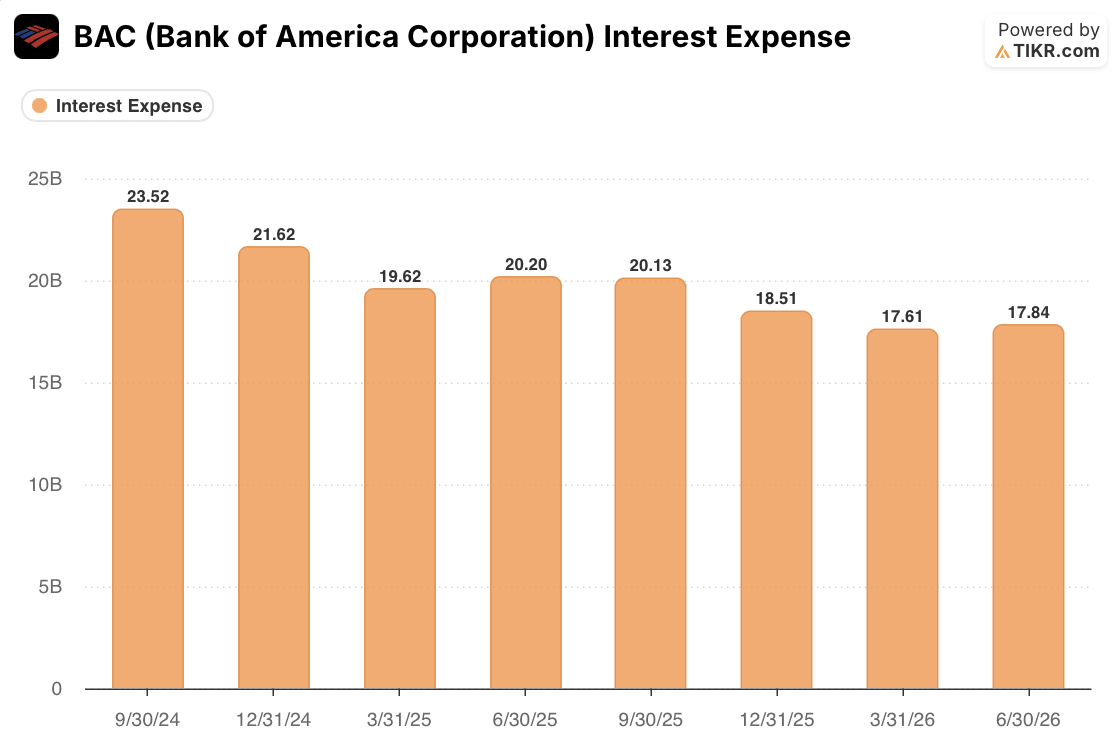
So far, the funding line has moved the right way. Deposits rose $94.77 billion, or about 4.9%, from Q3 2024 to Q2 2026. Interest expense fell about 24% over the same stretch. In the past year alone, deposits rose 0.7% from $2,011.61 billion to $2,025.12 billion, while interest expense dropped 11.7% from $20.20 billion to $17.84 billion.
What Q3 Must Show Before the AI Gains Count
The decline in interest expense is not proof that deposits are loyal. Management said on the Q2 call that a modestly lower short-rate environment was in play, and cheaper money likely explains much of the drop alongside the paydown of higher-cost funding. A funding line that fell because rates fell has not yet been tested by agents hunting for yield.
The latest quarter is mixed. Deposits slipped $12.5 billion from $2,037.66 billion in Q1, and interest expense ticked up 1.3% to $17.84 billion from $17.61 billion. Management attributed the muted sequential growth to seasonal tax outflows, though TIKR’s figures are period-end balances while management’s growth figures are averages.
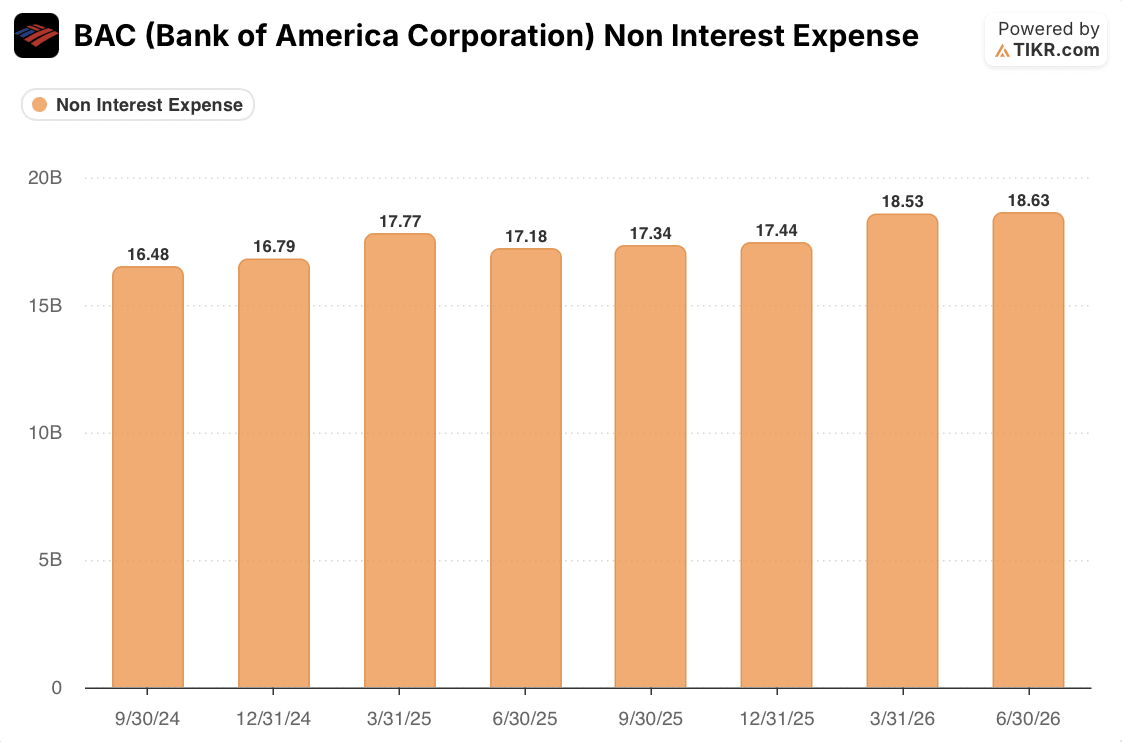
The cost base does not yet show the AI savings either. Noninterest expense reached $18.63 billion in Q2, up $1.45 billion, or 8.4%, from $17.18 billion a year earlier, and up 13% from $16.48 billion in Q3 2024. Management tied the increase to incentives, trading costs and technology investment, and Q2 revenue grew 15% over the same period, so the line is rising with the business rather than shrinking because of AI.
The evidence supports a narrow judgment. Bank of America’s deposit franchise has held through a falling-rate stretch, which is necessary but not sufficient, and the AI gains are real but too small to offset even a modest shift in funding costs. The principal unresolved risk is that rising rates and yield-seeking agents arrive together.
The October 14 report will show deposit balances and interest expense that barely reflect the hike, since it landed only in mid-September, so the fourth quarter is the cleaner test. Interest expense climbing above Q2’s $17.84 billion while deposits stay near $2.0 trillion would be the first sign the fear is arriving. If both hold, the selloff will look like it priced a threat the numbers have not delivered.
Bank of America’s October 14 report will show whether deposit costs held. Follow BAC’s earnings on TIKR for free →
So what is Bank of America Corporation stock actually worth?
TIKR lets you forecast the future price of any stock in less than a minute. Just enter a few assumptions into TIKR’s valuation model and see what BAC stock could be worth. Start from Wall Street consensus estimates, or adjust the inputs to reflect your own view of the business. It’s free to use.
Value Bank of America Corporation for free→
Disclaimer:
Please note that the articles on TIKR are not intended to serve as investment or financial advice from TIKR or our content team, nor are they recommendations to buy or sell any stocks. We create our content based on TIKR Terminal’s investment data and analysts’ estimates. Our analysis might not include recent company news or important updates. TIKR has no position in any of the stocks mentioned. Thank you for reading, and happy investing!