
Key Takeaways for The Boeing Company Stock as of July 2026
- TIKR’s mid case model values Boeing stock at $9,862 by 2030, up 4508%.
- Wall Street analysts are split 17 buy, 4 outperform, 6 hold and 1 underperform on Boeing stock, with a mean target of $270 that leaves a 26% gap to the current $214 price.
- China committed to 200 Boeing narrowbody jets in May 2026, the first new order from that market in nearly a decade, with executives pointing to underlying demand above 500 aircraft a year.
- March 2026 brought a 25% drawdown for Boeing stock. Shares now sit 15% off that high.
Boeing Stock Gets a 200-Jet China Order After a Decade-Long Freeze
Boeing (BA) secured a 200-airplane commitment from China in May 2026, the country’s first new narrowbody order in nearly a decade. The commitment came out of a trip alongside President Trump, and it reopens a market that had been closed to Boeing since a previous trade dispute froze new business.
CEO Kelly Ortberg addressed the significance directly at the Bernstein 42nd Annual Strategic Decisions Conference on May 27: “The China trip was super successful. My primary objective was to reopen that market to our narrowbody airplanes. As you know, we haven’t had an order in nearly a decade. And we accomplished that, which is a major, major accomplishment.” He added that China needs “well over 500 aircraft a year to support their GDP growth.”
That distinction matters. The 200-jet figure is an initial government-to-government commitment, not a firm airline order. Ortberg explained the mechanics: Beijing allocates a batch of narrowbody aircraft, then individual Chinese carriers negotiate firm contracts with Boeing airline by airline. So the 200 units will convert into bookings over time rather than landing on the backlog all at once.
Boeing already closed 2025 with more than 1,000 new orders, and its commercial backlog sat at a record $576 billion with more than 6,100 airplanes as of the first quarter of 2026. China adds a new demand pool on top of that base, one the current backlog never counted on. Reopening a market that buys 500-plus jets a year, even gradually, changes the ceiling on Boeing’s narrowbody volume in a way no single quarter of deliveries could.
Ortberg’s own framing settles the stakes: getting the market open again outweighs the size of the first order. That is the thesis. Boeing stock isn’t being repriced for 200 jets. It’s being repriced for a reopened pipeline.
Boeing Stock Climbs Off Its March Low While Analysts Stay Bullish
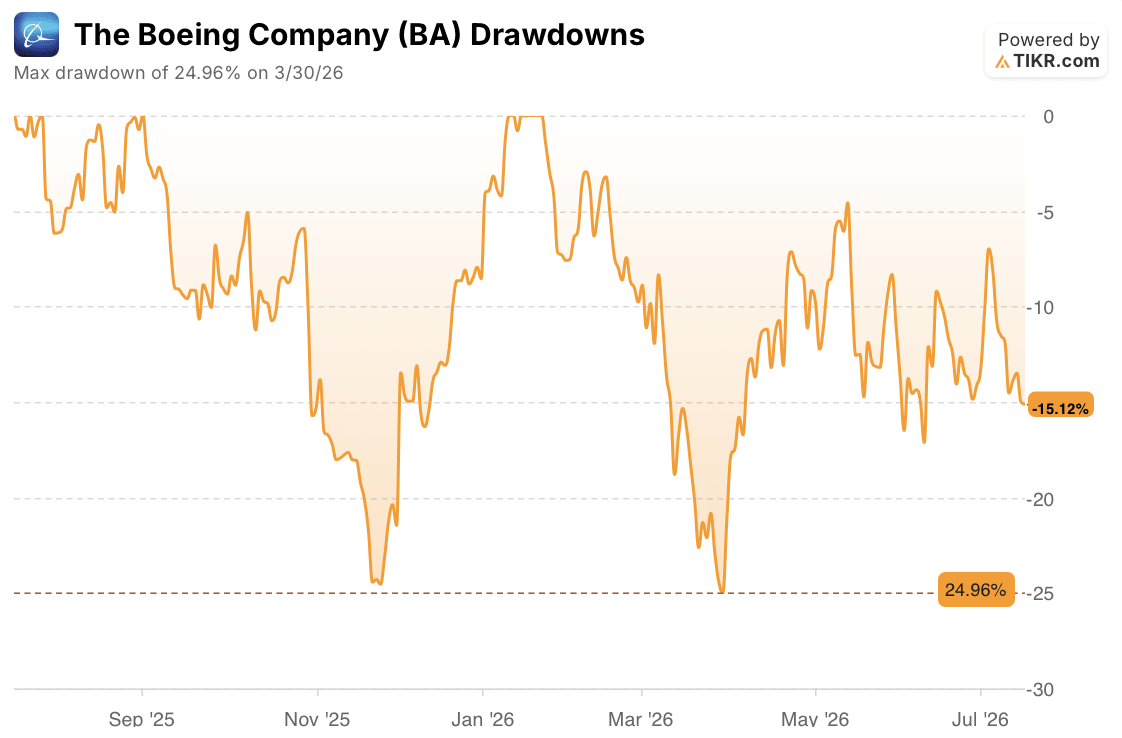
Boeing stock hit a maximum drawdown of 25% on March 30, 2026, its deepest pullback of the past year. Shares have since clawed back part of that loss and now trade 15% below the prior high.
The China commitment landed two months after the trough, and the stock’s partial recovery lines up with that timing even as broader jet-fuel cost pressure kept a lid on the rebound.

Wall Street rates Boeing stock 17 buy, 4 outperform, 6 hold and 1 underperform, with zero sell ratings among the 26 analysts covering the stock as of July 17, 2026. The mean target price sits at $270, a 26% premium to the $214 close, and that target has held near $270 for three straight quarters even as the stock price swung between $199 and $217.
Boeing stock’s target-to-price ratio of 126.2% shows the Street has priced in recovery well before the China order became public.
TIKR Values Boeing Stock at $9,862, Pricing In China-Driven Growth Through 2030
TIKR’s mid case model values Boeing stock at $9,862 by December 2030, a 4508% total return and 136% annualized gain from the current price of $214 over the next 4.4 years.

That return profile sits far outside what a typical aerospace recovery trade offers, where investors usually underwrite double-digit annualized gains rather than triple-digit ones. Boeing stock’s model output reflects a business compounding off a much larger order base than the one it operates against today.
The math holds because Boeing’s reopened access to China adds volume the current $576 billion backlog never priced in. Every additional narrowbody sold into a market of 500-plus jets a year layers onto delivery rates already climbing toward 47 a month this summer and 52 beyond that, and the model already assumes that compounding continues as the China pipeline converts from a government commitment into firm airline orders.
Boeing’s own order history without China averaged over 1,000 units in 2025 alone. Layering a reopened market of this scale onto that trajectory is exactly the kind of upside TIKR’s model captures years before consensus targets catch up.
Should You Invest in The Boeing Company?
The only way to really know is to look at the numbers yourself. TIKR gives you free access to the same institutional-quality financial data that professional analysts use to answer exactly that question.
Pull up The Boeing Company stock and you’ll see years of historical financials, what Wall Street analysts expect for revenue and earnings in the quarters ahead, how valuation multiples have moved over time, and whether price targets are trending up or down.
You can build a free watchlist to track The Boeing Company alongside every other stock on your radar. No credit card required. Just the data you need to decide for yourself.
Access Professional Tools to Analyze BA stock on TIKR for Free →
Looking for New Opportunities?
- See what stocks billionaire investors are buying so you can follow the smart money.
- Analyze stocks in as little as 5 minutes with TIKR’s all-in-one, easy-to-use platform.
- The more rocks you overturn… the more opportunities you’ll uncover. Search 100K+ global stocks, global top investor holdings, and more with TIKR.
Disclaimer:
Please note that the articles on TIKR are not intended to serve as investment or financial advice from TIKR or our content team, nor are they recommendations to buy or sell any stocks. We create our content based on TIKR Terminal’s investment data and analysts’ estimates. Our analysis might not include recent company news or important updates. TIKR has no position in any stocks mentioned. Thank you for reading, and happy investing!