
Key Stats for Illumina Stock
- Current Price: $186.65
- Target Price (Mid): ~$253
- Potential Total Return: ~36% (mid case, over ~4.4 years)
- Annualized IRR: ~7% / year
- Max Drawdown: 25.66% on 2/12/26
Now Live: Discover how much upside your favorite stocks could have using TIKR’s new Valuation Model (It’s free) >>>
What Happened?
Illumina (ILMN) spent the first half of July watching its analysts run out of patience with their own caution. Piper Sandler and Evercore ISI moved their price targets to $200. Leerink went to $210. Canaccord, TD Cowen, and Guggenheim all raised too. Those numbers sit well above the consensus mean of roughly $169 that shows up in the longer analyst record, which tells that the average is still catching up to a fast-moving group of bulls. For a company the Street had left for dead 18 months ago, that is a remarkable turn.
The stock has earned some of it. Shares closed at $186.65 on July 17, up about 44% for the year and within a few dollars of the 52-week high of $196.66. But a wave of $200 targets on a stock already near its high raises the real question. The upgrades are one-year calls. The fundamentals have to hold for years. And a credible new competitor just started shipping. The way to test the enthusiasm is to put it next to the model.
The Bulls Are Betting on Pricing Power, Not Just Placements
The upgrade case leans on clinical sequencing consumables, which grew 20%, excluding China, for a second straight quarter. Consumables are the chemical kits labs buy every time they run a sequencer, so they are the recurring, high-margin revenue that turns machines into annuities. When Piper Sandler lifted its target to $200, it framed the move around that idea: Illumina’s clinical mix is decoupling its growth from the volatile academic research market.
What makes analysts believe that mix holds its pricing is less about unit counts and more about how labs actually consume sequencing. CEO Jacob Thaysen spelled it out on the Q1 call, describing customers moving from exome testing to whole-genome work in rare disease, which “will require a 15x more sequencing intensity.” His point was that Illumina can offer aggressive per-unit pricing and still grow revenue, because volume expands faster than price falls. As he put it, “if we go in and provide a very aggressive pricing, we also see a very aggressive volume growth.” That elasticity, not the raw placement number, is the mechanism the $200 targets are underwriting. The placements matter as the delivery system: more than 80 NovaSeq X units shipped in Q1, roughly 20 above the year-ago quarter, each carrying about $1.3 million in lifetime consumables pull-through. But the bet is on what those machines consume, and at what margin.
Why the Street Can’t Agree With Itself on Illumina
The tell is not the $200 targets. It is the spread. The freshest analyst calls cluster at $200 to $210, yet the consensus mean still reads near $169, and that gap is not noise. It means half the Street re-underwrote this stock in the last two weeks, while the other half has not moved. When a mean lags its newest data points that far, the number in the middle is stale, not settled. Whoever updates last decides whether $169 climbs to meet the bulls or the bulls drift back down to it.
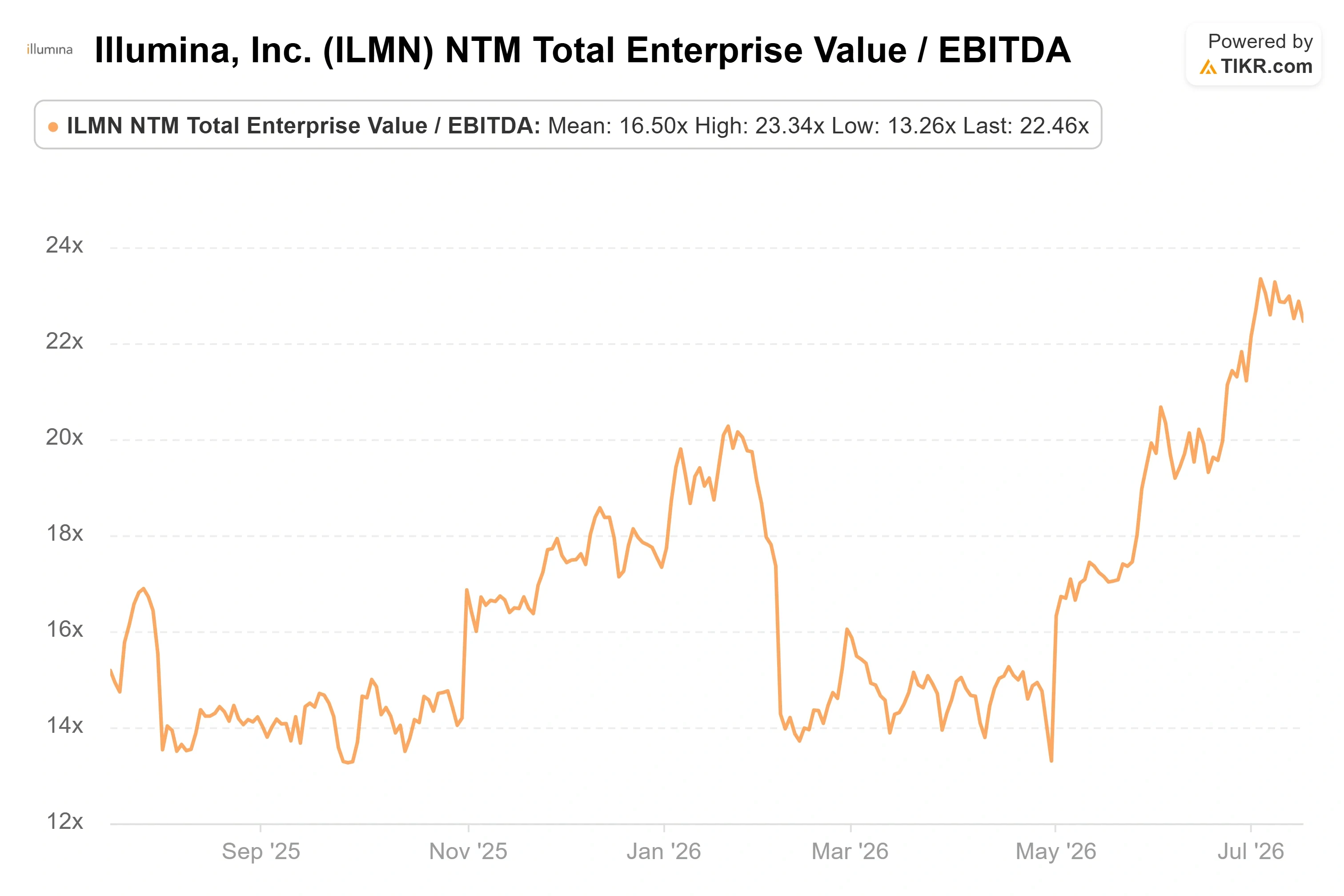
What the $200 camp is really paying up for is the multiple, not the earnings. On forward EV/EBITDA, Illumina sits around 22 times, against Thermo Fisher Scientific near 19, Agilent Technologies near 17, and Revvity near 16. It carries the richest multiple in its peer group, and a premium multiple is a bet that Illumina grows faster than the companies it trades against. That bet is defensible today, because clinical consumables are compounding at double digits while the broader tools group grows low single digits. The danger is that the premium and the growth rate are the same bet wearing two faces. If clinical growth slips toward the mid-single-digit pace the model assumes for later years, the multiple has nothing left to stand on, and the re-rating that carried the stock up in 2026 runs in reverse.
That is why the near-term targets and the longer arc can both be right without agreeing. A $200 print in twelve months rewards the momentum. The multi-year math rewards the execution.
See historical and forward estimates for Illumina stock (It’s free!) >>>
Roche Just Shipped the Risk Nobody Is Fully Pricing
The bull case has one genuine complication, and it arrived on June 29. Roche launched its Axelios 1 sequencer, built on a new “sequencing by expansion” chemistry, priced at about $750,000 in the United States. That sits well below the NovaSeq X, which lists between roughly $985,000 and $1.25 million, undercutting the top of that range by around 40%. When Roche previewed the platform in February, a Jefferies analyst called it the “greatest credible competitive threat in years.” This is not a roadmap slide. It is a shipping product with early collaborations at the Broad Clinical Labs and the Hartwig Medical Foundation.
The reasons to stay calm are specific, and worth stating precisely rather than waving away. Axelios launched for research use only, not for clinical diagnostic procedures, which walls it off from the exact clinical market driving Illumina’s growth today. Roche is targeting about 100 machines in its first year against the roughly 70% share of the installed base that analysts credit to Illumina, built over two decades. And JPMorgan, after speaking with customers, reported that management teams already transitioning to the NovaSeq X “aren’t urgently planning to switch.” Switching costs in sequencing are steep, because labs know Illumina’s software, its error profiles, and its reagents. On the Q1 call, Thaysen was blunt about the noise: “We are looking forward to compete when they finally get to the market.” Now Roche is in the market, and the next several quarters will show whether sticky is as sticky as the bulls believe. For where this year’s enthusiasm started, see our recent look at whether the GRAIL recovery is already priced in.
See how Illumina performs against its peers in TIKR (It’s free!) >>>
TIKR Advanced Model Analysis
- Current Price: $186.65
- Target Price (Mid): ~$253
- Potential Total Return: ~36%
- Annualized IRR: ~7% / year

See analysts’ growth forecasts and price targets for Illumina stock (It’s free!) >>>
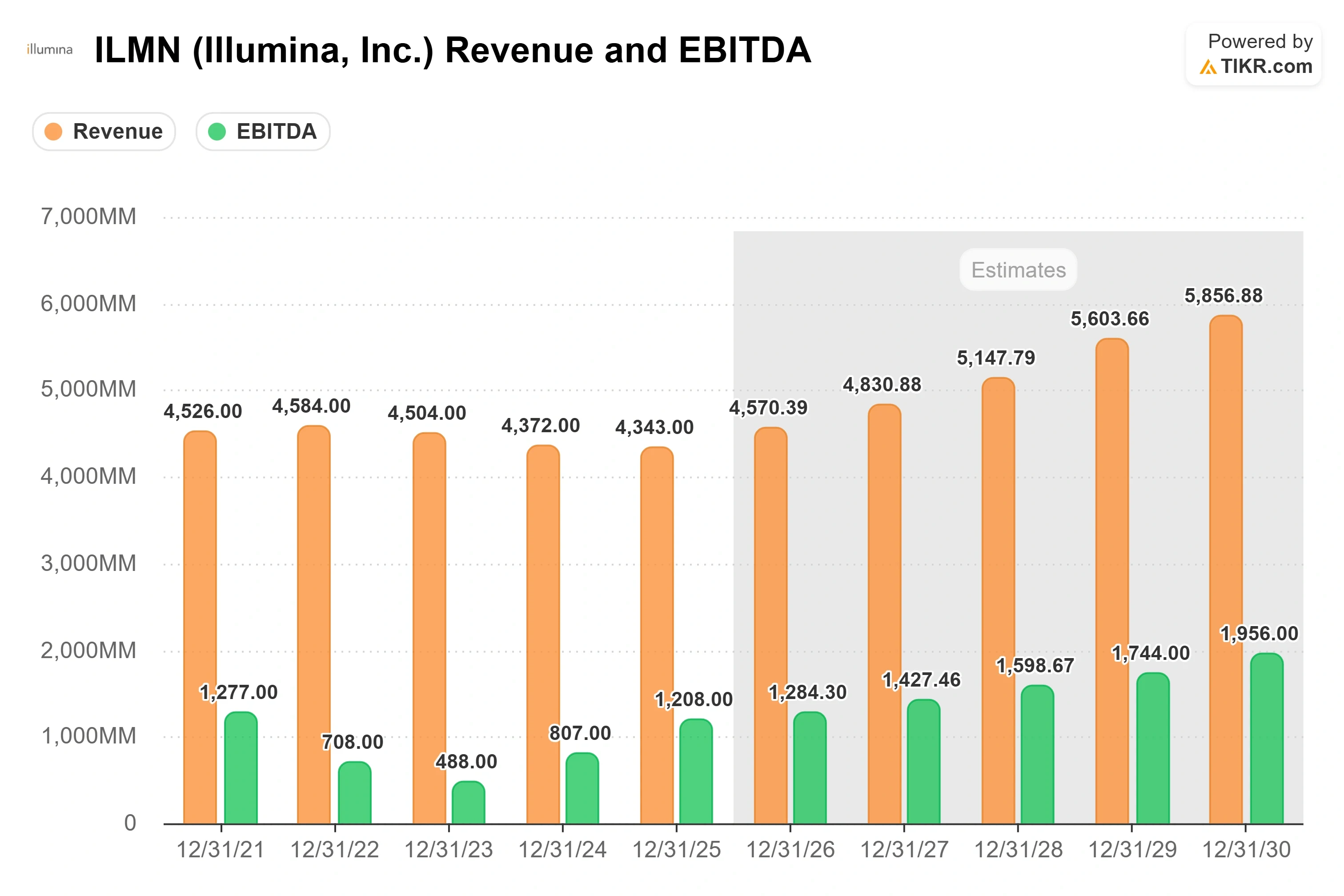
The mid case is the right lens because it captures the recovery without assuming research spending snaps back on schedule. The target of about $253 rides two revenue engines: double-digit clinical consumables growth as the NovaSeq X installed base scales, and a gradual return of research and applied spending once NIH grant money turns into orders. Margin expansion comes from operating leverage on that richer consumables mix, with full-year operating margin guided to 23.4% to 23.6%, up about 140 basis points year over year. The primary risk is multiple compression: at 34 times forward earnings, a premium stock has little room for a clinical growth disappointment. The upside is that clinical holds in the mid-teens and research recovers faster than modeled, pushing the high scenario well above $250. The downside is that Roche’s research beachhead widens and the multiple deflates before earnings catch up.
Conclusion
The tell comes on July 30, when Illumina reports Q2. Management guided to 4% to 6% Rest-of-World organic revenue growth and non-GAAP EPS of $1.20 to $1.25, and the CFO said Q2 placements could match Q1’s 80-plus pace. Watch two lines: the placement count and the clinical consumables growth rate. Another quarter near 20% clinical growth with placements holding around 80 confirms the story the July upgrades are underwriting, and the $200 targets start looking reasonable rather than early. A clinical rate sliding toward the low teens, or any sign that research-lab buyers are testing Roche’s machine, is the first crack in a stock priced for the good version of the future. The analysts have already voted. The quarter gets the final say.
See what stocks billionaire investors are buying so you can follow the smart money with TIKR.
Should You Invest in Illumina?
The only way to really know is to look at the numbers yourself. TIKR gives you free access to the same institutional-quality financial data that professional analysts use to answer exactly that question.
Pull up Illumina, and you’ll see years of historical financials, what Wall Street analysts expect for revenue and earnings in the quarters ahead, how valuation multiples have moved over time, and whether price targets are trending up or down.
You can build a free watchlist to track Illumina alongside every other stock on your radar. No credit card required. Just the data you need to decide for yourself.
Analyze Illumina on TIKR Free →
Looking for New Opportunities?
- See what stocks billionaire investors are buying so you can follow the smart money.
- Analyze stocks in as little as 5 minutes with TIKR’s all-in-one, easy-to-use platform.
- The more rocks you overturn… the more opportunities you’ll uncover. Search 100K+ global stocks, global top investor holdings, and more with TIKR.
Disclaimer:
Please note that the articles on TIKR are not intended to serve as investment or financial advice from TIKR or our content team, nor are they recommendations to buy or sell any stocks. We create our content based on TIKR Terminal’s investment data and analysts’ estimates. Our analysis might not include recent company news or important updates. TIKR has no position in any stocks mentioned. Thank you for reading, and happy investing!