Key Stats for Marvell Stock
- Current Price: $188.68
- Target Price (Mid): ~$500
- Street Target: ~$254
- Potential Total Return: ~165%
- Annualized IRR: ~24% / year
- Max Drawdown: 40.49% on July 16, 2026
Now Live: Discover how much upside your favorite stocks could have using TIKR’s new Valuation Model (It’s free) >>>
What Happened?
Marvell Technology (MRVL) spent the spring as one of the market’s favorite AI stories and the early summer giving much of it back. Shares closed at $188.68 on July 17, down from a 52-week high of $329.88, a decline of roughly 43% from that peak. The steepest single stretch of the fall registered as a 40.49% drawdown dated July 16, its deepest of the year.
What makes the fall notable is that nothing in the fundamentals broke. Marvell beat on revenue, EBITDA, and earnings in its most recent quarter. Data center revenue is still accelerating, and management raised its multi-year target three separate times over the past year. The sources reviewed here do not tie the slide to a single company-specific event, and part of it tracks a broader pullback in richly valued semiconductor names. So the market is not repricing the business so much as the price, which had run far ahead of even a fast-growing company’s numbers. The question for investors now is simple: has a roughly 40% haircut made a great business affordable, or is it still too expensive even here?
A 40% Drop That Left the Business Untouched
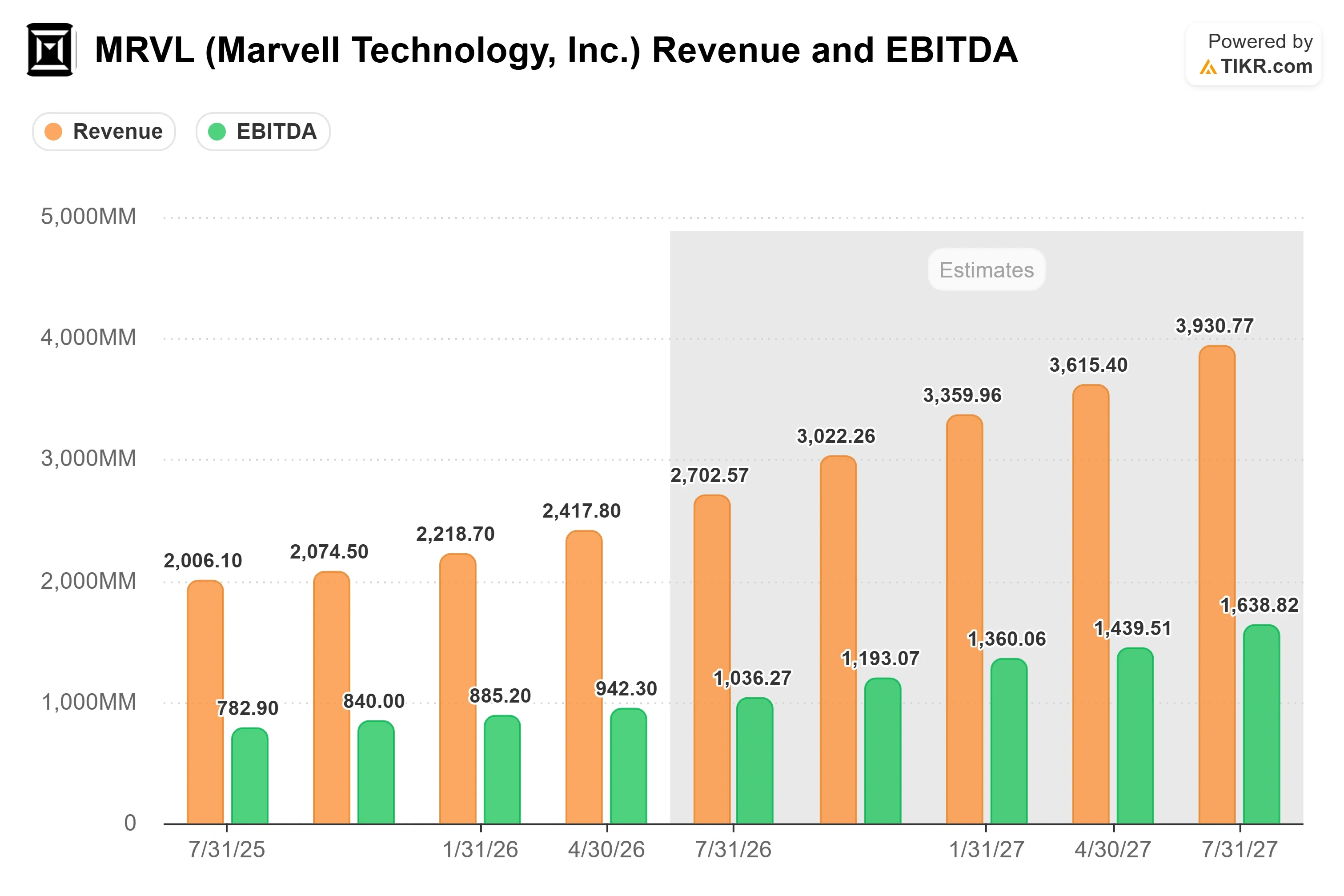
Start with what did not change. In the quarter ending April 30, 2026, Marvell reported revenue of $2,417.80 million against a $2,407.81 million estimate, with adjusted earnings of $0.80 per share versus $0.79 expected. EBITDA of $942.30 million beat the $903.82 million consensus by more than 4%. Shares rose 3.09% on the print. This was a company clearing the bar, not stumbling.
The bigger picture is stronger still. Full-year fiscal 2026 revenue reached $8,194.60 million, up around 42% year over year. Data center has grown from under 10% of revenue a decade ago to roughly 75% today, expanded 46% last year, and management is guiding toward 55% growth. At the Bank of America Global Technology Conference on June 3, CEO Matthew Murphy framed the cycle as “a true global infrastructure build” on “the scale of an industrial revolution type of event.” That is the context for the drawdown: a repricing of a stock, not a downgrade of a business. The move from a $329.88 high to $188.68 erased more than a year of gains, but it landed on fundamentals that were still improving.
See historical and forward estimates for Marvell stock (It’s free!) >>>
The Multiple Is the Whole Argument
Here, the case gets uncomfortable. Even after the fall, Marvell is not cheap. Shares trade at around 42 times next twelve months earnings and roughly 33 times NTM EV/EBITDA, which measures total company value against earnings before interest, taxes, depreciation, and amortization. Against its own June peak, that is a discount. Against its peers, it is still a steep premium.
The named comparisons are stark. NVIDIA trades near 16 times NTM EV/EBITDA, and Broadcom, Marvell’s closest rival in custom silicon and optics, near 19 times. Marvell’s 33 times leaves it at a premium of roughly 75% to Broadcom and more than 100% to NVIDIA, the two names it is measured against most. The drawdown narrowed the gap; it did not close it.
Does the premium make sense? The bull answer is not hand-waving. Marvell’s forward two-year revenue is expected to compound at around 43% and forward two-year EPS at nearly 48%, both well ahead of that peer set. A company growing earnings that fast can carry a richer multiple, because the multiple compresses on its own as earnings arrive. The risk is timing. If data center capital spending cools faster than Marvell assumes, or a key custom-silicon program slips, the growth rate that justifies the premium fades, and the multiple has far to fall. That is what a buyer at $188.68 underwrites: exceptional growth against a price that still needs the growth to show up on schedule.
What Management Is Actually Promising
The growth is more than hope because Marvell keeps raising its own bar in public. Murphy walked through the sequence at the BofA conference: fiscal 2027 revenue guided from $9.4 billion last September to $11 billion, then $13 billion, then $15 billion, and now $16.5 billion. “We’ve been getting the performance out of our suppliers,” he said, describing supply he claims to have forecast years ahead. Rising guidance backed by locked supply is a different signal than a promise on a slide.
Diversification matters as much as the top-line number, because concentration was the bear case for two years. Head of Investor Relations Ashish Saran pointed to “3 new $1 billion businesses” arriving within a year across high-performance analog, cloud switching, and data center interconnect. Murphy added that custom silicon, once feared as a single-customer bet, is tracking toward “15, 18 products in production” by 2028 across multiple customers. For a stock that fell partly on fear of over-reliance on one or two AI buyers, that spread is the counterargument, and it is arriving as revenue rather than forecast.

See how Marvell performs against its peers in TIKR (It’s free!) >>>
TIKR Advanced Model Analysis
- Current Price: $188.68
- Target Price (Mid): ~$500
- Potential Total Return: ~165%
- Annualized IRR: ~24% / year

See analysts’ growth forecasts and price targets for Marvell stock (It’s free!) >>>
The TIKR Valuation Model mid case, realized January 31, 2031, points to a target near $500, an implied total return of around 165% over roughly four and a half years, or an annualized IRR of about 24% per year. That sits well above the Street mean of around $254, and the gap is worth naming. Wall Street’s 40 analysts, weighted toward Buy and Outperform, are modeling the next twelve months. The model prices a longer runway, so the two measure different distances rather than contradict each other.
Two drivers carry it. Revenue is projected to compound at around 23% in the mid case, powered by data center demand and the ramp of custom silicon and scale-up connectivity. Margin expansion is the second, with net income margin modeled near 32% as the higher-value data center mix crowds out legacy revenue. The primary risk is the one the whole piece circles: an AI capital-spending slowdown would hit the growth rate and the multiple at once, and at 33 times EV/EBITDA, there is little cushion. Upside is that guidance keeps climbing as it has all year, and the stock re-rates from a lower base. Downside is that spending cools, growth drifts toward the peer average, and a premium multiple compresses into an ordinary one.
Conclusion
The number that settles this is not a price target. It is the fiscal 2027 revenue guide. Marvell has walked it from $9.4 billion to $16.5 billion in a year, and the entire premium rests on that figure holding or rising again. Watch the next earnings report, expected in late August. If guidance holds near $16.5 billion and data center growth stays above 50%, the drawdown looks like the entry the bulls waited all year for. If guidance flattens or data center growth slips below 45%, the market will decide the premium was never affordable, and 33 times EV/EBITDA becomes the ceiling. The business did not break in July. The next print tells whether the price was the only thing that did.
See what stocks billionaire investors are buying so you can follow the smart money with TIKR.
Should You Invest in Marvell?
The only way to really know is to look at the numbers yourself. TIKR gives you free access to the same institutional-quality financial data that professional analysts use to answer exactly that question.
Pull up Marvell, and you’ll see years of historical financials, what Wall Street analysts expect for revenue and earnings in the quarters ahead, how valuation multiples have moved over time, and whether price targets are trending up or down.
You can build a free watchlist to track Marvell alongside every other stock on your radar. No credit card required. Just the data you need to decide for yourself.
Analyze Marvell on TIKR Free →
Looking for New Opportunities?
- See what stocks billionaire investors are buying so you can follow the smart money.
- Analyze stocks in as little as 5 minutes with TIKR’s all-in-one, easy-to-use platform.
- The more rocks you overturn… the more opportunities you’ll uncover. Search 100K+ global stocks, global top investor holdings, and more with TIKR.
Disclaimer:
Please note that the articles on TIKR are not intended to serve as investment or financial advice from TIKR or our content team, nor are they recommendations to buy or sell any stocks. We create our content based on TIKR Terminal’s investment data and analysts’ estimates. Our analysis might not include recent company news or important updates. TIKR has no position in any stocks mentioned. Thank you for reading, and happy investing!