Key Stats for PepsiCo Stock
- Current Price: $137.12
- Target Price (Mid): ~$191
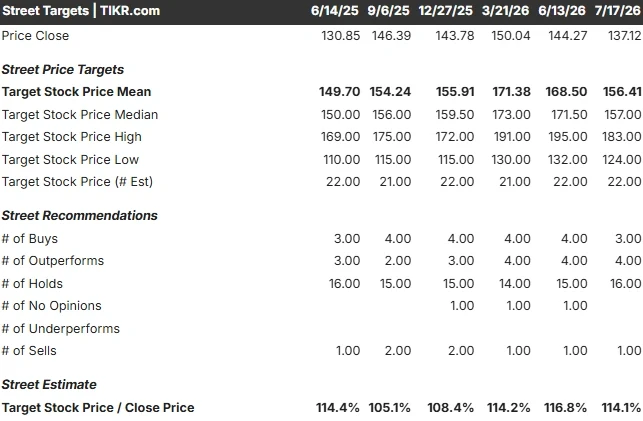
- Street Target: ~$156
- Potential Total Return: ~39%
- Annualized IRR: ~8% / year
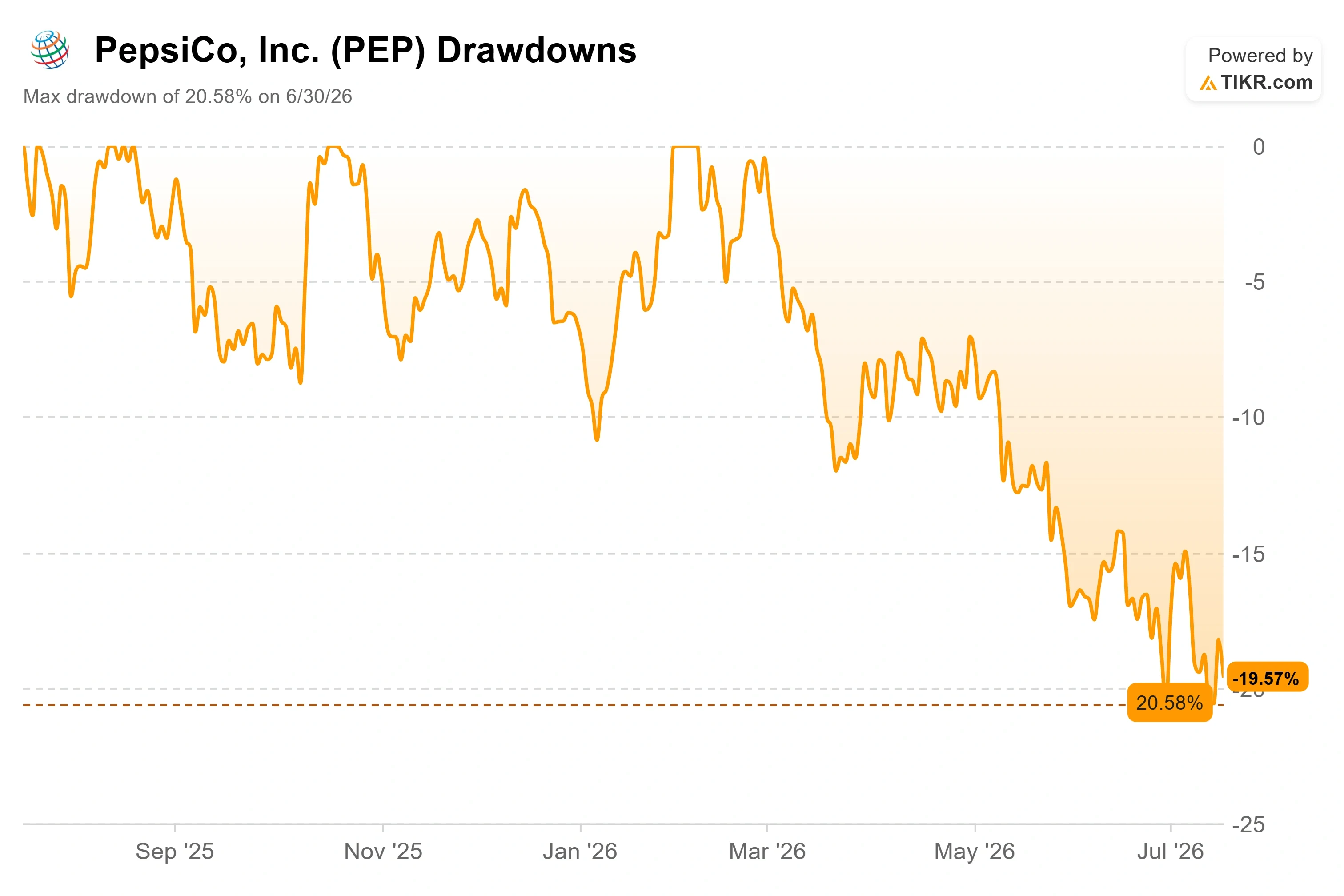
- Max Drawdown: 20.58% on 6/30/26
Now Live: Discover how much upside your favorite stocks could have using TIKR’s new Valuation Model (It’s free) >>>
What Happened?
On the morning of July 9, PepsiCo (PEP) told the market its revenue had grown faster than Wall Street expected. By the next morning, at least seven banks had cut their price targets on the stock. That sequence captures the strange spot the company occupies right now. It did the hard thing this quarter, pushing global volumes to their best growth since 2022 and getting its U.S. snack business back to gaining share, and the reward was a lower stock and a line of analysts trimming their numbers. Shares closed at $137.12 on July 17, a few dollars above the 52-week low of $134.65 and roughly 20% below the 52-week high of $171.48.
So which read is correct? The bull sees a business reaccelerating into a weak consumer and a rare entry point on a dividend compounder. The bear sees a penny earnings miss, softening U.S. demand, and a management team already hinting it will land at the low end of its own guidance, and calls it a value trap that keeps getting cheaper for a reason. The question the market cannot yet answer is whether the U.S. weakness is a gas-price problem that fades or a demand problem that lingers.
A Revenue Beat That Came With a One-Cent Sting
PepsiCo reported second-quarter revenue of $24.18 billion, up 6.4% year over year and ahead of the roughly $23.95 billion the Street wanted. Adjusted earnings came in at $2.20 per share, one cent below the $2.21 consensus. That is a rounding error on the income statement, yet it landed on an already nervous stock that had been sliding for weeks into the print. TIKR’s data shows shares finished the report day down 0.35%, a muted close that undersold how uneasy investors were about the guidance tone.
What actually spooked the market was the geography of the growth. International carried the quarter almost single-handedly, while the U.S. sagged. PepsiCo Beverages North America (PBNA), the domestic drinks unit behind Pepsi and Gatorade, saw volume fall 4%. PepsiCo Foods North America (PFNA), the Frito-Lay snack business, held volume flat despite a full-court press on affordability and new products. For a stock whose entire 2026 recovery story rests on the U.S. turnaround, flat and down were not the words bulls needed to hear.
See historical and forward estimates for PepsiCo stock (It’s free!) >>>
Seven Target Cuts in Two Days, and What They Actually Signal
The analyst reaction was swift. In the 48 hours around the print, at least seven banks lowered their price targets. UBS went from $172 to $159. Evercore ISI cut from $170 to $150. Deutsche Bank moved from $168 to $155. Jefferies dropped from $162 to $152. TD Cowen trimmed to $145, and RBC Capital moved to a Hold rating while nudging its target to $161. Barclays cut all the way to $138, essentially where the stock already trades.
Here is the part worth sitting with. Almost every one of those revised targets still sits above the current price. Even after the cuts, the Street mean target is around $156, which implies roughly 14% upside from $137.12. TIKR’s Street data shows the recommendation split at 3 buys, 4 outperforms, 16 holds, and 1 sell. That is a cautious, holds-heavy consensus, not a bearish one. The banks lowered how much they think the stock is worth. They did not abandon the view that it is worth more than today’s price. The downgrade wave reads less like a verdict and more like the Street marking its models to a slower U.S. recovery.
The Consumer Signal Hiding Inside a Snack Company
The most useful thing management said had nothing to do with the quarter’s math. It was a read on the American consumer. CEO Ramon Laguarta was blunt about where the pain showed up: “Probably some channels, more of the impulse channels have been impacted where there is more of a correlation with the price of gas, certain convenience stores.” When gas hit a four-year high near $4.56 a gallon this spring after the Iran conflict disrupted oil, the reflex purchase of a Gatorade or a bag of chips at the pump simply stopped happening as often.
That matters because self-inflicted damage that fades is very different from structural demand loss. It also fits a broader shift. According to Deloitte’s 2026 Consumer Products Industry Outlook, 47% of consumers globally now qualify as “value seekers,” people who regularly trade down and hunt for deals, including 35% of high-income households. Laguarta framed his affordability push as the answer, telling analysts the strategy already flipped a category “that was negative in volume” back to positive and returned PepsiCo to gaining “share in volume.” The bet is that the U.S. shopper comes back as fuel costs ease and the price investments compound. Management guided to a gradual second-half improvement, though at a more moderate pace than it expected coming into the quarter.
PepsiCo’s discount to its peers frames the whole debate. The stock trades at about 11.7x forward EV/EBITDA, a measure of enterprise value against earnings before interest, taxes, depreciation, and amortization. Coca-Cola sits near 22x on the same basis, more than double PepsiCo’s multiple, despite a comparable dividend pedigree and similar scale. Even against cheaper global brewers like Heineken, near 8.4x, and Anheuser-Busch InBev, near 9.7x, PepsiCo’s low-double-digit multiple looks unremarkable for a business with its snack franchise. The market is pricing PepsiCo as a company with a domestic problem, not a global compounder having one soft patch.
See how PepsiCo performs against its peers in TIKR (It’s free!) >>>
TIKR Advanced Model Analysis
- Current Price: $137.12
- Target Price (Mid): ~$191
- Potential Total Return: ~39%
- Annualized IRR: ~8% / year

See analysts’ growth forecasts and price targets for PepsiCo stock (It’s free!) >>>
TIKR’s mid-case model values PepsiCo at around $191, implying roughly a 39% total return, or about 8% annualized over the next four-plus years. The two revenue drivers behind that case are the international business, now on pace to cross $40 billion this year with an operating margin that expanded a full point in the quarter, and the U.S. affordability recovery converting flat PFNA volume back into growth as gas prices normalize. The margin driver is productivity: record first-half cost savings plus roughly a point of full-year EPS help from tariff refund claims on duties paid last year, which management is using to fund reinvestment rather than protect the bottom line. The primary risk is that the U.S. consumer does not recover on management’s timeline, leaving domestic volume soft while commodity inflation builds in the back half.
The upside case: gas prices keep falling, the impulse channel snaps back, and PepsiCo’s discount to staples peers closes as the turnaround proves durable. The downside case: the value-seeking consumer proves stickier than a fuel-price blip, U.S. volume stays stalled, and the stock stays cheap because earnings power keeps drifting lower.
Conclusion
The number that settles this debate is not on an income statement. It is the price of gas through the summer. Management drew the line itself: the U.S. impulse channel weakness tracks fuel costs, and a gradual recovery depends on those costs easing. Watch PepsiCo’s next quarterly report, its Q3 print due in the fall, for PBNA volume and PFNA share. Volume back toward flat-to-positive in North America beverages, with foods reaccelerating, confirms the gas-price thesis and the case for a mispriced stock. Another quarter of U.S. volume declines, while gas moderates, says the problem is the consumer, not the pump, and the discount is earned. Until then, the stock trades on faith that the cheapest name in its peer group is cheap for a reason that expires.
See what stocks billionaire investors are buying so you can follow the smart money with TIKR.
Should You Invest in PepsiCo?
The only way to really know is to look at the numbers yourself. TIKR gives you free access to the same institutional-quality financial data that professional analysts use to answer exactly that question.
Pull up PepsiCo, and you’ll see years of historical financials, what Wall Street analysts expect for revenue and earnings in the quarters ahead, how valuation multiples have moved over time, and whether price targets are trending up or down.
You can build a free watchlist to track PepsiCo alongside every other stock on your radar. No credit card required. Just the data you need to decide for yourself.
Analyze PepsiCo on TIKR Free →
Looking for New Opportunities?
- See what stocks billionaire investors are buying so you can follow the smart money.
- Analyze stocks in as little as 5 minutes with TIKR’s all-in-one, easy-to-use platform.
- The more rocks you overturn… the more opportunities you’ll uncover. Search 100K+ global stocks, global top investor holdings, and more with TIKR.
Disclaimer:
Please note that the articles on TIKR are not intended to serve as investment or financial advice from TIKR or our content team, nor are they recommendations to buy or sell any stocks. We create our content based on TIKR Terminal’s investment data and analysts’ estimates. Our analysis might not include recent company news or important updates. TIKR has no position in any stocks mentioned. Thank you for reading, and happy investing!