Key Takeaways
- Kraft Heinz yields 7.2% and General Mills 7.7%, and General Mills plans to hold its dividend at the current rate in the near term while it pays down debt.
- Kraft Heinz paid the same $1.60 a share in fiscal 2025 as in fiscal 2020, while General Mills’s dividend grew 3.9% a year from fiscal 2021 to fiscal 2026.
- Kraft Heinz’s dividend took 50% of free cash flow over the twelve months to June 2026, against 85% for General Mills over the twelve months to August 2026.
- General Mills’s net debt was 3.7x EBITDA in fiscal 2026, above its 3x target, and its CFO expects at least a couple of years to get back there.
Anyone hunting for a 7%-plus yield in the grocery aisle ends up looking at two familiar names: Kraft Heinz (KHC), yielding 7.2%, and General Mills (GIS), at 7.7% after its stock fell almost 22% in September.
Neither dividend is growing right now. Kraft Heinz paid $1.60 a share in both fiscal 2020 and fiscal 2025, and on Sept. 23, General Mills said it would hold its rate in the near term while it pays down debt.
So with both checks standing still, which is the better high-yield dividend stock?
| Metric | Kraft Heinz (KHC) | General Mills (GIS) |
|---|---|---|
| Dividend yield | 7.2% | 7.7% |
| Annual dividend | $1.60 | $2.44 |
| Dividend growth, 5 years | 0.0% a year (FY2020–FY2025) | 3.9% a year (FY2021–FY2026) |
| Cash dividend payout ratio, TTM | 50% (to June 27, 2026) | 85% (to Aug. 30, 2026) |
| Cash dividend payout ratio, forward | 69% (FY2026 consensus) | 76% (FY2027 consensus) |
| Net debt/EBITDA (LTM) | 2.71x | 3.67x |
Kraft Heinz: a flat dividend with room underneath
Kraft Heinz is spending to fix a shrinking business. Organic net sales fell 1.3% in the second quarter (ended June 27, 2026), with North America down 2.7%. Management expects adjusted operating income to fall 16% to 18% in constant currency for 2026.
The dividend can afford the wait. Over the twelve months to June 27, 2026, Kraft Heinz paid $1.90 billion in dividends from $3.82 billion of free cash flow, a comfortable 50% cash dividend payout ratio. Free cash flow has topped dividends in every fiscal year from 2019 to 2025 except 2022, after dividends paid dropped from $3.18 billion in fiscal 2018 to $1.95 billion in fiscal 2019.

Analysts expect free cash flow to fall 25% in fiscal 2026, to $2.76 billion, in line with that profit guidance. That still leaves a forward payout of 69%.
Management says its priorities are “unchanged and remain very clear, sustaining the dividend and protecting our investment-grade credit profile,” and the coverage backs that up. The risk is the shelf itself: retailers are stepping up price investments in private label.
General Mills: the bigger check, on a thinner cushion
General Mills is fighting the same soft grocery aisle, with a bigger dividend and less room under it. In its fiscal 2027 first quarter (ended Aug. 30, 2026), organic net sales were flat, as North America Retail fell 3% organically on weak cereal and snacks. The company expects adjusted operating profit to fall 8% to 13% in constant currency this fiscal year, and adjusted EPS of $3.00 to $3.20, against $3.55 in fiscal 2026.
Its dividend grew 3.9% a year from fiscal 2021 to fiscal 2026, from $2.02 to $2.44 a share, but only 1.7% in fiscal 2026. Meanwhile, free cash flow fell from $3.22 billion in fiscal 2020 to $1.63 billion in fiscal 2026, while dividends paid rose from $1.20 billion to $1.32 billion.

That took the cash dividend payout ratio from 58% in fiscal 2025 to 81% in fiscal 2026, and to a tight 85% over the twelve months to Aug. 30, 2026. Analysts expect free cash flow to rise 8% to $1.75 billion in fiscal 2027, which would bring the ratio down to 76%.
CFO Kofi Bruce said on Sept. 23 that “we remain fully committed to our dividend, and in the near term, we expect to maintain the current rate per share while we prioritize deleverage.” So that 3.9% five-year rate overstates the raises ahead.
So which dividend wins?
Kraft Heinz is the better high-yield dividend stock. Its payout takes 50% of free cash flow over the trailing 12 months and 69% on fiscal 2026 estimates, against 85% and 76% for General Mills.
Leverage is the sticking point for General Mills. Its net debt rose from 2.7x EBITDA in fiscal 2022 to 3.7x in fiscal 2026, above the company’s 3x target.
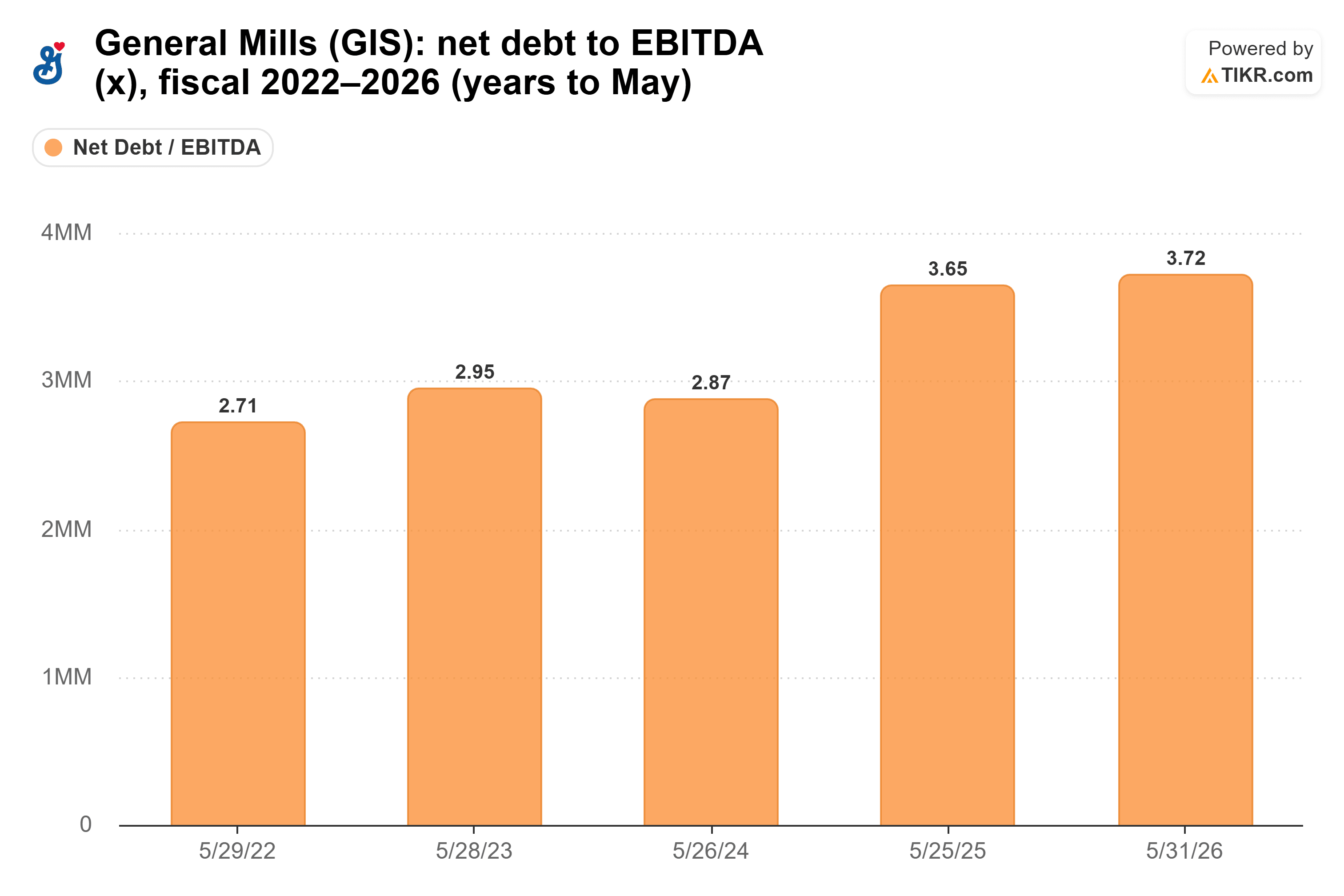
On the company’s own count it’s a little over 4x, and getting back to 3x will take “at least a couple of years,” Bruce said on Sept. 23. That’s a long wait for the next raise.
This isn’t to say General Mills’s dividend is in trouble. It pays the bigger check: $770 a year on $10,000, against $720 from Kraft Heinz. If General Mills got back to fiscal 2026’s 1.7% pace, that $10,000 would pay about $894 in year 10, and Kraft Heinz’s flat $720 would never catch up.
Still, with yields this high, the room under the check matters more to me than an extra $50 a year, and Kraft Heinz has far more of it.
Of course, Kraft Heinz still has to deliver that free cash flow while North America shrinks. Its third-quarter report and its Nov. 12 investor day are the next tests.
So what is Kraft Heinz stock actually worth?
TIKR lets you forecast the future price of any stock in less than a minute. Just enter a few assumptions into TIKR’s valuation model and see what Kraft Heinz could be worth. Start from Wall Street consensus estimates, or adjust the inputs to reflect your own view of the business. It’s free to use.
Disclaimer:
Please note that the articles on TIKR are not intended to serve as investment or financial advice from TIKR or our content team, nor are they recommendations to buy or sell any stocks. We create our content based on TIKR Terminal’s investment data and analysts’ estimates. Our analysis might not include recent company news or important updates. TIKR has no position in any of the stocks mentioned. Thank you for reading, and happy investing!