Key Takeaways
- Clorox yields 6.1% and Amcor yields 6.3%, and each has grown its dividend 2% a year over its last five fiscal years.
- Over the last 12 months, Clorox’s dividends came to 149% of its free cash flow, against 97% for Amcor.
- Clorox’s net sales were down 5% in fiscal 2026, while Amcor’s were up 57% with its Berry acquisition.
- Amcor’s interest coverage is thinner, at 3.1x against Clorox’s 6.8x.
Anyone hunting for a 6% dividend yield will run into Clorox (CLX) and Amcor (AMCR) right now. Both closed fiscal years that ended June 30 fighting rising input costs, and they came out of them in very different shape.
In fiscal 2026, Clorox’s net sales fell 5% from fiscal 2025 to $6.72 billion, and its adjusted EPS fell 28% to $5.53 from $7.72. Amcor’s net sales jumped 57% to $23.5 billion with its Berry acquisition, and its adjusted EPS rose 13% to $4.02 from $3.56.
So which is the better high-yield dividend stock?
| Metric | Clorox (CLX) | Amcor (AMCR) |
|---|---|---|
| Dividend yield | 6.1% | 6.3% |
| Current dividend | $5.00 a year | $2.60 a year |
| Dividend growth, 5 years | 2.0% a year (fiscal 2021–2026) | 2.1% a year (fiscal 2020–2025) |
| Cash dividend payout ratio (TTM) | 149% | 97% |
| Net debt / EBITDA | 4.29x | 3.63x |
| Interest coverage | 6.84x | 3.13x |
| Forward P/E | 14.6x | 10.1x |
Clorox’s dividend is running ahead of its cash
Over the 12 months to June 30, 2026, Clorox paid $602 million in dividends against $405 million of free cash flow. That’s a risky 149% cash dividend payout ratio, and even cash from operations, $612 million in fiscal 2026, barely topped the dividend. Dividends topped free cash flow in three of the last five fiscal years, and fiscal 2026’s $405 million was well short of fiscal 2025’s $761 million.
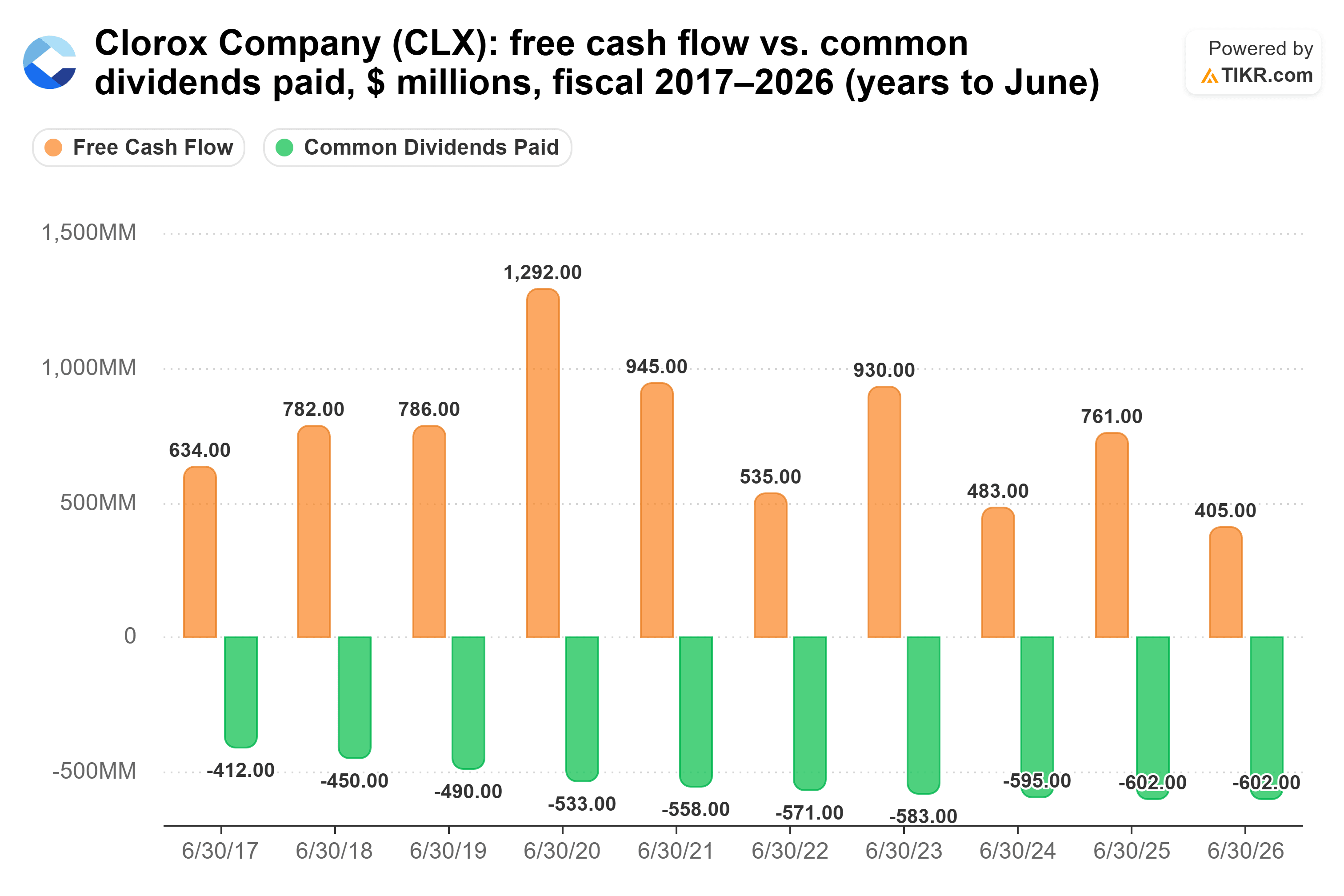
Management called the payout “a bit elevated, but we see this as something more transitory as we rebuild our gross margin and not something structural.” Its guidance gives that some backing: a gross margin of about 42% and adjusted EPS of $5.70 to $6.00 in fiscal 2027, against $5.53 in fiscal 2026.
Health and hygiene, which now includes Clorox Purell from the GOJO deal, is more than half of net sales and growing.
The main risk is debt, at 4.29x EBITDA. It’s about $5.1 billion after GOJO ($2.147 billion) and a Glad stake ($476 million), and S&P cut Clorox’s rating to BBB in February 2026. CFO Luc Bellet said Clorox structured it to be repaid “with the free cash flow that we’ll generate over the next 12 to 18 months.” The dividend needs that same cash.
Clorox is also changing leaders: on May 28, it said CEO Linda Rendle will step down for health reasons once a successor is appointed.
Amcor covers its check, with little to spare
Amcor faced the same cost squeeze, and came out of it with its dividend covered.
Over the 12 months to June 30, 2026, Amcor paid $1.20 billion in dividends against $1.23 billion of free cash flow. That’s a tight 97% cash dividend payout ratio. Free cash flow covered the dividend in every fiscal year from 2020 to 2026 except fiscal 2025, but the ratio went from 72% in fiscal 2022 to 97% in fiscal 2026.

In August, Amcor raised its quarterly dividend to 65.0 cents a share from 63.75 cents a year earlier, adjusted for its 1-for-5 reverse stock split in January. Foodservice, pet care and protein packaging grew strongly in fiscal 2026, and North America returned to volume growth.
The main risk is interest. Amcor had $12.9 billion of net debt at June 30, 2026, and its interest coverage of 3.13x is less than half of Clorox’s. CFO Stephen Scherger said Amcor targets “recovering more than $500 million in cash over the next 12 months,” mostly working capital tied up by the Middle East conflict.
So which dividend wins?
Amcor is the better high-yield dividend stock. It pays more today, grows its dividend about as fast, covers it with cash, and its sales and earnings grew in fiscal 2026.
On $10,000, Amcor’s 6.3% yield pays $630 a year, against $610 from Clorox’s 6.1%. At their five-year rates of 2.1% and 2.0% a year, that becomes about $759 against about $730 in year 10: a 7.6% yield on the $10,000, against 7.3%. And Clorox’s latest raise, on July 31, was a penny a quarter, to $1.25.
Amcor also looks cheap against its own history. It trades at 10.1x forward earnings, against a five-year average of 13.1x and a low of 9.2x in May 2026.

This isn’t to say Clorox’s dividend is about to go. Its interest coverage is more than twice Amcor’s, and management says “our commitment to support the dividend has not changed.” It’s just that Amcor’s cash already covers its dividend, while Clorox still needs its recovery to show up.
Of course, Amcor has little room to spare. Its results for the six months to December 31, 2026, will show whether that $500 million of cash is coming back.
So what is Amcor stock actually worth?
TIKR lets you forecast the future price of any stock in less than a minute. Just enter a few assumptions into TIKR’s valuation model and see what Amcor could be worth. Start from Wall Street consensus estimates, or adjust the inputs to reflect your own view of the business. It’s free to use.
Disclaimer:
Please note that the articles on TIKR are not intended to serve as investment or financial advice from TIKR or our content team, nor are they recommendations to buy or sell any stocks. We create our content based on TIKR Terminal’s investment data and analysts’ estimates. Our analysis might not include recent company news or important updates. TIKR has no position in any of the stocks mentioned. Thank you for reading, and happy investing!