
Key Stats for IonQ Stock
- Current Price: $36.27
- Target Price (Mid): ~$133
- Street Target: ~$67
- Potential Total Return: ~267%
- Annualized IRR: ~36% / year
Now Live: Discover how much upside your favorite stocks could have using TIKR’s new Valuation Model (It’s free) >>>
What Happened?
IonQ (IONQ) lost about $1.44 billion in market value on October 12, more than the stated value of the deal it announced that day. Shares fell 9.07% to $36.27 after the company, per its investor relations materials, agreed to buy Elisity in an all-stock deal valued at up to $1.3 billion. Elisity sells zero-trust software, which limits each user, device, or AI agent to only the network access it needs. Quantum peers slid too, so not all of the drop belongs to the deal.
See historical and forward estimates for IonQ stock (It’s free!) >>>
Paying in Shares for Revenue IonQ Has Not Disclosed
The value includes up to $150 million in earnouts tied to Elisity’s performance. Closing is expected in the fourth quarter of 2026, pending regulatory approval. IonQ said Elisity has a track record of doubling revenue and customers year over year, with zero churn among deployed customers and more than 100 deployments. It gave no revenue figure.
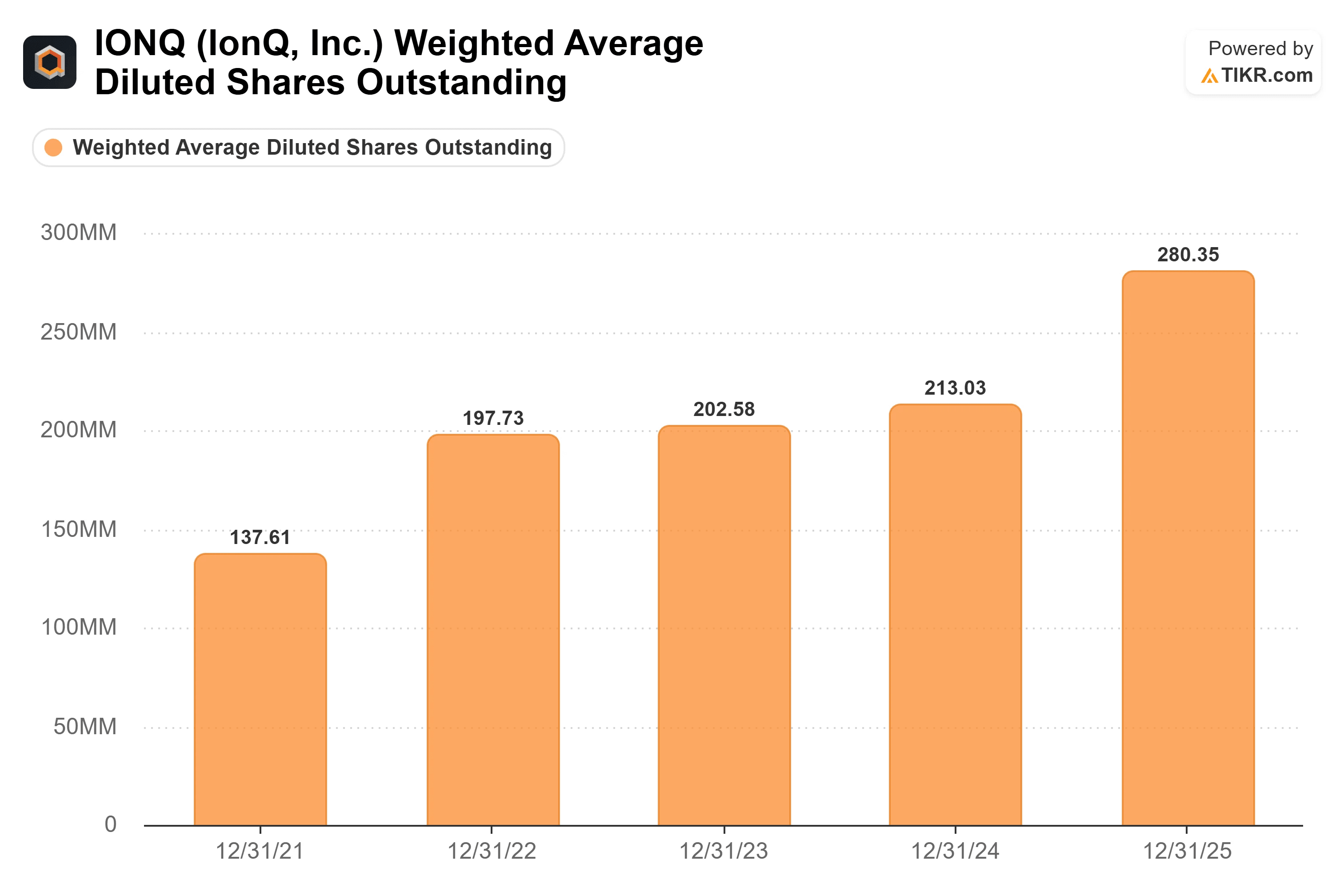
Share count will be set by IonQ’s 20-trading-day volume-weighted average price before closing, inside a $33.07 to $49.61 collar. At the October 12 close, and if the earnout is paid in full in stock, $1.3 billion equals about 35.8 million shares. That is roughly 9% on top of 397.30 million outstanding. Issuing that many shares for a business valued at zero would shrink each existing share’s claim by about 8%. IonQ fell 9.07%, and coverage tied the selling to dilution.
Singh Pitched Security as the Door to Compute Sales
At IonQ’s September 8 Investor Day, CFO and COO Inder Singh described a land-and-expand strategy in which “security can open the door to a conversation that leads to compute use cases.” What counts, he said, is “how many of your products they use.” Elisity adds more than 100 deployments and deep CISO relationships to that door.
IonQ executive Jordan Shapiro said a June executive order pulled the U.S. migration timeline for quantum-safe security to 2030 from 2035. On October 12, Chairman and CEO Niccolo de Masi said “Q-Day is coming much faster than predicted.” If that urgency holds, Elisity’s channel reaches enterprise and government buyers just as federal agencies face an earlier deadline.
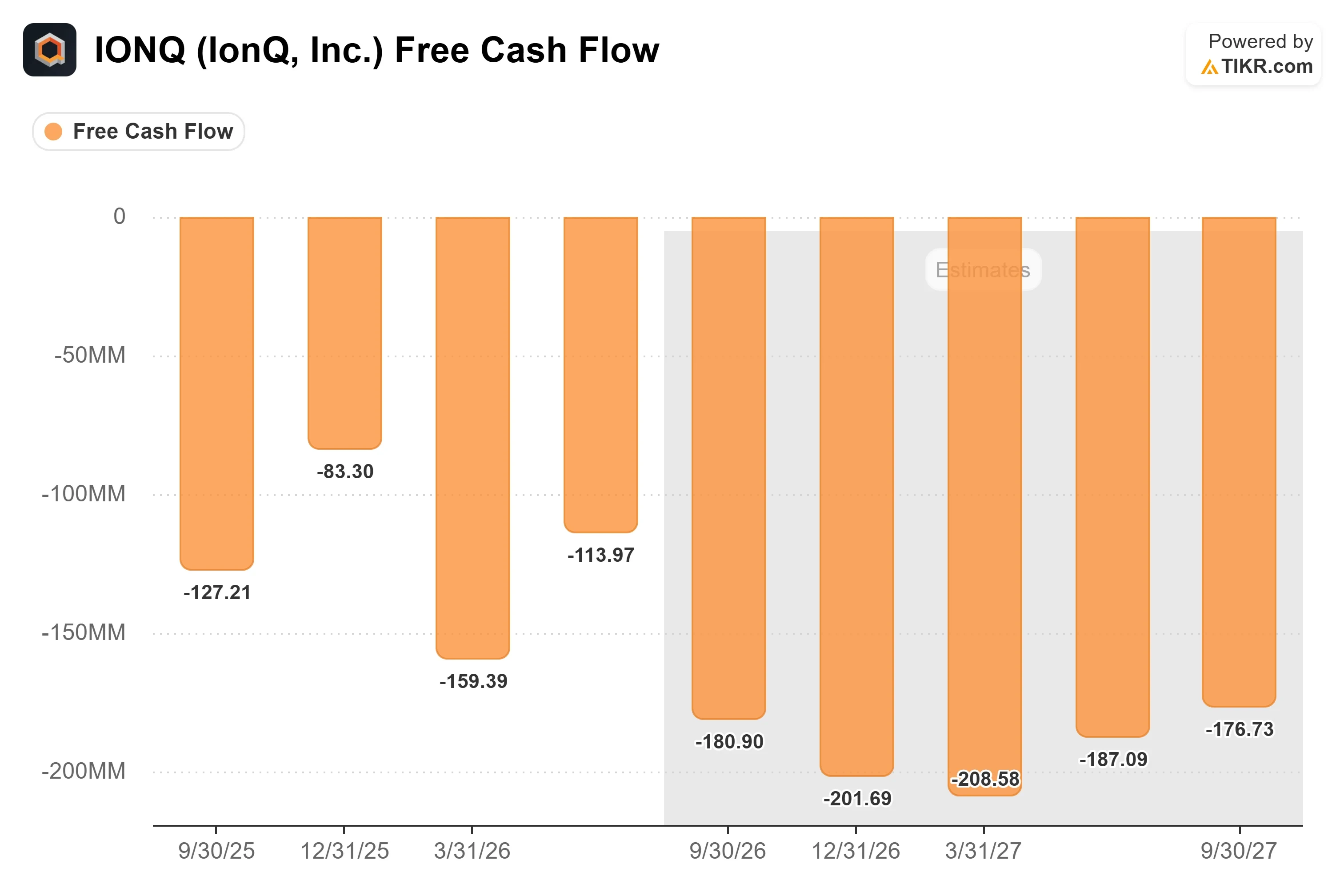
Paying in stock also spares cash. Singh said IonQ put roughly $1 billion into Oxford Ionics and almost $2 billion into SkyWater, whose July 31 closing included $15 in cash per SkyWater share. He wants a balance sheet “not too strong, certainly not too weak.” Analysts on TIKR expect free cash flow of around negative $640 million in 2026 and around negative $740 million in 2027, so every dollar not spent on Elisity extends the runway.
On October 7, IonQ also reached the final stage of DARPA’s Quantum Benchmarking Initiative alongside IBM (IBM), Atom Computing, and Diraq. Its agreement is worth up to $300 million through 2029, a ceiling rather than committed funding.
See how IonQ performs against its peers in TIKR (It’s free!) >>>
TIKR Advanced Model Analysis
- Current Price: $36.27
- Target Price (Mid): ~$133
- Potential Total Return: ~267%
- Annualized IRR: ~36% / year

See analysts’ growth forecasts and price targets for IonQ stock (It’s free!) >>>
The TIKR model’s mid case, the case its summary card reports, points to around $133 by December 31, 2030. That is a total return of about 267%, or roughly 36% a year. Its assumptions, which run from 2025 through 2035, compound revenue around 53% a year while holding net income margin near negative 54%.
Consensus revenue estimates on TIKR were unchanged on October 13 from September 30, so they do not yet reflect Elisity. Upside comes if Elisity lifts multiproduct revenue, which IonQ said grew 40% year over year in the second quarter. The downside comes if the shares are issued while Elisity’s revenue stays undisclosed.
Conclusion
The collar decides how many shares IonQ issues. If its 20-day average sits below $33.07 near closing, the full deal tops out near 39.3 million shares, and Elisity’s sellers absorb the shortfall in value. Above $49.61, it drops to about 26.2 million shares, worth more than $1.3 billion at that price.
IonQ’s third-quarter report, which one market calendar lists for November 5, is the next chance to disclose Elisity’s revenue or annual recurring revenue. That is the figure investors need to price the $1.15 billion non-earnout portion. A reaffirmed $450 million to $460 million 2026 revenue outlook would show the base business holding while the deal waits.
See what stocks billionaire investors are buying so you can follow the smart money with TIKR.
So what is IonQ stock actually worth?
TIKR lets you forecast the future price of any stock in less than a minute. Just enter a few assumptions into TIKR’s valuation model and see what IonQ could be worth. Start from Wall Street consensus estimates, or adjust the inputs to reflect your own view of the business. It’s free to use.
Disclaimer:
Please note that the articles on TIKR are not intended to serve as investment or financial advice from TIKR or our content team, nor are they recommendations to buy or sell any stocks. We create our content based on TIKR Terminal’s investment data and analysts’ estimates. Our analysis might not include recent company news or important updates. TIKR has no position in any stocks mentioned. Thank you for reading, and happy investing!