Tencent Holdings (TCEHY) is back in the bond market for the second time in four months. On October 13, Reuters reported, citing term sheets, that the company is selling US dollar and offshore yuan notes in a deal that could raise at least $4.5 billion as it pays for a jump in AI spending.
Tencent’s capex more than doubled to 96.3 billion yuan in the first half of 2026, from 45.9 billion a year earlier, according to the offering documents. It last borrowed in June, raising about $4.66 billion. Final tranche sizes haven’t been set.
Tencent’s Order Books Look Bigger Than They Are
On the surface, demand is strong. Dollar orders topped $2 billion and offshore yuan orders passed 35 billion yuan ($5.2 billion), so combined books cover the $4.5 billion target about 1.6 times.
A large part of that came from the banks running the deal. The joint lead managers put in $525 million of the dollar book (about 26%) and 20.25 billion yuan of the yuan book (about 58%). Strip those out and outside yuan demand is closer to 14.75 billion yuan, or about $2.2 billion.
Tencent’s Free Cash Flow Just Turned Negative
The cash flow statement shows why Tencent is borrowing now.

Capex hit $8.63 billion in the June quarter, about 3.4 times the $2.52 billion of a year earlier. First-half spending reached $13.99 billion, more than double the $6.30 billion of the first half of 2025.
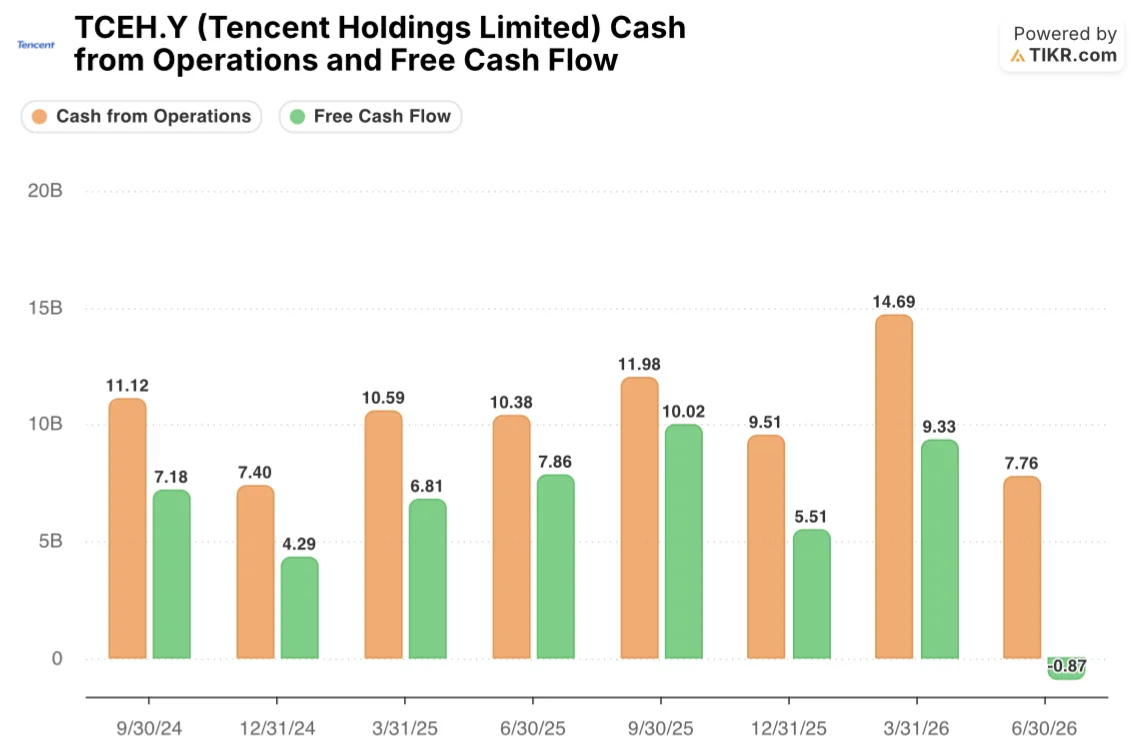
Operating cash flow went the other way, falling 25% to $7.76 billion in the June quarter. On TIKR’s operating-cash-flow-minus-capex measure, free cash flow fell to negative $0.87 billion from positive $7.86 billion a year earlier. Tencent’s own measure, which also deducts media-content and lease-liability payments, was negative RMB13.8 billion (about $2.1 billion). Management said large AI-related prepayments weighed on operating cash flow; excluding compute-procurement prepayments, its free cash flow would have been positive RMB37.6 billion (about $5.6 billion).
Why Tencent Doesn’t Need the Money
None of this makes Tencent short of cash.
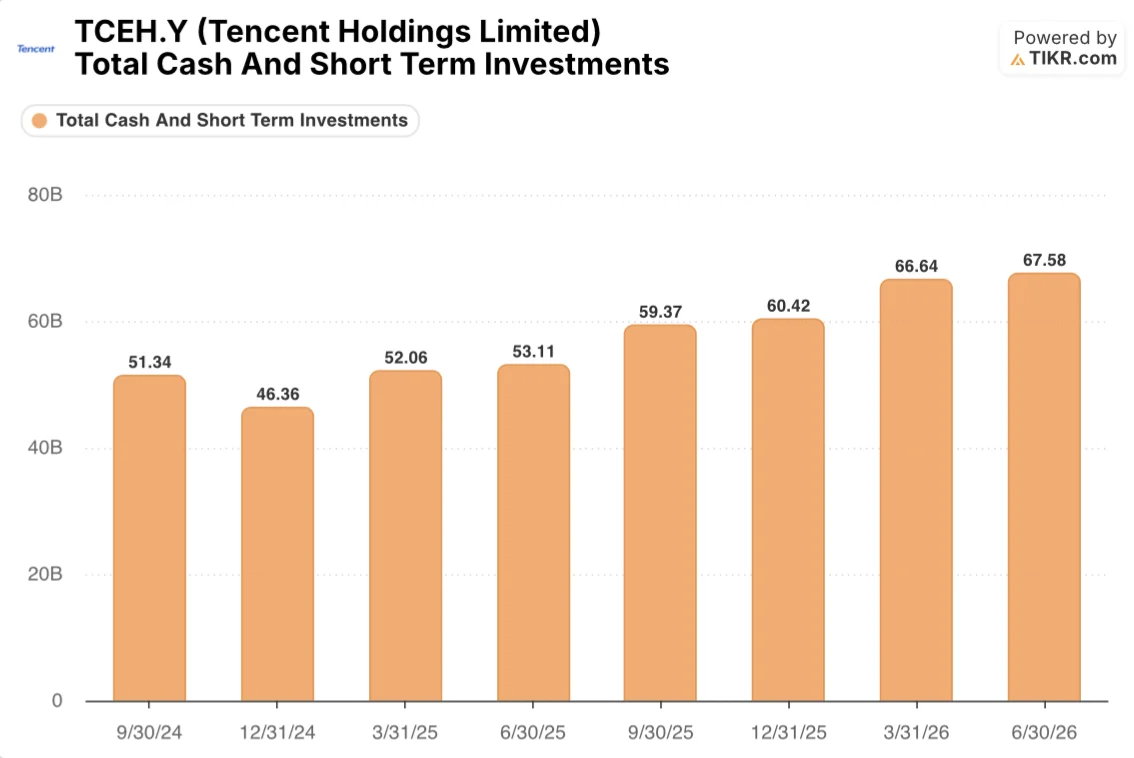
Cash and short-term investments stood at $67.58 billion at the end of June, up $14.47 billion from a year earlier. A $4.5 billion raise is less than 7% of that pile. With yuan guidance at about 2.90% for 10 years and 3.50% for 30 years, Tencent is choosing cheap, long-dated funding over drawing down its cash.
It also isn’t spending alone. The FT reported on October 13 that combined capex at Tencent, Alibaba (BABA), and ByteDance could more than double to about $104 billion this year. Part of Tencent’s bill goes offshore too, through its deal to lease access to about 100,000 AI chips from Oracle (ORCL).
What Tencent’s Bond Sale Really Signals
The bond itself isn’t a warning sign. Tencent’s cash and short-term investments were about 15 times the proposed $4.5 billion raise. The bonds are expected to carry A1/A+ ratings, and initial guidance for the 10-year dollar notes was about 115 basis points over Treasuries.
The negative free cash flow quarter is the number that matters, even with the prepayment caveat. If quarterly capex stays above $8 billion and continues to exceed operating cash generation, Tencent could draw down liquidity or seek additional financing. Reuters notes investors have grown more selective about companies funding costly AI buildouts, and Tencent stock is already down about 30% this year. The September-quarter cash flow, due with third-quarter results, will show whether June was a peak or the new run rate.
So what is Tencent stock actually worth?
TIKR lets you forecast the future price of any stock in less than a minute. Just enter a few assumptions into TIKR’s valuation model and see what TCEHY stock could be worth. Start from Wall Street consensus estimates, or adjust the inputs to reflect your own view of the business. It’s free to use.
Value Tencent Holdings Limited for free→
Disclaimer:
Please note that the articles on TIKR are not intended to serve as investment or financial advice from TIKR or our content team, nor are they recommendations to buy or sell any stocks. We create our content based on TIKR Terminal’s investment data and analysts’ estimates. Our analysis might not include recent company news or important updates. TIKR has no position in any of the stocks mentioned. Thank you for reading, and happy investing!