
Key Takeaways
- B. Riley cut its IREN price target to $64 from $91 on Oct. 30 but kept its Buy rating, so it still sees 161% upside.
- IREN is down 68% from its November 2025 high. A weak fiscal fourth quarter, worries about what neoclouds pay to borrow and Microsoft’s lower-than-expected capital spending all pushed it down.
- Analysts expect revenue to jump, but their loss estimates for the next two fiscal years have grown much bigger.
- The stock looks cheap against its own sales multiple. But the target depends on IREN paying for a $25 billion to $30 billion build without issuing many more shares, and the Nov. 5 report is the next test.
IREN Limited (IREN) is down 68% from its November 2025 high, and B. Riley thinks the market has overshot. On Oct. 30, the firm cut its price target to $64 from $91 but kept its Buy rating, so it still sees 161% upside from $24.51.
The neocloud trade cracked
The slide started with the business. IREN’s Aug. 27 report showed June-quarter revenue of $137.2 million, down from $187.3 million a year earlier, as it shifted from Bitcoin mining to AI cloud. Adjusted EBITDA fell to $19.2 million from $59.5 million in the March quarter, and management guided fiscal 2027 capex of $25 billion to $30 billion.
October hit the whole group. Hot inflation data weighed on IREN and the Bitcoin miners, worries grew about what neoclouds pay to borrow, and on Oct. 26 Elon Musk said more than 200 of them are “going to see guppy-level death and consolidation.”
On Oct. 28, Microsoft (MSFT) reported capital spending below expectations, a sign that its partners are taking longer to deliver capacity. That one lands close to home: Microsoft’s contract is expected to bring in about $1.94 billion of the $4 billion in annualized run-rate revenue IREN has contracted for 2026.
TIKR tracks 20 analysts on IREN. How many say “Buy”?
See the full breakdown of Buy, Hold, and Sell ratings on IREN, along with Wall Street’s revenue and earnings estimates, all in one place. More than 500,000 investors use TIKR to research stocks like this one. See IREN’s Analyst Ratings
B. Riley is still a buyer
It’s B. Riley’s second cut in a month. On Sept. 29, it lowered its target to $91 from $96, citing higher yields, regulatory uncertainty and slower customer signings.
Even so, $64 sits 17% below the Street. The consensus target from the 20 analysts who cover IREN has risen over the past year, from $63 to $77:
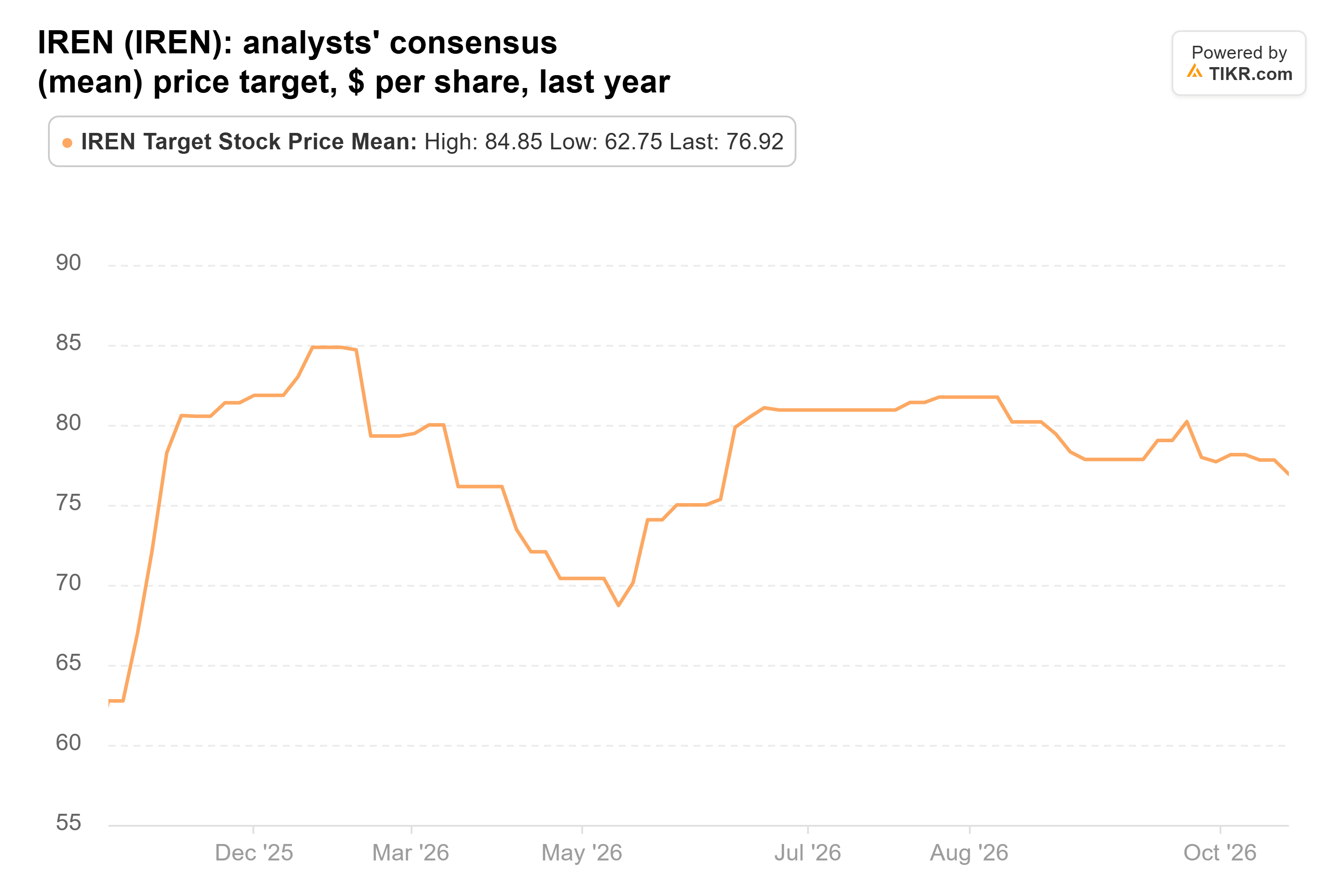
Individual targets run from $37 to $139.
Can IREN get to $64?
Revenue is the bull case. Analysts expect it to jump 297% to $2.81 billion in the fiscal year ending June 2027, then reach $7.41 billion in fiscal 2028:
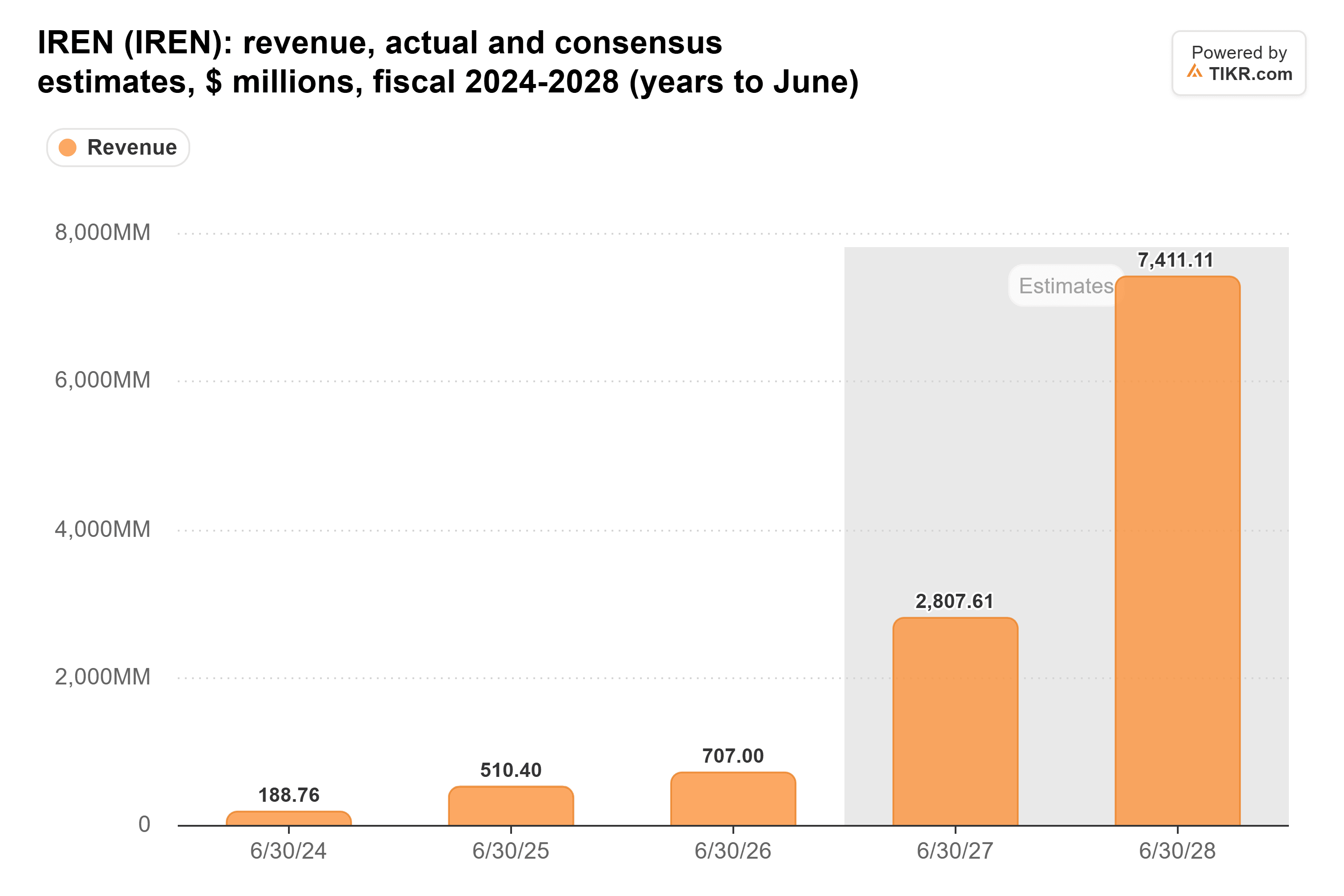
Earnings estimates have gone the other way. The consensus now calls for a loss of $3.42 a share in fiscal 2027, against a $0.94 loss 90 days ago, and a $3.98 loss in fiscal 2028, against $0.20. Only four analysts make those estimates.
With no profit to price, IREN trades on forward sales. That multiple sits below its five-year average of 4.2x and far below the 11x it hit in September 2025.
The catch is the share count
The risk is funding. IREN has about $14 billion of cash, committed GPU financing and prepayments against that $25 billion to $30 billion plan, and shares outstanding rose 48% in fiscal 2026.
On valuation, B. Riley has a point: a stock trading below its usual sales multiple, with revenue set to roughly quadruple, looks oversold. But $64 only pays off for shareholders if IREN funds the build without leaning on many more new shares, and its record says that’s far from certain.
The Nov. 5 report is the first test. Its Sept. 30 share count, against 394 million on Aug. 14, will show whether debt is doing more of the work.
So what is IREN stock actually worth?
TIKR lets you forecast the future price of any stock in less than a minute. Just enter a few assumptions into TIKR’s valuation model and see what IREN could be worth. Start from Wall Street consensus estimates, or adjust the inputs to reflect your own view of the business. It’s free to use.
Disclaimer:
Please note that the articles on TIKR are not intended to serve as investment or financial advice from TIKR or our content team, nor are they recommendations to buy or sell any stocks. We create our content based on TIKR Terminal’s investment data and analysts’ estimates. Our analysis might not include recent company news or important updates. TIKR has no position in any of the stocks mentioned. Thank you for reading, and happy investing!