Key Stats for AT&T Stock
- Current Price: $29.10
- Target Price (Mid, 12/31/30): $37.90
- Street Target (Mean): $30.46
- Potential Total Return: +30.2%
- Annualized IRR: 5.70% / year
Now Live: Discover how much upside your favorite stocks could have using TIKR’s new Valuation Model (It’s free) >>>
What Happened?
AT&T (T) stock has become one of the quieter outperformers in telecom this year, and Wall Street is starting to take notice.
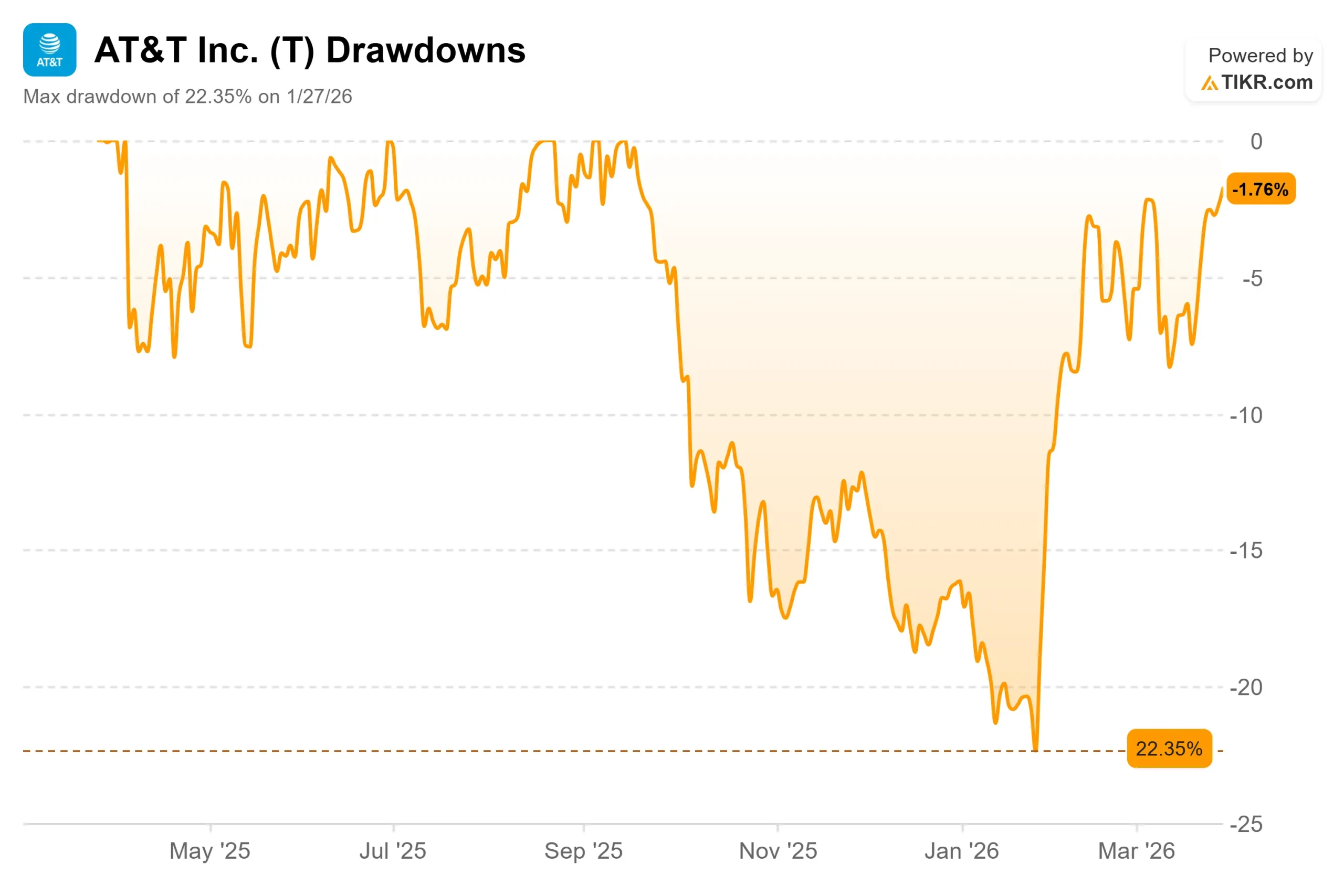
The stock pushed near its 52-week high of $29.79 this week after Citi analyst Michael Rollins raised his price target from $29 to $31.50 and named AT&T Citi’s top carrier pick.
Bulls argue the market still undervalues what AT&T is building: a fiber network scaling toward 60 million locations and a convergence model that locks in customers who bundle wireless with broadband.
Bears point to a debt load that remains heavy, a legacy wireline business in structural decline, and a Q1 earnings warning from CFO Pascal Desroches that rattled the stock earlier this month.
The central question is whether AT&T’s fiber and 5G investment cycle is finally producing the durable, compounding growth the stock has lacked for years.
Two catalysts drove the Citi upgrade.
On March 13, AT&T simplified its wireless lineup to three plans and launched a lower-priced Value 2.0 tier. Rollins called the pricing shift “positive” and said it could strengthen sentiment ahead of the April 22 earnings report.
Then on March 26, AT&T Chief Technology Officer Igal Elbaz presented at the NSR/BCG Global Connectivity Leaders Conference, where he laid out how the company’s fiber, 5G, and AI programs connect into a single network strategy.
The foundation for the upgrade was the January earnings print.
AT&T reported Q4 2025 revenue of $33.5 billion, up 3.6% year over year, and delivered its best year for consumer broadband subscriber growth in a decade.
CEO John Stankey said on the earnings call that AT&T “met or exceeded all of our consolidated full-year financial guidance, driven by another solid year of 5G and fiber subscriber growth.”
See historical and forward estimates for AT&T stock (It’s free!) >>>
Is AT&T Undervalued Today?
At $29.10, AT&T trades at 7.55x NTM EV/EBITDA (enterprise value relative to forward earnings before interest, taxes, depreciation, and amortization).
The premium to peers demands justification, and AT&T has one. Comcast trades at 5.86x NTM EV/EBITDA and BT Group at 5.07x, both well below AT&T’s 7.55x.
The case for that gap rests on AT&T’s convergence rate: 42% of AT&T Fiber households also subscribe to AT&T wireless, and the company’s postpaid phone market share in fiber areas runs an estimated 10 percentage points higher than in non-fiber areas.
Bundled customers churn less and spend more. If that flywheel keeps building, the valuation premium earns its keep.
The fiber build itself has reached a scale that is difficult for competitors to replicate quickly.
At the NSR/BCG conference, Elbaz stated the network now covers 36 million living units and that no one else has a fiber network of that size or is building at AT&T’s pace.
The February 2026 closing of the Lumen acquisition added 4 million locations to that total, with AT&T targeting 40 million by year-end and 60 million by the end of 2030.
The acquired Lumen footprint carries only 25% customer penetration, well below AT&T’s native 40%, which represents a tangible upsell runway over the next several years.
At the Deutsche Bank conference on March 9, Desroches warned that Q1 2026 EBITDA and free cash flow would come in below the full-year run rate, sending the stock down 3% that day.
Capital expenditure is rising to $23 billion to $24 billion in 2026 to fund the Lumen integration and accelerated fiber construction.
The AI dimension adds an underappreciated angle.
At the NSR/BCG conference, Elbaz described early network signals already appearing: higher upstream data volumes from AI applications, enterprise demand for 400-gigabit connections, and autonomous AI agents that generate unpredictable traffic patterns around the clock.
He noted AT&T’s internal AI models have improved the energy efficiency of its cell site programs by 20% to 30% compared to prior-generation tools, and that the company already has fiber connections to 600 data centers across the U.S.
These are management claims from the conference, but they point to infrastructure investments that are already in place.

See how AT&T performs against its peers in TIKR (It’s free!) >>>
TIKR Advanced Model Analysis
- Current Price: $29.10
- Target Price (Mid, 12/31/30): $37.90
- Potential Total Return: +30.2%
- Annualized IRR: 5.70% / year

See analysts’ growth forecasts and price targets for AT&T stock (It’s free!) >>>
The TIKR mid-case model targets $37.90 by December 31, 2030, a 30.2% total return and a 5.70% annualized IRR from today’s $29.10. Two revenue drivers underpin the path: fiber subscriber growth as AT&T scales toward 60 million locations, and mobility service revenue expanding as the convergence rate compounds. The model assumes a 3.2% revenue CAGR and a 13.3% net income margin, both consistent with AT&T’s LTM gross margin of 59.6%.
The margin driver is network modernization. Elbaz’s open architecture program retires legacy copper faster, consolidates infrastructure, and redeploys capital toward fiber and 5G rather than maintaining parallel systems, supporting the margin stability built into the mid-case.
The upside case requires the Lumen footprint to ramp toward AT&T’s native 40% penetration and Advanced Connectivity service revenue to exceed management’s 5%-plus growth target for 2026. The downside case is simpler: if debt paydown stalls or the convergence rate plateaus, the story becomes an income trade primarily. At a 3.8% dividend yield near the 52-week high, that is still a defensible outcome. It just is not the compounding story the $37.90 target requires.
Conclusion: Watch fiber net additions at the Q1 2026 earnings report on April 22. If AT&T delivers 250,000 or more fiber net adds while keeping adjusted EBITDA growth on pace for the full-year 3% to 4% guidance range, it validates the Citi upgrade and sets up a challenge of the $29.79 52-week high. A miss on either confirms the March 9 warning was more than seasonal noise.
AT&T is a capital-intensive compounder finally building the infrastructure moat it has needed for a decade. The 5.70% annualized IRR to December 31, 2030, only works if fiber and convergence keep delivering the way the last eight quarters suggest they can.
See what stocks billionaire investors are buying so you can follow the smart money with TIKR.
Should You Invest in AT&T?
The only way to really know is to look at the numbers yourself. TIKR gives you free access to the same institutional-quality financial data that professional analysts use to answer exactly that question.
Pull up AT&T, and you’ll see years of historical financials, what Wall Street analysts expect for revenue and earnings in the quarters ahead, how valuation multiples have moved over time, and whether price targets are trending up or down.
You can build a free watchlist to track AT&T alongside every other stock on your radar. No credit card required. Just the data you need to decide for yourself.
Looking for New Opportunities?
- See what stocks billionaire investors are buying so you can follow the smart money.
- Analyze stocks in as little as 5 minutes with TIKR’s all-in-one, easy-to-use platform.
- The more rocks you overturn… the more opportunities you’ll uncover. Search 100K+ global stocks, global top investor holdings, and more with TIKR.
Disclaimer:
Please note that the articles on TIKR are not intended to serve as investment or financial advice from TIKR or our content team, nor are they recommendations to buy or sell any stocks. We create our content based on TIKR Terminal’s investment data and analysts’ estimates. Our analysis might not include recent company news or important updates. TIKR has no position in any stocks mentioned. Thank you for reading, and happy investing!