


Key Stats for AbbVie Stock
- This Week Performance: -3%
- 52-Week Range: $164 to $245
- Current Price: $225
What Happened to AbbVie Stock?
AbbVie (ABBV) shares closed at $224.8 today up just 0.21%, though the stock absorbed three major developments within the same 72-hour window: an FDA approval for Venclexta plus acalabrutinib in CLL, a $1.73 quarterly dividend declaration, and the filing of FY2025 results showing $61.16 billion in revenue.
Also today, the FDA approved the all-oral, fixed-duration combination of Venclexta and acalabrutinib for previously untreated chronic lymphocytic leukemia patients, supported by Phase 3 AMPLIFY trial data, expanding Venclexta’s addressable market beyond its existing $2.79 billion annual revenue base.
The approval extended a broader regulatory momentum that included Rinvoq winning FDA clearance in giant cell arteritis, Emrelis receiving accelerated approval in NSCLC, and a litigation settlement securing Rinvoq against generic competition until at least April 2037, all within FY2025.
Investors are increasingly reweighting AbbVie away from its Humira-dependent past, as Skyrizi’s $17.56 billion in FY2025 revenue (+49.9%) and Rinvoq’s $8.3 billion (+39.1%) together now more than triple Humira’s $4.54 billion, which fell 49.5% under biosimilar pressure.
Meanwhile, AbbVie’s February 11 lawsuit against HHS challenging Botox price controls under the Inflation Reduction Act introduced a live litigation risk, given that Botox contributed just over 10% of the company’s $61.16 billion in FY2025 revenue with the case now assigned to U.S. District Judge Carl Nichols.
Beyond near-term catalysts, AbbVie’s pipeline presentation at the Piper Sandler Immunology Symposium on February 13 revealed multiple late-stage readouts expected in 2026, including lutikizumab and Rinvoq week-16 data in HS, Skyrizi subcutaneous IBD data, and alpha4beta7 combination results, collectively representing the next growth layer after Skyrizi and Rinvoq.
Wall Street’s Take on ABBV Stock
The Venclexta-acalabrutinib CLL approval, the Rinvoq generic litigation win locking out competition until 2037, and a deepening immunology pipeline presented at Piper Sandler collectively reinforce that AbbVie’s post-Humira growth engine is now fully operational across multiple franchises.
Consensus estimates project FY2026 revenue of $67.07 billion (+9.7% YoY) and normalized EPS of $14.52 (+45.2%), a dramatic re-acceleration that reflects Skyrizi and Rinvoq absorbing the last of Humira’s biosimilar erosion while newer assets like Venclexta add incremental volume.
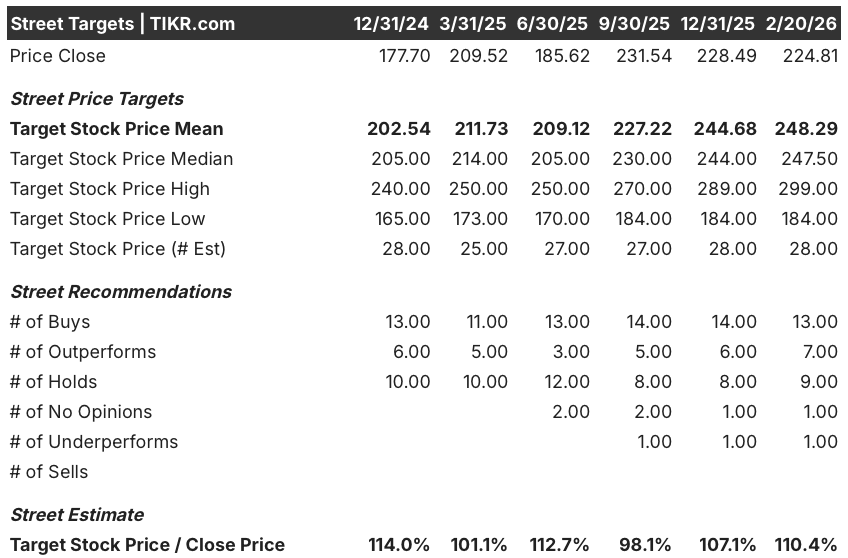
Wall Street’s mean price target of $248.29 across 28 analysts sits roughly 10.4% above the February 20 close of $224.81, with 13 buys, 7 outperforms, and only 1 underperform reflecting broad conviction that AbbVie’s pipeline transition is succeeding.
The target range spans from a low of $184.00 to a high of $299.00, a $115 spread that captures disagreement over Botox price control litigation outcomes, the pace of next-generation pipeline conversions, and how quickly lutikizumab and Rinvoq expand in HS.
What Does the Valuation Model Say?
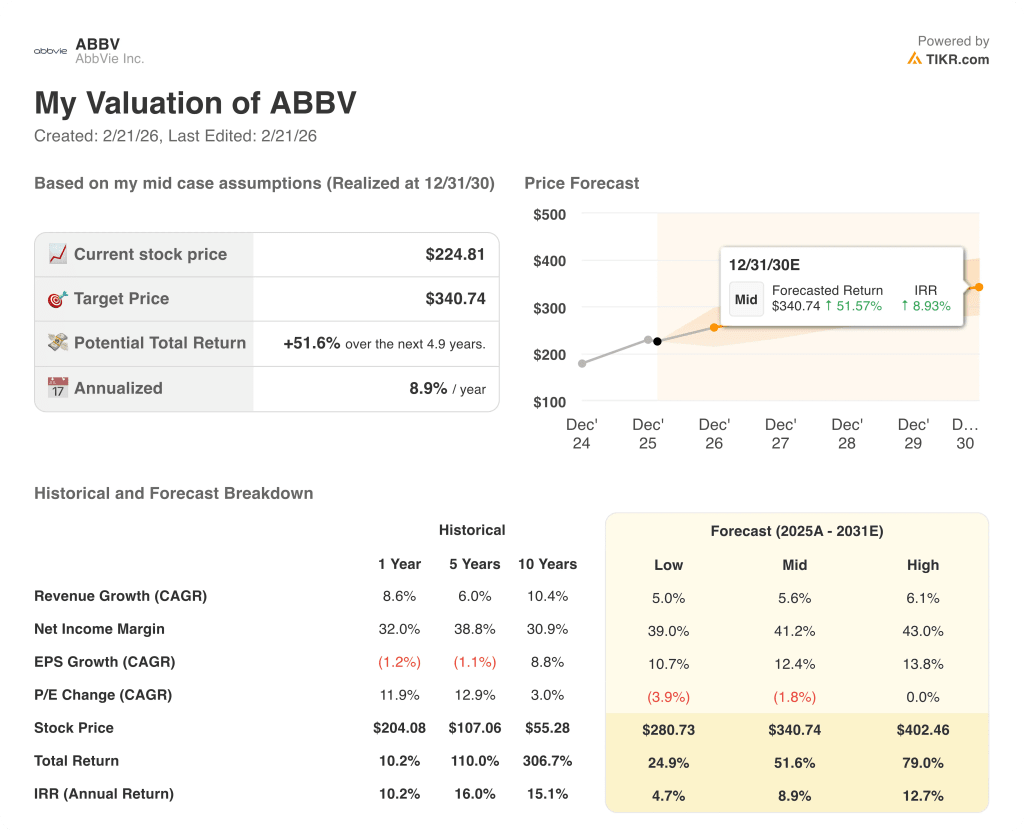
Anchored by Skyrizi’s $17.56 billion revenue run rate, the Venclexta CLL expansion, and a 2026 EPS re-acceleration, a mid-case TIKR valuation model prices ABBV at $341 by December 2030, implying a 51.6% total return and an annualized IRR of 8.9% from current levels.
The primary risk is the live Botox litigation, where an adverse ruling against AbbVie’s plasma-derived product exclusion argument could subject more than 10% of total revenue to CMS price controls, compressing margins in a product line that grew 14.8% therapeutically in FY2025.
At $224.8, ABBV stock trades at a modest discount to its $248.3 mean analyst target and a substantial discount to the $340.74 model fair value, making it look undervalued for investors who believe the Humira cliff is behind the company and Skyrizi’s growth arc has years left to run.
Value Any Stock in Under 60 Seconds (It’s Free)
With TIKR’s new Valuation Model tool, you can estimate a stock’s potential share price in under a minute.
All it takes is three simple inputs:
- Revenue Growth
- Operating Margins
- Exit P/E Multiple
From there, TIKR calculates the potential share price and total returns under Bull, Base, and Bear scenarios so you can quickly see whether a stock looks undervalued or overvalued.
If you’re not sure what to enter, TIKR automatically fills in each input using analysts’ consensus estimates, giving you a quick, reliable starting point.


